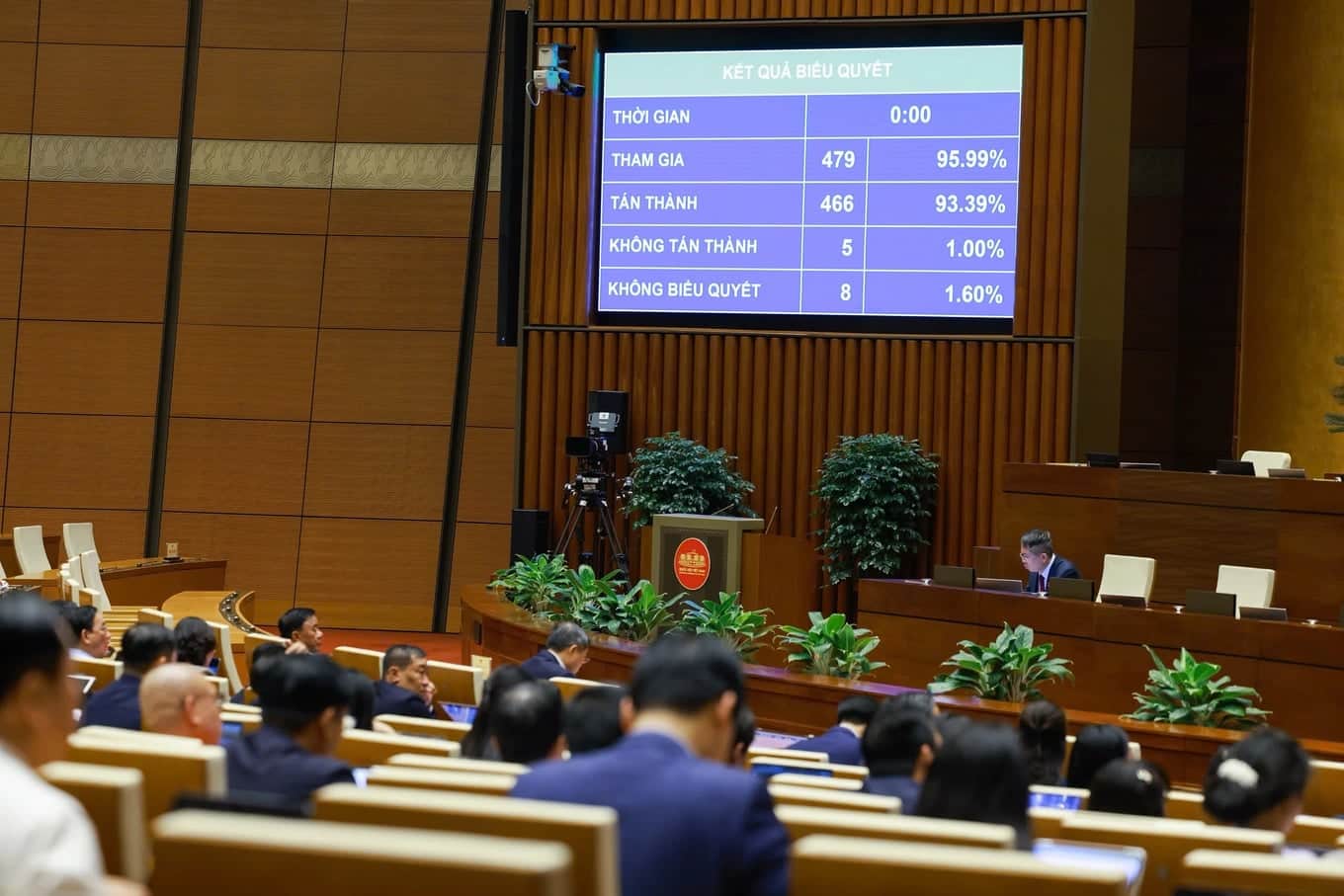
On November 21, the National Assembly passed the Law Amending and Supplementing Several Articles of the Law on Environmental Protection.
One of the law's notable provisions adds principles for establishing and managing low-emission zones. These zones are areas where measures are applied to reduce emissions, mainly from transport, and improve air quality and protect public health.
High-emission vehicles will be prioritized for control
Under the provision added to Article 65, establishing and managing a low-emission zone must meet requirements for protecting air quality and public health. One management principle is to prioritize control of high-emission vehicles and vehicles using fossil fuels.
This means gasoline- and diesel-powered vehicles fall into the group that will be prioritized when emission-management measures are applied in these areas. The provision sets a management principle but does not establish specific traffic restrictions for each type of vehicle. The Government will set the criteria and measures for managing emissions in low-emission zones.
A selected area must fit urban planning, traffic organization and the capacity of the public-transport system. Implementation must follow a suitable roadmap, remain feasible and transparent, and limit negative effects on production, business, services and people's daily lives.
Management of low-emission zones must also be linked to public transport, technical infrastructure for low-emission transport, clean energy and policies supporting vehicle conversion.
Provincial authorities will submit zones for council approval
Under the law, a provincial-level People's Committee will assess local conditions and submit a proposal to the same-level People's Council to decide on establishing a low-emission zone and the emission-management measures within it.
This allows zones to be considered according to each locality's conditions rather than imposing one common area of application in the law. In special-grade and grade-I cities, provincial authorities must also introduce traffic-routing and pollution-control measures to limit air pollution.
The Government will set the criteria for establishing low-emission zones and the measures for managing emissions there. It will also define incentives, support and encouragement for public transport and vehicles using renewable energy, consuming less fuel, producing low emissions or no emissions.
The Government will also regulate the conversion of fossil-fuel vehicles and vehicles that pollute the environment. Thus, alongside the principle of prioritizing control of high-emission vehicles, the law requires the development of replacement vehicles and policies to support the transition.
The law takes effect on March 1, 2027. The provision on the capacity requirements for organizations providing environmental consulting services takes effect on January 1, 2028.
Sources: Dân Trí