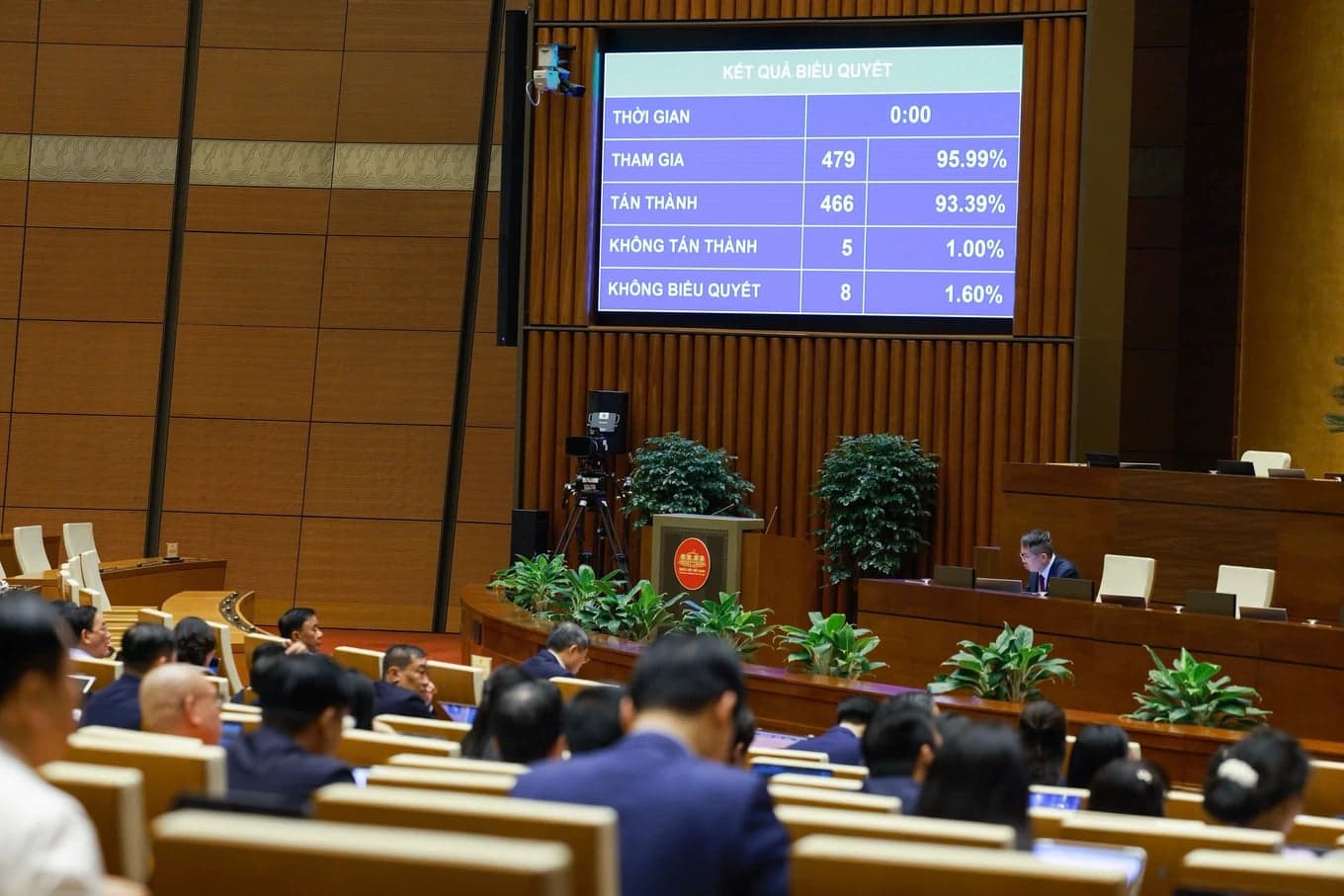
Vietnam's National Assembly passed the 2026 Land Law on November 21, with 466 of the 479 lawmakers present voting in favor, or 93.39% of all lawmakers. The law has 112 articles and will take effect on July 1, 2027. Land-price tables and adjustment coefficients under the law will apply from January 1, 2028.
Land recovery only when it is truly necessary
One change in the new law concerns state-determined land prices. Prices must match development goals for each period, follow the required valuation procedures and rely on land data and other relevant sector data.
The law also requires land valuation to balance the interests of the state, land users and investors, and to be honest, objective, open and transparent.
Provincial-level People's Councils will approve land-price tables and adjustment coefficients once every three years. They may be reviewed, supplemented, increased or reduced because of land and price-management requirements, development goals, or changes in infrastructure, planning or administrative boundaries.
The law sets out specific cases for land recovery for national defense, security, and socio-economic development in the national and public interest.

Presenting the government's explanation and response report before the vote, Minister of Agriculture and Environment Trinh Viet Hung said the bill tightens the rules on land recovery.
Land recovery for socio-economic development projects in the national and public interest will be allowed only when it is truly necessary. Provincial-level People's Councils will determine this for each case.
When preparing a compensation, support and resettlement plan, authorities will also have to estimate funding to restore the livelihoods of people whose land is recovered for at least three years after the recovery decision.
More cases may qualify for land-use certificates
The new law expands the cases in which households and individuals may be considered for land-use certificates.
Certificates may be issued to households and individuals who received land from the state, leased land from the state, or received land-use documents, if they used the land for a different purpose before July 1, 2014, and the use complies with planning when the certificate is issued.
Another case covers state-allocated or state-leased land, and land with land-use documents, that was used for a different purpose from July 1, 2014, until before the new law takes effect. A certificate may be issued if the use is stable, complies with planning and does not affect national defense, security, the environment or the safety of structures.
Land that was encroached on or occupied before July 1, 2014, may also be considered for a certificate if its use complies with planning when the certificate is issued.
Land allocated without proper authority or in violation of the law before August 1, 2024, is also included in cases that may be considered under government regulations.

Households and individuals who acquired land-use rights through a transaction before August 1, 2024, but have not completed the transfer procedure, may also receive a certificate if they meet the relevant conditions.
The law also lists cases in which certificates will not be issued. These include leased or subleased land.
A certificate will also not be issued for land covered by an effective land-recovery notice or land for which a competent state agency has already issued a recovery decision.
However, if more than three years have passed since the recovery decision and compensation, support or resettlement payments have not been made for part of the land, a certificate may still be issued under the Land Law.
A certificate will not be issued for land under dispute or land subject to other measures to secure enforcement under civil-enforcement law.
Sources: Dân Trí