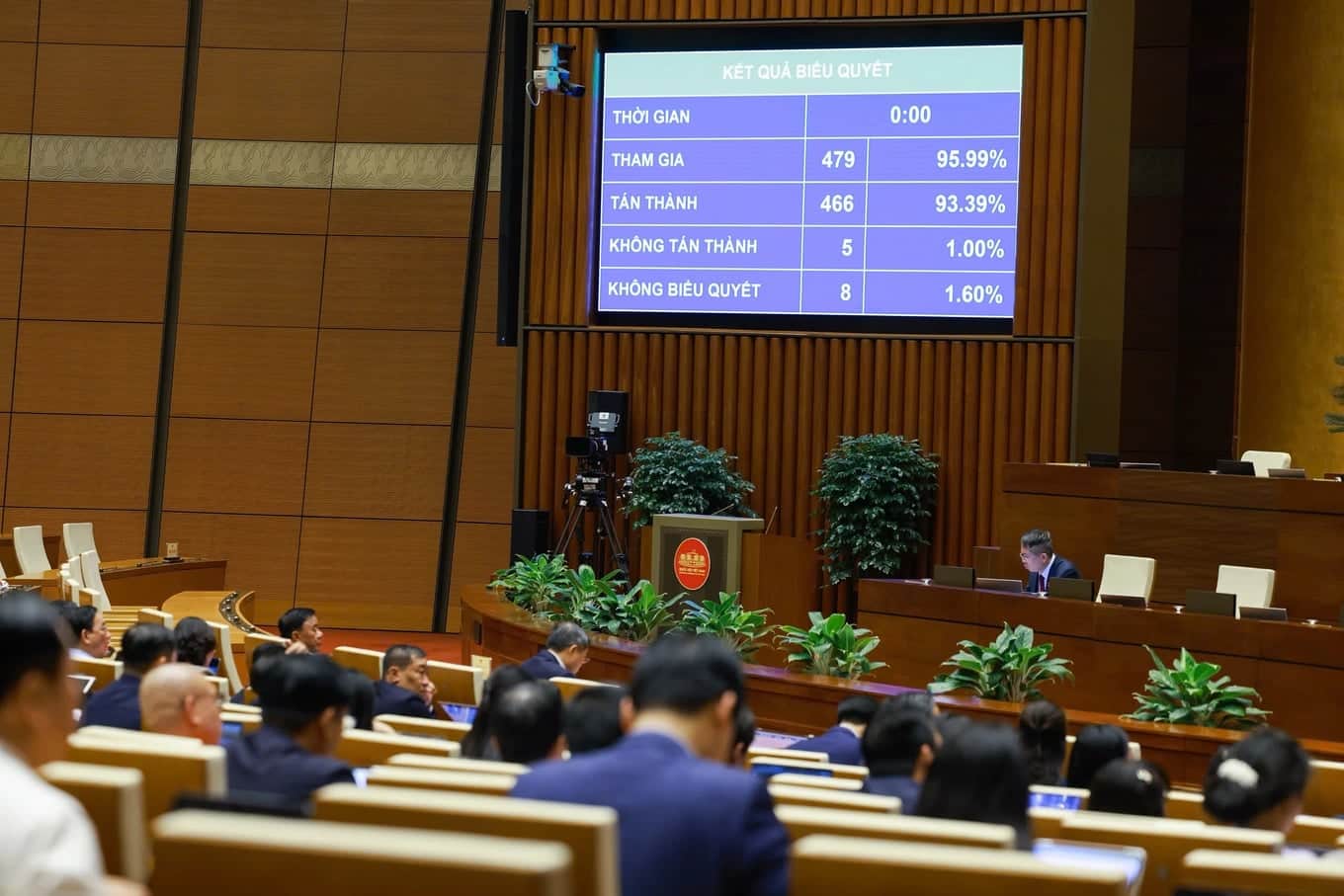
HÀ NỘI. Lawmakers at the 16th National Assembly's second session on Friday approved three laws and two resolutions on justice and crime prevention, including the revised Penal Code and a resolution approving investment policy for a national target programme on drug and crime prevention and control for 2026-35.
The revised Penal Code was approved by 463 of the 472 deputies present. It consists of 25 chapters and 417 articles and will take effect on March 1, 2027. The National Assembly also adopted a resolution on implementing the revised code.
Minister of Public Security General Lương Tam Quang said the drafting agency had proposed abolishing the death penalty for six offences while retaining life imprisonment as the maximum punishment. The proposal aims to ensure humane treatment and proportionate sentencing and support international integration while maintaining strict crime prevention.
The draft also allows courts to impose sentences below the prescribed minimum on defendants who voluntarily confess, cooperate with authorities and accept the proposed punishment. Their efforts to compensate for damage and remedy the consequences of their offences will also be considered.
The revised provisions on corporate criminal liability clarify the liability of individuals who directly commit offences and commercial legal entities acting in their name. The scope of liability has been adjusted to balance social welfare, the business environment, workers' interests and private-sector development under the Political Bureau's Resolution No. 68-NQ/TW.
The draft adds new offences and criminal acts, particularly those involving high technology, information technology and economic crimes. Penalty thresholds and sentences for certain offences have been adjusted to prevent both overly broad criminalisation and omissions, while avoiding overlapping or contradictory provisions and legal gaps.
The revised Law on the Organisation of Criminal Investigation Bodies, comprising eight chapters and 54 articles, was approved with 458 of 467 votes in favour. It will take effect on March 1, 2027.
The law stipulates that the investigation system comprises agencies under the People's Public Security and the Vietnam People's Army. The public security investigation agency is authorised to investigate seven offences, including four related to aviation security, two involving the proliferation of weapons of mass destruction, and one concerning the desecration of the national flag, national emblem, national anthem and Party flag.
It abolishes the one-month investigation powers previously granted to customs, forest rangers and fisheries surveillance forces. These agencies may now conduct preliminary investigative activities for up to seven days before transferring case files to investigation agencies.
The revised Law on Handling of Administrative Violations was approved with 460 of 464 votes in favour. It comprises six chapters and 131 articles and will take effect on January 1, 2028, with certain exceptions.
The law sets maximum fines and statutes of limitations for each sector. In certain complex fields, the limitation period will be three years, with maximum fines of VNĐ1.5 billion (US$58,000) for individuals and VNĐ3 billion (US$116,000) for organisations. By contrast, the limitation period for environmental protection and several transport sectors will be reduced to one year.
The law also introduces community service as an alternative to fines of up to VNĐ5 million (US$194) for individuals who admit violations and voluntarily request the measure.
The suspension of electricity, water and internet supplies, as well as vehicle registration and inspection services, will be classified as preventive measures. Stricter conditions and procedures will apply to protect citizens' rights.
For minors, it allows family-based management or community education in certain cases, in line with the Law on Justice for Minors' emphasis on diversionary measures.
The National Assembly unanimously adopted a resolution on investment policy for the national target programme on drug and crime prevention and control for 2026-35. All 470 deputies voted in favour.
Effective upon adoption, the resolution replaces Resolution No. 163/2024/QH15 dated November 27, 2024.
Minister Quang said the programme aims to strengthen grassroots crime prevention and public self-protection, particularly among women, children and vulnerable groups.
By 2030, at least 50 per cent of commune-level areas and 20 per cent of provincial-level areas are expected to be drug-free.
The programme includes 10 projects and 10 sub-projects, with defined targets, tasks and responsibilities.
Funding for 2026-30 will focus on urgent needs and high-risk areas, particularly disadvantaged, border, ethnic minority and mountainous regions.
The resolution also sets out funding allocation, adjustment and transitional arrangements to ensure continuous implementation, including preparations for the 2027 state budget.
Sources: Viet Nam News