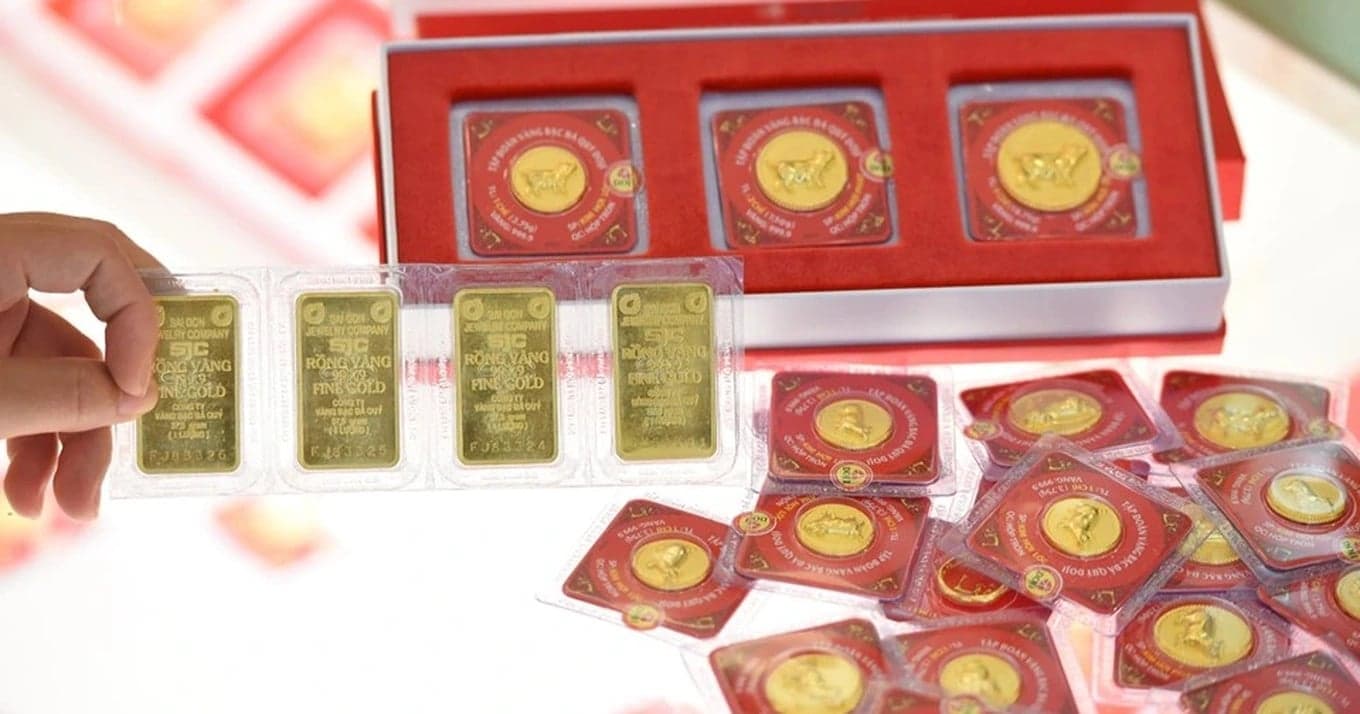
Gold prices in Vietnam continued to adjust lower. As of noon on November 21, SJC gold bars were listed at 128.5 million dong per luong for buying and 133.5 million dong for selling, down 700,000 dong per luong from the previous session's close. The buy-sell spread for the bars remained at 5 million dong per luong.
SJC gold rings fell to 127.3 million dong per luong for buying and 133.3 million dong for selling. The two-way spread widened to 6 million dong per luong, a record since the beginning of the year and double the previous gap of 3 million dong.
Compared with the peak of 191.3 million dong per luong set on January 29, the selling price of SJC gold bars has fallen by nearly 58 million dong per luong. Someone who bought at the peak and sold now would lose nearly 63 million dong per luong.
The fall to a 14-month low has led many people to consider buying. Thao Anh, who lives in Ho Chi Minh City, said she had followed gold for months but was not yet in a hurry to buy more.
“Since the beginning of the year, I have bought in small amounts. Whenever gold fell, I bought 1–2 chi to set aside. During the first nine months of the year, I saw gold rebound many times after reaching 136 million dong. However, the price has now fallen deeply, so I will wait and not rush into a new purchase,” Thao Anh said.
According to an expert, the widening buy-sell spread is increasing risks for investors. Investors should remain calm and avoid hasty decisions because no one can identify the bottom of the gold price.
Speaking to Dân trí, Dr. Nguyen Tri Hieu advised investors to assess their financial capacity calmly and avoid panic selling after the sharp decline.
For investors considering a bottom-fishing strategy, Hieu noted that no one can accurately identify the final bottom of the gold price. He therefore advised against putting all capital into one investment channel and recommended spreading it across different asset classes.
“In my view, people who bought gold at high prices are carrying paper losses of 20% to 50%. If they used spare money and can tolerate the risk, they should not panic and sell at a loss,” the expert said. For people who bought gold with borrowed money or have limited financial capacity, Dr. Nguyen Tri Hieu said they could cut losses at 20–30% to protect their cash flow.
On the global market, gold was priced at $3,524 per ounce on the morning of November 21, Vietnam time, down about $101 from the previous morning. At the current exchange rate, excluding taxes and fees, that was equivalent to about 110 million dong per luong.
Gold ended the week near its lowest level since September 2025 and recorded its sharpest weekly decline in about eight months, losing around 9%. Renewed tensions in the Strait of Hormuz were not enough to lift prices, while investors continued to reduce their commodity holdings.
Pressure on gold increased as the US dollar remained near a high level and markets placed greater bets on the Federal Reserve raising interest rates in December. The dollar is close to a 19-month high, making gold, which is priced in the currency, more expensive for investors using other currencies.
At the beginning of 2026, analysts and investors had expected gold to rise to $5,000–6,000 per ounce. The precious metal has since continued to lose support levels.
Justin Lin, a strategist at Global X ETFs, said gold had fallen into a “gap” with almost no technical support until the $3,300–3,400 per ounce range. “The precious metal looks very fragile now, and I do not see anything that could reverse the decline at this point,” he said.
Goldman Sachs also cut its forecast for gold at the end of 2027 from $4,800 to $4,650 per ounce. The investment bank warned that further Federal Reserve rate increases could lead private investors to reduce their gold holdings, adding pressure on prices through early 2027.
This was the second time the financial institution had cut its forecast in just one month. Goldman Sachs still viewed gold's long-term outlook positively because of central-bank demand, estimated at an average of 60 tonnes per month, and expectations that the Federal Reserve could begin cutting rates from late 2027.
Sources: Dân Trí