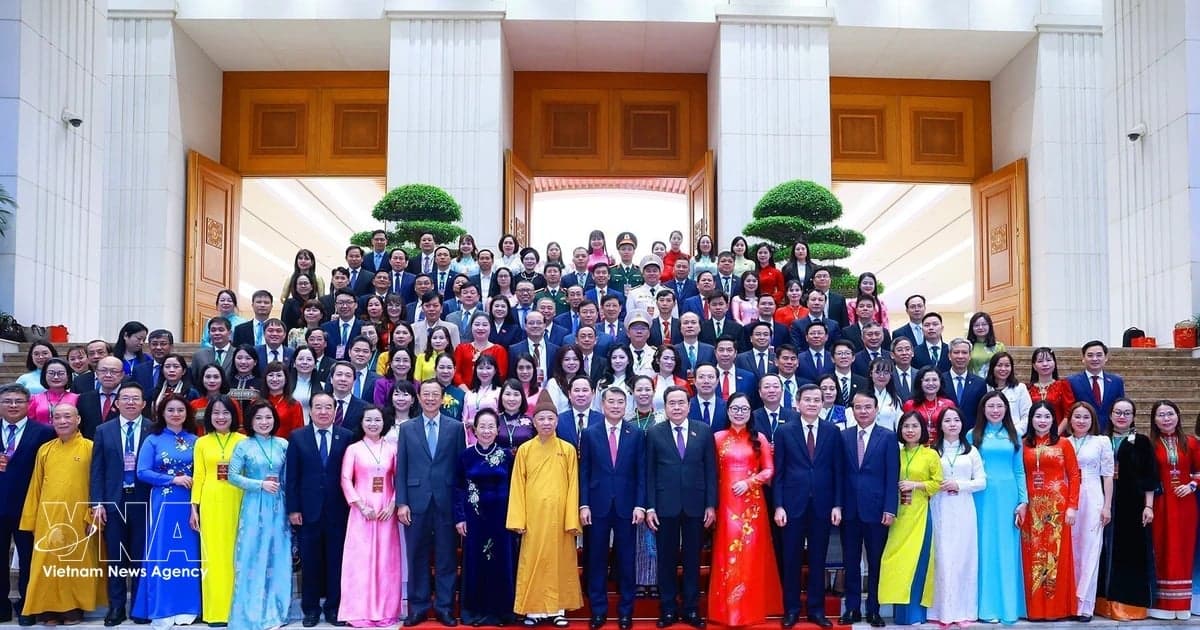
The education and training sector must take the lead in preparing high-quality human resources and talented people for national development, Prime Minister Le Minh Hung said at a meeting with outstanding teachers from across the country in Hanoi on November 19.
The meeting was co-chaired by PM Hung and National Assembly President Tran Thanh Man. It marked the 44th anniversary of Vietnamese Teachers’ Day, observed on November 20 and established in 1982. It brought together 70 outstanding teachers recognised for their contributions to education in 2026 and 31 teachers who are National Assembly members.
Teachers shared stories about their efforts to bring education to students across the country, particularly in disadvantaged areas. They spoke about overcoming difficulties, renewing teaching methods, applying information technology, organising practical learning activities and incorporating local cultural values into lessons to support students’ development.
They also proposed measures to improve education quality and called for continued attention to policies for teachers, especially those working in mountainous, remote and disadvantaged areas.
Addressing the meeting, the prime minister expressed his deep gratitude to teachers, education managers and teacher-deputies, as well as more than 1.4 million teachers nationwide. Vietnam has a long-standing tradition of learning and respect for teachers, he said.
The prime minister said teachers’ contributions had played an important role in the education sector’s achievements in recent years.
Fundamental and comprehensive education reforms have made significant progress. Teaching content and methods have become more practical, and education quality has improved at all levels. Policies on tuition exemption and support, student loans and scholarships have also been implemented effectively, according to the prime minister.
The prime minister highlighted the government’s efforts to improve learning conditions for students in disadvantaged areas. Under the direction of the Party and the Politburo, and with the leadership of the general secretary of the Communist Party of Vietnam Central Committee and President To Lam, boarding schools in mainland border communes built in the first phase of the project to build multi-level schools have begun operating.
The government is directing ministries, sectors and localities to complete the second phase. It is also working towards providing free textbooks from the 2028–2029 school year, one year earlier than the timeline set out in the Politburo’s resolution, he said.
The prime minister stressed that Vietnam is entering a new stage of development, with the ambition of building a peaceful, independent, democratic, prosperous, strong, civilised and happy country. In this process, the education and training sector must move ahead to prepare the human resources and talents needed for national development.
He described Politburo Resolution No. 71 on breakthroughs in education and training development as reflecting the Party and State’s strategic vision, innovative thinking and strong political determination. The resolution reaffirms education and training as a top national priority that will shape the country’s future, while calling for comprehensive, modern, high-quality, equitable and internationally integrated education.
The prime minister called for education to become a pillar of human development and a key driver of the country’s future growth.
He stressed that education must nurture knowledge and professional abilities alongside ethics, character, historical and cultural awareness, and a spirit of dedication among young people. The goal is to develop people who are knowledgeable, capable, compassionate, honest and responsible, with a strong sense of patriotism and commitment to serving the country and its people.
He also underscored the need to consistently put learners at the centre, regard schools as the foundation and teachers as the driving force. Every student should be given opportunities to develop their abilities and strengths. Efforts should also be made to tackle the pursuit of academic achievements at all costs and reduce unnecessary pressure, so that learning brings joy, knowledge and positive values.
The prime minister urged the education sector to accelerate reform and modernisation at all levels, from preschool and general education to higher education and vocational training, ensuring that training is practical and aligned with national development needs.
He called for stronger application of science and technology, artificial intelligence and digital transformation, alongside reforms to curricula and teaching methods that focus on developing learners’ qualities and capabilities.
The prime minister also highlighted the importance of closer links between schools, research institutions and businesses, as well as stronger connections between training, scientific research, innovation and production.
Finally, he called for equal access to quality education for people of all ages and backgrounds, with particular attention to disadvantaged areas, remote and border regions, islands and ethnic minority communities. Vietnam should also proactively integrate into the international education system, learn from global best practices and gradually strengthen its position and contribution to education worldwide, the prime minister stressed.
Sources: VietnamPlus / Vietnam News Agency