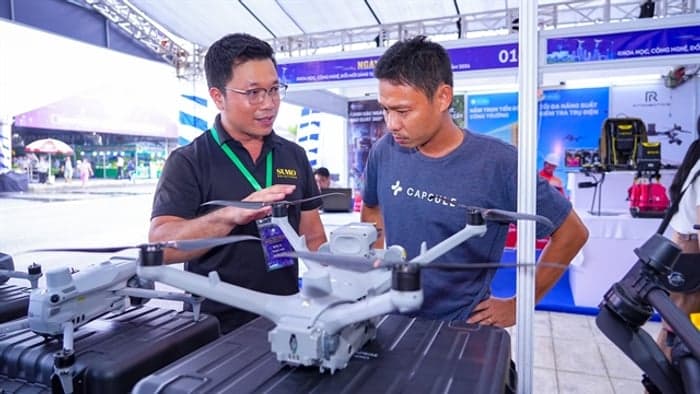
Tay Ninh Province is expanding drone use in agriculture and studying applications in resource management to ease labour shortages, reduce costs and improve efficiency.
The initiative is part of efforts to implement Politburo Resolution No. 57 on breakthroughs in science and technology, innovation and national digital transformation, issued in December 2024.
In the southern province's border areas, drones are increasingly being used for agricultural spraying and crop monitoring, while large rubber plantations are exploring their potential to improve management and production efficiency.
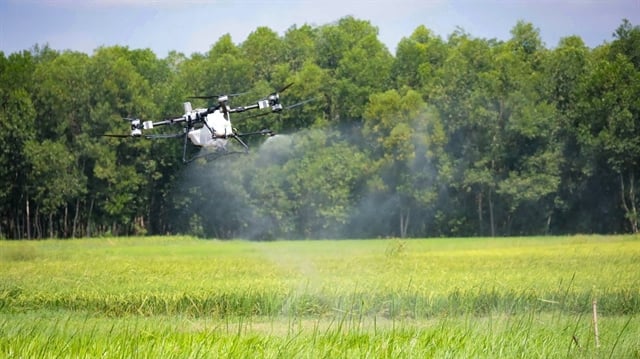
In Hoa Hoi Commune, drones are changing traditional farming practices by allowing farmers to spray pesticides over larger areas in less time and with less manual labour.
Nguyen Cong Danh, a 43-year-old local farmer, said a worker spraying crops manually could cover only around three to four hectares a day, compared with 30-40 hectares for an agricultural drone.
The technology helps reduce working time and the need to hire workers, particularly during periods when crops require intensive care, he said.
Nguyen Dong Dung, chairman of the Hoa Hoi Commune People's Committee, said the commune had promoted science and technology, mechanisation and digital transformation in agriculture in recent years to increase productivity, reduce costs and raise local incomes.
Drones save time and labour, improve spraying efficiency and reduce farmers' direct exposure to chemicals, Dung said.
Their use also supports modern, smart and sustainable agriculture while helping protect workers' health and the environment.
Beyond traditional farming areas, interest in drone technology is also growing among operators of large plantations.
At Dong Rum Rubber Plantation in Tan Thanh Commune, labour shortages have made it increasingly difficult to care for rubber trees, particularly during peak production periods.
According to Hong Viet Thang, deputy director of the plantation, finding enough workers to tend trees across the extensive plantation area is a challenge.
The problem becomes more acute at the start of the rainy season, when workers are also needed to plant new trees.
Applying technology and mechanising operations are increasingly urgent priorities to ease labour shortages and improve management and production efficiency.
The plantation is exploring the use of drones for surveys, monitoring and management across large areas.
Luong Viet Quoc, general director of Ho Chi Minh City-based Real-Time Robotics Vietnam Corporation, said drones could operate at different altitudes to collect data, monitor crop conditions and support production management.
Applying drone technology at Dong Rum could bring tangible socio-economic benefits, he said.
Besides agriculture, the province is also looking to expand drone applications into resource management and other areas.
It is seeking to develop an ecosystem of unmanned vehicles and tap the economic potential of low-altitude airspace.
Huynh Thi Hong Nhung, director of the provincial Department of Science and Technology, said Tay Ninh had issued a plan outlining 11 tasks to implement a strategy for developing "Make in Viet Nam" technology and applying technological solutions to practical problems.
The plan benefits from extensive land, border areas, large agricultural production zones, industrial parks and clusters, and an expanding infrastructure network.
These conditions create opportunities for drone applications in precision agriculture, resource and environmental monitoring, urban management, disaster prevention and response, search and rescue, and logistics.
The strategy also addresses the need to manage and protect low-altitude airspace while ensuring national defence and security, flight safety, data sovereignty and technological self-reliance.
Le Van Han, chairman of the provincial People's Committee, said science and technology, innovation and digital transformation would be key drivers of growth in the coming years.
This year, Tay Ninh allocated nearly VND1.2 trillion (US$46.4 million) to these areas, equivalent to 2.04 per cent of its budget.
Sources: Viet Nam News