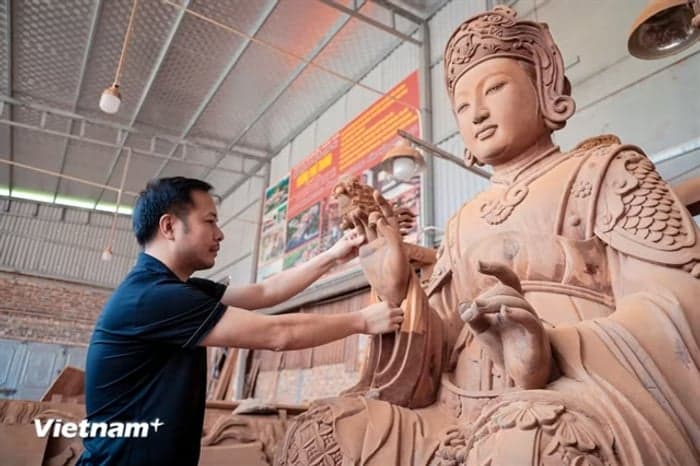
For centuries, artisans in Son Dong Village on the outskirts of Hanoi have carved wooden statues and religious ornaments for temples and pagodas across Vietnam.
Their work can be seen at the Temple of Literature, Ngoc Son Temple and One Pillar Pagoda. As demand has become less predictable, craftspeople are turning to digital technology and modern machinery.
They use 3D scanning, artificial intelligence, digital modelling and computer-controlled carving machines. The technology shortens production times and reduces manual labour, while finer work remains in human hands.
Technology changes production
Nguyen Xuan Thang, a third-generation woodcarver from Hoai Duc Commune, expanded his family workshop after graduating from the University of Industrial Fine Arts. It had traditionally made altars, carved panels, parallel couplets and large Buddha statues.
Foreign visitors admired Son Dong's craftsmanship but found large objects difficult to take home, so the workshop began making smaller souvenirs with traditional motifs.
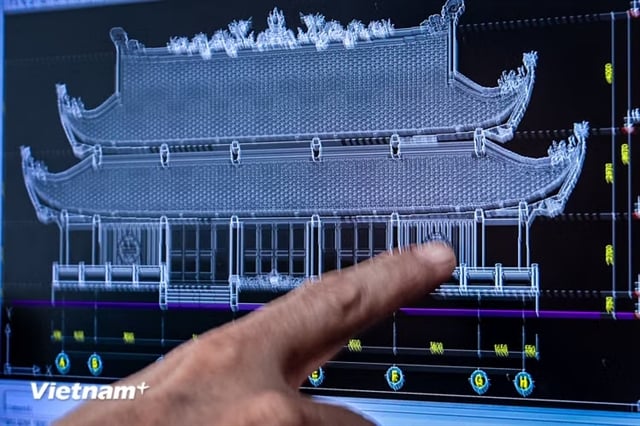
The workshop uses 3D scanning to digitise antiques. AI creates initial designs that Thang estimates are 60 to 70 per cent accurate before refinement. Four-head CNC machines can work on several pieces at once.
Thang said a machine running for 10 hours can produce about as much as three skilled hand carvers, and the technology cuts large-order production time by at least 50 per cent.
Nguyen Trung Kien creates technical drawings and 3D models for local workshops. He said 3D printing allows artisans to test prototypes before production, and work that once took nearly a month can now be completed in a few days.
New markets and traditional values
The village is modernising as it seeks customers beyond its traditional market. Thang said that after the COVID-19 pandemic, households cut spending and demand for large religious construction and renovation projects fell.
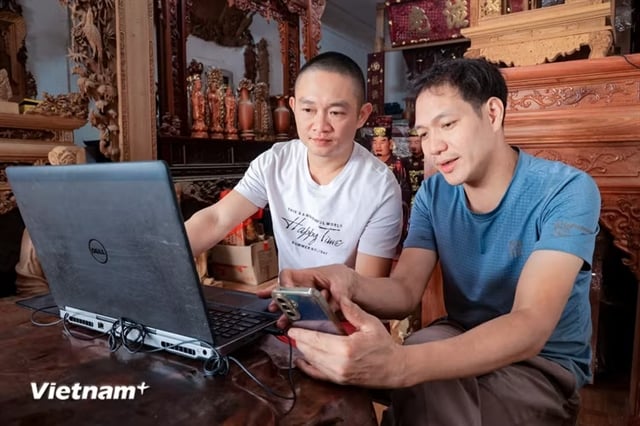
Thang developed smaller products using motifs such as the mythical guardian nghe, decorative figures and Ly Dynasty dragons. Desk ornaments, paperweights and pen holders are easier for visitors and younger consumers to buy and carry home.
He is also testing alternative materials as timber becomes scarcer and more expensive. The aim is not to replace wood, but to control costs and meet demand. Alternative materials can be lighter and more durable in different climates.
Mechanisation has raised concerns about traditional skills. Thang said CNC machines and 3D printers reduce physically demanding work and produce basic shapes, but do not replace artisans. Machines complete about 80 per cent of basic shaping, while finishing depends on skilled hands.
Nguyen Trung Thanh, a descendant of artisan Nguyen Van Hong, said religious sculpture requires skill and tâm, which he described as conscience, dedication and spiritual focus. Artisans must understand the cultural and spiritual meaning of the figures they create.
Faces, decorative details and more than a dozen layers of lacquer and gold leaf require patience, precision and an experienced eye.
For Son Dong's artisans, the issue is not choosing between tradition and technology, but combining them. Workshops are developing goods for new markets while preserving the skills and cultural identity that have sustained the craft for generations.
Sources: Viet Nam News