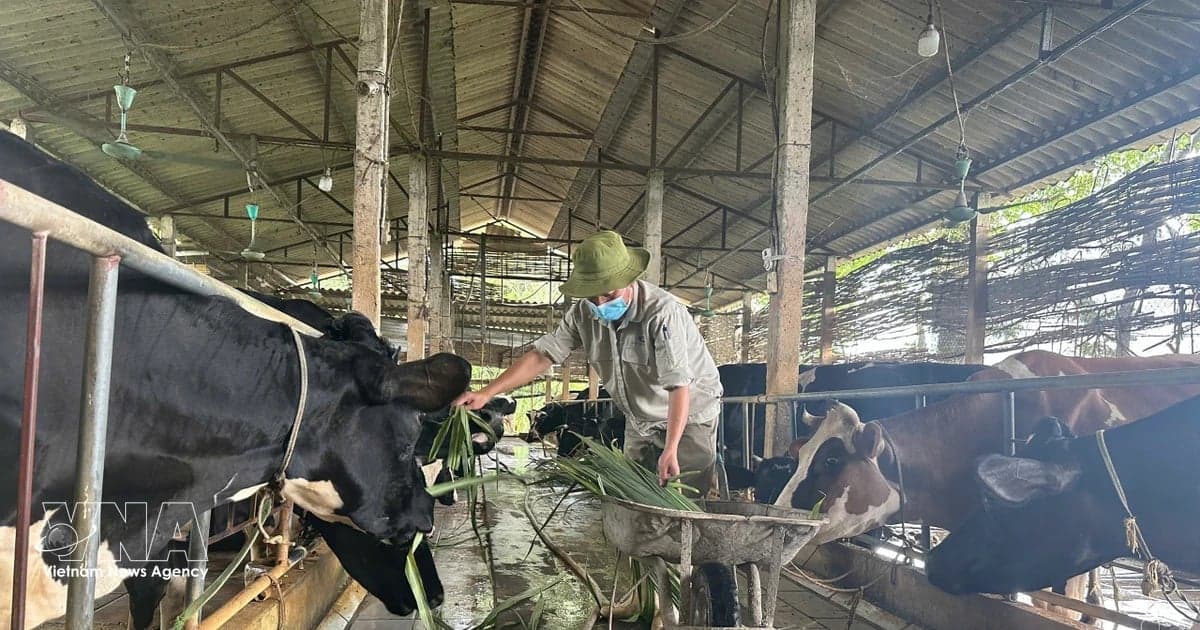
Phu Tho province in northern Vietnam is accelerating its shift from small household farms to concentrated, technology-driven livestock production linked with integrated value chains. Authorities aim to turn the province into a livestock hub for the northern midland and mountainous region.
The transition is gaining momentum with the involvement of major agricultural companies and a stronger focus on sustainable development.
Ta Cong Luong's family in Hamlet 4 of Yen Ky commune raises Ho and Mia chickens, producing 15,000 to 17,000 birds a year. After nearly 15 years of farming, the flock has remained largely disease-free thanks to technical measures, regular vaccination and proper environmental sanitation.
Luong said concentrated farming was essential to improving efficiency. It made management, disease control and product sales easier, while allowing the use of technology, lower costs and better economic returns.
Small-scale, scattered farming was once common among local households. Growing animal-disease risks and stricter environmental and food-safety requirements, however, have exposed the limits of that model.
In response, the provincial agriculture and environment sector has stepped up efforts to encourage farmers to adopt safer and more efficient production models. The number of small livestock households has gradually declined as awareness of modern farming practices has grown.
Phu Tho now has nearly 381,000 buffaloes and cows, more than 1.81 million pigs and over 38.5 million poultry. The sector includes 113 cooperatives, more than 5,300 farms and 46 enterprises. Large farms account for about 44% of the pig herd, 33% of poultry and 14.1% of buffaloes and cows. In addition, 80 production, processing and consumption chains have been established to secure markets and increase product value.
Major investors include CP Vietnam Livestock Joint Stock Company, Mavin Group, Dabaco and Hoa Phat. Several large high-tech projects are also being promoted.
One of them is Xuan Thien Group's high-tech livestock complex, with estimated investment of 64.6 trillion VND, or 2.5 billion USD. The project will use multi-storey barns, water-saving floor systems and a zero-discharge model. It is designed for 77,000 breeding sows and annual production of 2.53 million pigs, alongside a 300,000-tonne animal-feed plant.
Another complex, jointly developed by Da Phuc Agriculture JSC and Yen Thuy Agriculture JSC, will include facilities for 40,000 breeding sows, annual production of one million pigs, a slaughtering system with capacity for 1.4 million pigs and a 400,000-tonne animal-feed factory.
The projects are expected to create integrated chains covering breeding, feed production, farming, slaughtering and processing, increasing the value of the province's livestock sector.
Livestock development will focus on meeting domestic demand for safe products and gradually improving compliance with export standards. Production planning will also take climate change, natural disasters and animal-disease risks into account.
In the coming years, Phu Tho aims to develop concentrated, modern and sustainable livestock farming, with more emphasis on specialty products, circular-economy models and organic production linked to ecotourism and environmentally friendly practices.
Hoang Manh Thong, head of the provincial Sub-Department of Livestock Production, Fisheries and Veterinary Medicine, said improving the investment climate and promoting the private sector were among the province's priorities.
He added that authorities would continue creating favourable conditions for companies to invest in large-scale and high-tech livestock farming, with a focus on sustainable growth, modernisation and environmental protection.
Sources: VietnamPlus / Vietnam News Agency