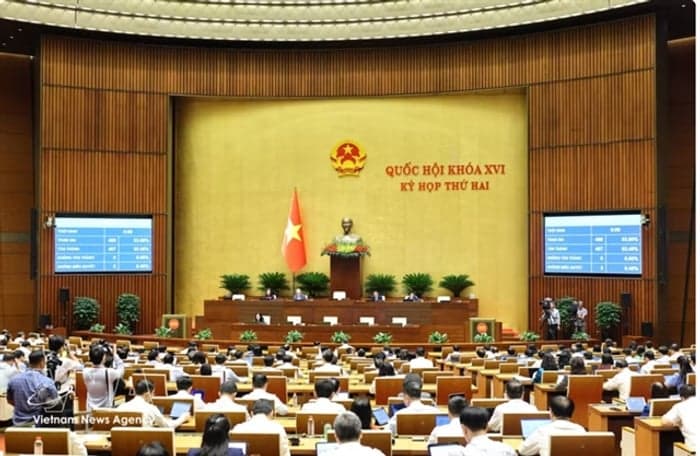
Vietnam's National Assembly on November 7 approved a resolution on the 2027 socio-economic development plan. The resolution passed with 467 of the 469 deputies present voting in favour, and sets a target of economic growth of at least 10 per cent.
The draft resolution was discussed in groups on October 18 and at plenary sittings on October 30 and 31 during the 16th National Assembly's second session.
The resolution sets the objectives, targets and main directions for socio-economic development in 2027. It provides a basis for the Government, ministries, sectors and local authorities to turn them into specific programmes and action plans. It also calls for efficient use of resources, rapid and sustainable growth, social progress, equality and improved living standards.
Before the vote, Finance Minister Ngo Van Tuan, on behalf of the Prime Minister, presented a report on the Government's consideration of deputies' feedback and revisions to the draft resolution.
He said deputies broadly supported the draft but proposed a wide range of practical and feasible measures across almost all sectors. The Government considered the recommendations while finalising the document and will take them into account in directing, managing and implementing the 2027 plan.
The Government will continue directing ministries, sectors and local authorities to implement the plan and strive to meet or exceed the approved targets. Each ministry, sector and local authority will receive assigned responsibilities, specific deadlines and expected results.
Priorities include further improving the institutional framework, unlocking resources and improving the efficiency of their management and use, supporting traditional growth drivers and creating new ones. The Government will also accelerate economic restructuring and renew the growth model, focusing on science and technology, innovation, digital transformation and higher labour productivity.
According to Tuan, relevant agencies will develop all economic sectors, strengthen the role of the private sector and improve the economy's endogenous capacity, autonomy and competitiveness.
The Government will also link economic growth more closely with cultural and social development, environmental protection, job creation, higher incomes and living standards. It will seek to distribute the gains from growth more broadly and fairly among regions and population groups, so that people can benefit directly from development achievements and so that a foundation for rapid and sustainable growth remains in place during 2026-2030 and beyond.
The report says the global and regional economic outlook in 2027 will remain complex and unpredictable. Higher energy, raw material and transport costs, together with uncertainty over monetary policy in major economies, may increase pressure on domestic macroeconomic management.
The Government considers maintaining macroeconomic stability, controlling inflation and ensuring major economic balances necessary to reach the growth target of at least 10 per cent.
The resolution says 2027 should be a year of acceleration and breakthroughs, building momentum, strengthening the country's position and increasing its capacity to successfully implement the resolution of the 14th National Party Congress.
The National Assembly calls for determined efforts to achieve economic growth of at least 10 per cent while maintaining macroeconomic stability, controlling inflation and ensuring major economic balances. Tangible results, productivity and people's living standards should be the main measures of performance.
The resolution also calls for stronger delegation of authority together with resource allocation, a decisive shift from policy formulation to implementation with clear responsibility, deadlines and results, and the smooth and effective operation of the two-tier local administration system.
It also refers to balanced development in the economy, culture, society and the environment, social protection, continued efforts to combat corruption and misconduct, thrift and waste prevention, stronger national defence and security, expanded foreign relations and international integration, mass mobilisation and policy communication.
The National Assembly has set a 2027 target of per capita GDP of around US$6,100 and average consumer price index growth of around 4.5 per cent. Industry and construction are targeted to grow by 12.2 per cent, while manufacturing and processing are expected to expand by 12.3 per cent. Services are expected to grow by around 9.8 per cent, and agriculture, forestry and fisheries by 3.8 per cent.
The industrial production index is projected to rise by 11.5-12.5 per cent, total retail sales of goods and consumer service revenue by 14 per cent, merchandise exports by 15 per cent and imports by 12 per cent.
The legislature also called for market development and economic expansion. Its 2027 targets include 1.18 million operating enterprises and e-commerce sales growth of 15-17 per cent. The digital economy is expected to account for 23.5 per cent of GDP, while 37 per cent of enterprises are targeted to engage in innovation activities.
Sources: Viet Nam News