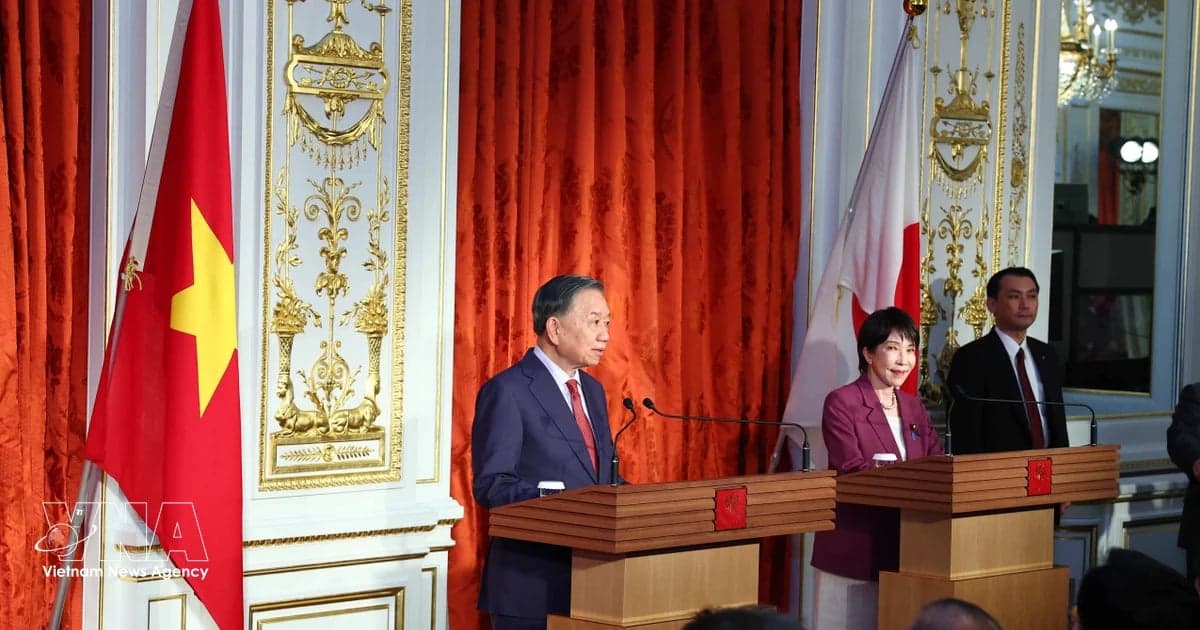
General Secretary of the Communist Party of Vietnam Central Committee and President To Lam and Japanese Prime Minister Takaichi Sanae met the press in Tokyo on the evening of November 9 local time, right after their talks and the exchange of cooperation documents during the Vietnamese leader's official visit to Japan.
Takaichi recalled her May 2026 visit to Vietnam and said the Vietnamese leader's speech at Japan's National Diet during the current visit had stirred a strong desire to move Japan-Vietnam relations forward together.
She said the Japan-Vietnam Joint Vision Statement, announced the same day, would lift relations to a new level. She expressed her belief that cooperation would develop strongly within the framework of the Comprehensive Strategic Partnership for Peace and Prosperity in Asia and the World.
The two sides also discussed creating a favourable business environment to soon implement gas-fired and liquefied natural gas power projects involving Japanese companies. Japan will contribute to Vietnam's target of training 100 doctoral holders in artificial intelligence. They also exchanged cooperation documents, including documents on the Vietnam-Japan University, described as a symbol of bilateral education cooperation.
To Lam described the talks as effective, substantive and successful. The two sides agreed to issue the Vietnam-Japan Joint Vision Statement and lift the Comprehensive Strategic Partnership to a new level. The statement describes the countries as equal partners that accompany and co-create development for mutual benefit, quality growth, strategic autonomy and self-reliance, for the benefit of the two peoples and for peace, stability, cooperation and prosperity in the Asia-Pacific region and the world.
The sides agreed on major directions, including stronger political trust through deeper and more substantive defence, security and diplomatic ties, stronger high-level diplomacy, cooperation through Party, State, Government and parliamentary channels, a larger role for parliamentary friendship groups, upgraded cooperation mechanisms and substantive national defence and security cooperation under signed documents.
Vietnam and Japan will strengthen economic links for sustainable long-term development based on equality, mutual assistance and mutual benefit, and boost trade, investment and a new generation of official development assistance. They will work on economic, energy and food security, diversify supply chains, strengthen strategic autonomy, expand marine and ocean cooperation and share information to support businesses. The sides also announced the imminent conclusion of negotiations to open markets for Vietnam's green-skinned pomelo and Japanese grapes.
Vietnam is committed to facilitating quality Japanese investment projects tied to technology transfer. To Lam added that the two sides had agreed to continue improving the business climate.
To advance cooperation in science, technology, innovation and quality workforce training, the two countries will work together in space technology, marine and ocean science, artificial intelligence, digital technology, semiconductors, medical technology, hi-tech agriculture and cybersecurity. They will implement 14 projects under the Joint Crediting Mechanism, expand research and training, and establish a network of Vietnamese and Japanese scientists.
The sides will also strengthen workforce links and people-to-people exchanges through local cooperation, labour, healthcare, culture and tourism. They plan to soon break ground on the Vietnam-Japan University, hold the Vietnam-Japan Tourism Year in 2027 and 2028, co-host the third bilateral local cooperation forum in 2027, and develop cooperation in healthcare, elderly care and an early social insurance agreement.
To Lam asked the Japanese Government to continue offering possible support to nearly 700,000 Vietnamese living, studying and working in Japan.
He underscored close cooperation and mutual support at international and regional forums and on issues of mutual concern. The sides reaffirmed the importance of settling disputes in the East Sea by peaceful means in line with international law and the 1982 United Nations Convention on the Law of the Sea.
Vietnam supports Japan's regional initiatives, including the Free and Open Indo-Pacific Vision, which is linked to ASEAN's Indo-Pacific Outlook and complies with international law. The sides said these efforts contribute to peace, stability, cooperation and development in the region and the world.
Sources: VietnamPlus / Vietnam News Agency