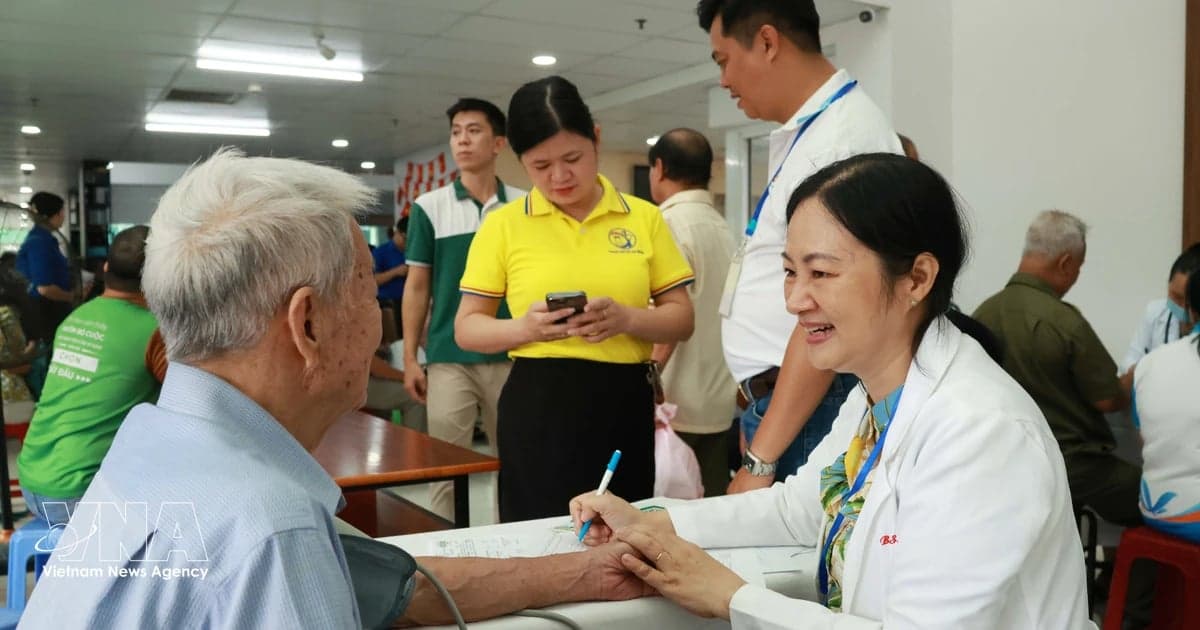
More than 9.5 million Ho Chi Minh City residents have received periodic health check-ups, equivalent to 74.6% of the city's population. During the remaining period of 2026, authorities are accelerating the programme to reach 100% coverage.
According to Tang Chi Thuong, director of the municipal Department of Health, the programme's result is measured not only by the number of people examined. The city also needs to use examination data for healthcare management, prevention and public health services.
Analysed data will be sent to local health stations and community-based continuous healthcare teams. They will be able to proactively contact people at high risk and those diagnosed with diseases, advise them and monitor their condition. The programme shifts the system from mass examinations to continuous, targeted health management and from treatment to prevention, in line with Politburo Resolution No. 72-NQ/TW.
Statistics from the municipal Department of Health showed that, as of November 9, more than 9.53 million people had undergone health examinations and screening or had their health records updated, representing 74.6% of the city's population. During the acceleration phase, authorities are focusing on students, workers and residents whose check-up records have not yet been registered locally.
Seven localities have recorded coverage below 50%: the wards of Binh Tri Dong, An Nhon, An Lac, Cau Ong Lanh and Phu Thanh, and the communes of Thuong Tan and Binh Hung. The municipal People's Committee instructed these localities to review each target group, assign responsibilities, organise suitable examinations and fully update the results in the electronic health management system.
Among formally employed workers, 2,391,312 have received health check-ups, equivalent to 53.2% of an estimated workforce of about 4.5 million. Coverage in export processing zones and industrial parks has reached 86.2%, while the rate in the hi-tech park is only 22.31%.
The municipal People's Committee tasked the Ho Chi Minh City Labour Federation, the Ho Chi Minh City Export Processing and Industrial Zones Authority (HEPZA), and the Management Board of the Saigon Hi-Tech Park with organising periodic worker check-ups through trade unions and businesses in accordance with the Law on Occupational Safety and Hygiene. All workers under their management are expected to receive regular examinations before November 30, 2026.
Health check-up coverage has reached 93.9% in primary schools and 87.1% among children under six, while the rate among upper-secondary pupils is 62.6%. Among university and college students, the rate is only 44.8%, or 201,423 out of an estimated 450,000.
The Department of Education and Training must work with relevant agencies and localities to review the number of students who have not yet been examined and ensure that check-ups for all pupils and students are completed before November 30, 2026.
The municipal authorities also instructed the Department of Health to regularly monitor and assess progress in each ward, commune and special zone. Medical personnel and healthcare facilities from areas where coverage exceeds 90% or the work is largely complete will support areas with lower rates. Healthcare facilities have been asked to increase staffing, extend examination hours and expand examination venues.
The department must also strengthen checks on examination quality and ensure that facilities upload complete and accurate results to the community health management platform. It will continue reviewing, cross-checking and integrating data from periodic check-ups, medical examinations and treatment, and chronic disease monitoring to avoid duplication, prevent wasted resources and reduce inconvenience for residents.
Using data from the universal health check-up programme, the department will continue preparing analytical reports on disease patterns, non-communicable diseases, risk factors and health-risk stratification by age, gender and residential area.
Particular attention will be paid to identifying groups at high risk of cardiovascular disease, hypertension, diabetes and other common chronic conditions. The data will provide a basis for appropriate intervention programmes.
Sources: VietnamPlus / Vietnam News Agency