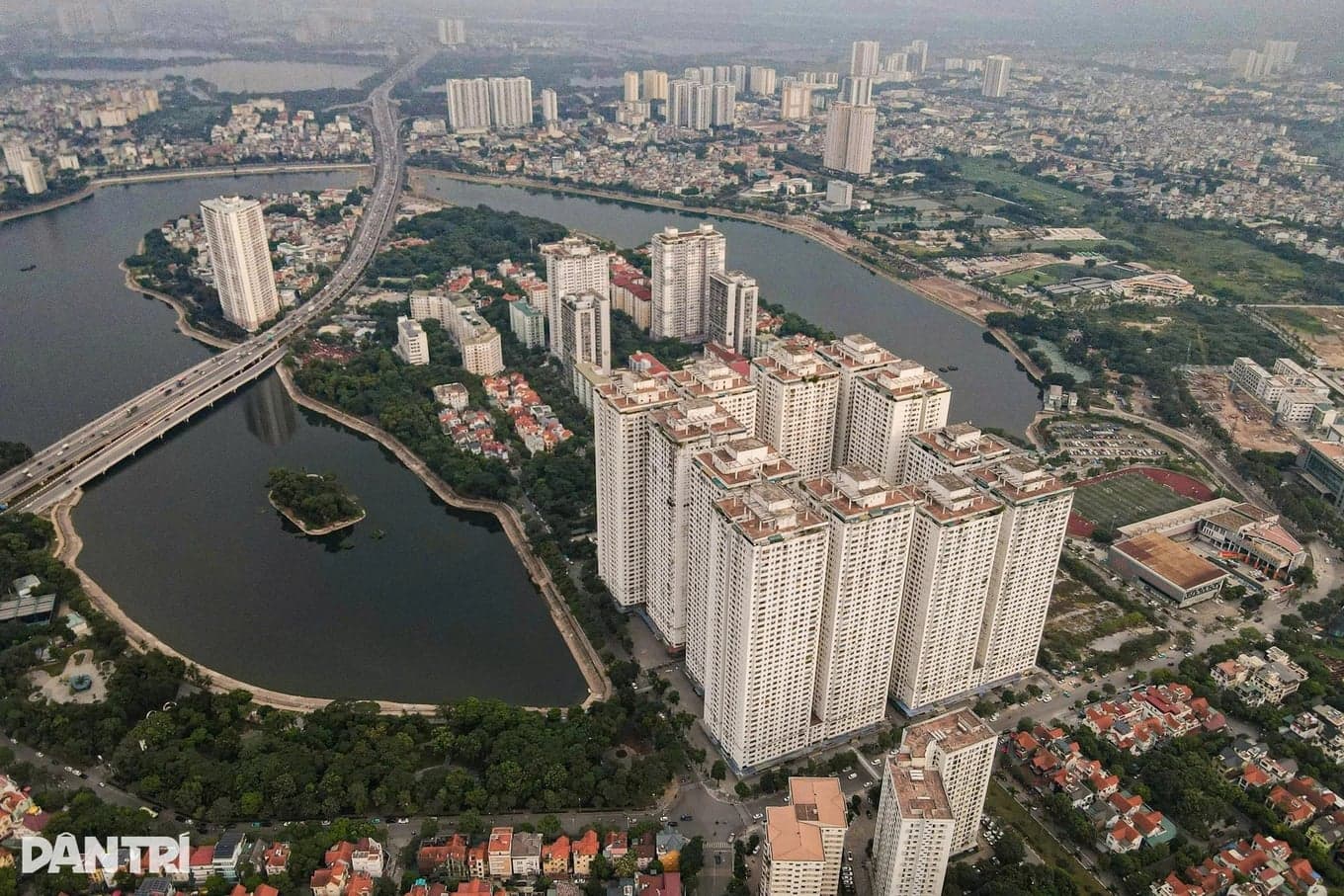
On November 17, the Hanoi People's Committee approved Plan No. 6301 to implement Resolution No. 96 of the city's People's Council. The plan sets out mechanisms and measures to address violations of land and construction regulations at 12 Mường Thanh buildings and projects, alongside urban renovation and improvement.
The list includes CT6 Kiến Hưng, also known as Bemes, in Kiến Hưng; the Đại Thanh mixed-use complex in Đại Thanh; CT5 Tân Triều and Xa La residential area in Hà Đông; CT11 and CT12 Kim Văn, Kim Lũ in Định Công; and VP3, VP5, VP6, HH1, HH2, HH3 and HH4 Linh Đàm in Hoàng Liệt.
Under the plan, residents will be relocated from apartments identified for demolition or for restoration to public use by December 31, 2027.
By December 31, 2028, the city is to restore or change the use of podium areas and community spaces, demolish apartments and houses that do not meet requirements, and carry out renovation and improvement works. Hanoi also plans to confirm by that date the actual condition of buildings and parts of buildings allowed to remain under certain conditions.
In the fourth quarter of 2028, authorities are to complete the issuance or withdrawal of certificates for land-use rights and ownership of property attached to land for houses and apartments that are either outside or within the relocation category.
The investor must pay the financial obligations, costs of remedying the violations and other related expenses. Hanoi also required the plan to be carried out openly and transparently, with residents kept safe during relocation, demolition and renovation. State funds must not be used for costs assigned to the investor.
Implementation schedule
Commune-level authorities must regularly hold meetings with residents at each project, explain the plan and answer questions.
In the fourth quarter of 2026, an appraisal council will determine the market value of apartments and houses for each project. Commune-level authorities will identify the exact area of each apartment or house subject to relocation. Their chairpersons must issue decisions on compulsory demolition and other remedial measures within their authority during the same quarter.
In the second quarter of 2027, the investor and commune-level authorities will prepare and make public a relocation, compensation and support plan for each project. Compensation will be calculated using the rates set by the appraisal council and the areas of apartments and houses supplied by the local authorities. The local authorities will approve the plans prepared by the investor.
In the third and fourth quarters of 2027, the investor is expected to sign agreements and contracts with households, pay compensation and support, and receive the apartments and houses handed over by residents. During this period, commune-level authorities will organize relocations, carry out compulsory relocations where necessary and address outstanding issues.
After relocation is complete, in the fourth quarter of 2028, the investor must demolish the buildings and parts of buildings subject to removal, renovate and improve the sites, and change their use under the approved plan. The investor must also build essential technical and social infrastructure in the project areas.
During the same quarter, commune-level authorities must confirm the actual condition of buildings and parts of buildings allowed to remain under certain conditions.
That afternoon, the Hanoi Party Committee's steering committee on preventing corruption, waste and negative conduct held a meeting on the progress and results of cases under its supervision. The agenda included violations, remedial measures and social welfare in cases related to Mường Thanh.
At the meeting, Trần Đức Thắng, secretary of the Hanoi Party Committee, instructed the Party organization of the city People's Committee to begin implementing the tasks in Plan No. 6301 without delay.
He also ordered a press conference to provide official information about the resolution and plan, as well as the urgent preparation of question-and-answer materials on the criteria, conditions, eligible groups, compensation and support mechanisms under the resolution. The materials should also state how many buildings and apartments may remain and how many will be subject to relocation.
Sources: Dân Trí