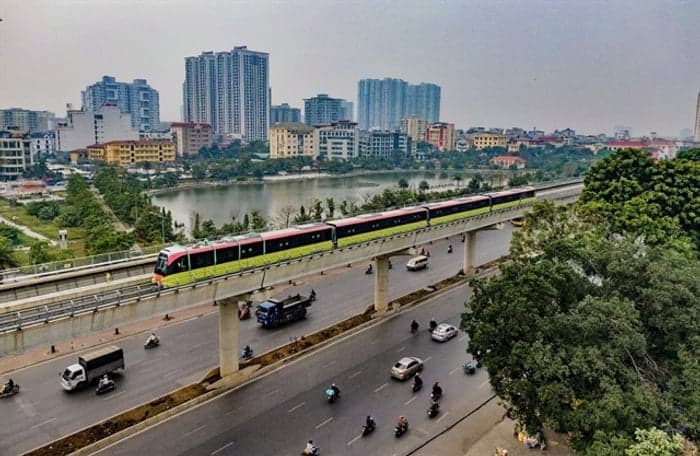
Hanoi expects to complete about 253.5km of urban railway in five years, with investment capped at US$120 million per kilometre.
To finish five urban railway lines by 2030, the capital's authorities are considering special mechanisms for investment and technology transfer. They are also setting requirements for strict cost control and early workforce planning.
At a session of the 17th-term Hanoi People's Council on October 28, delegates called for clarification of investment-cost controls, capital mobilisation plans and training solutions for the five urban railway lines.
Reviewing the draft resolution, Tran Hop Dung, head of the Urban Affairs Division of the Hanoi People's Council, said it was an unprecedented task involving special mechanisms and policies and the use of very large amounts of public money.
The division therefore asked the Hanoi People's Committee to clarify the scope of each mechanism and policy.
Specific measures should be established to control resources, costs and the use of capital.
The mechanisms for guarantees, advances, recovery of advances and payment conditions should also be clarified.
On technology transfer, the reviewing body proposed defining the list and scope of technologies to be transferred from the technology and contractor selection stage.
It also proposed setting out a roadmap, the rights and obligations of the parties, and measures for cases in which technology-transfer obligations are not fulfilled or are only partly fulfilled.
Regarding strategic-contractor selection criteria, handling plans and risk-management measures, the Urban Affairs Division asked delegates to study the review report, continue discussions and offer comments on the draft resolution.
At the discussion, delegate Tran Thi Thanh Tu analysed risks related to the capital structure, the ability to issue local government bonds, dependence on the central budget and contingency capacity.
She asked the city to clarify its financial plan to ensure the feasibility and safety of projects on such a large scale.
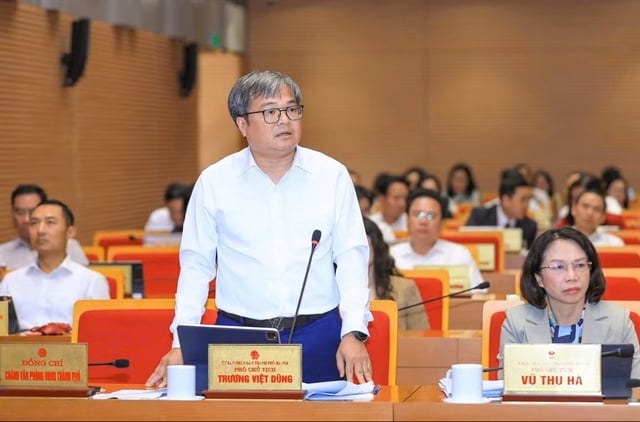
Truong Viet Dung, deputy chairman of the Hanoi People's Committee, said the urban railway projects were extremely large, highly complex and unprecedented.
Under the plan now being calculated, the total contract value is nearly VND794 trillion, or US$31 billion.
The city has referred to projects using similar technologies while calculating costs on the basis of integrated technology, trains and the entire system.
Addressing difficulties in recruiting personnel to manage, operate and maintain urban railways, Dung said Hanoi Metro One Member Co Ltd had been assigned a staffing quota of 1,292 people. It currently has 1,168 employees, 1,068 of whom operate the existing urban railway lines.
The city is drawing on the experience of several countries to gradually develop an appropriate organisational and operational model.
According to Dung, many positions require lengthy training, so city leaders instructed relevant agencies to study a training roadmap for officials and staff who will serve the urban railway lines in the coming period.
As for the financial plan, the city is calculating its capital structure. It will continue working with relevant agencies in the coming years to clarify the possibility of central-budget allocations, advance-payment arrangements and various financial scenarios.
After the discussion, the session chair asked the Hanoi People's Committee to continue improving the documents and provide complete financial reports and related materials so delegates could study them before making a decision.
According to the chair, the resolution is very large in scope and particularly important, requiring determination and the participation of the entire political system.
Sources: Viet Nam News