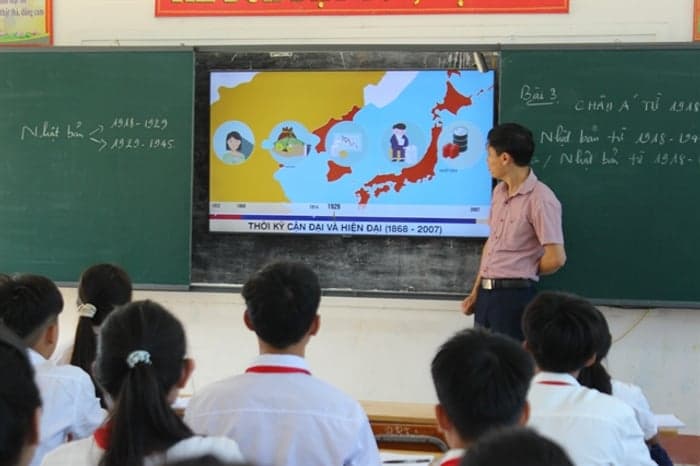
Staff and teachers at schools across Ha Tinh Province are applying digital technology and artificial intelligence (AI) to lessons and administrative work.
The province has invested considerable effort despite infrastructure problems and the pressure created by a larger area after school mergers. Technology helps reduce administrative procedures and workloads while encouraging pupils’ interest and creative thinking.
Access to technology is not limited to younger teachers. At schools in disadvantaged areas, teachers have taught themselves to use digital tools and changed their methods to make learning more engaging.
Trần Thị Ngọc Bích, principal of Kỳ Tây Primary and Junior Secondary School, said some teachers initially felt unfamiliar with digital tools. Training and exchanges of experience helped the staff gradually learn to use them. The school made self-directed learning, exploration and digital skills part of its end-of-year criteria.
Teachers use computers, presentation equipment, Canva and ChatGPT to prepare lessons and organise activities. In literature classes, pupils use AI from outlining to drafting. Canva is used for videos about history books. Civic education classes use short videos, humorous scenarios and educational games to draw pupils into discussions of real-life issues.
History and geography teacher Lê Văn Nam said diagrams, maps, images and videos help pupils visualise and understand the subjects. Technology gives teachers more ways to enrich lessons and helps pupils take a more active role.
Principal Nguyễn Xuân Quý said equipment remained a difficulty because not every pupil had a suitable computer. Investment in infrastructure was also important.
Management difficulties
At Thạch Hà Primary School, the new school year began with 2,652 pupils, 79 classes and 136 employees, including managers, teachers and support staff. The school's size created management challenges, but digital technology in management and teaching reduced the pressure.
School head Lê Thị Phương said digital transformation helps improve education. The school encourages teachers to use information technology for classroom management, build digital learning resource libraries and change their teaching methods.
Teacher Nguyễn Thị Thương said software for lively lessons and interactive games made pupils more enthusiastic than traditional methods. They absorbed knowledge more quickly and developed concentration and sharp thinking.
At Lộc Hà Junior Secondary School, three schools were merged into one institution with 64 classes, 2,683 pupils and 137 managers and teachers at one main site and two branch campuses.
In the 2026–2027 school year, the school introduced AI-integrated electronic records management. The system digitised pupil records, administrative permissions, work schedules, finance and accounting.
Principal Đặng Hữu Tường said the technology and AI allowed the leadership of the merged school to oversee work in a coordinated and transparent way. The software reduced administrative procedures and staff workloads and enabled monitoring of each teacher’s professional activities through a continuous two-way communication channel.
The combination of software-based management and changes in teaching methods provides a foundation for education in disadvantaged areas of Ha Tinh to advance under the national digital transformation programme.
Sources: Viet Nam News