
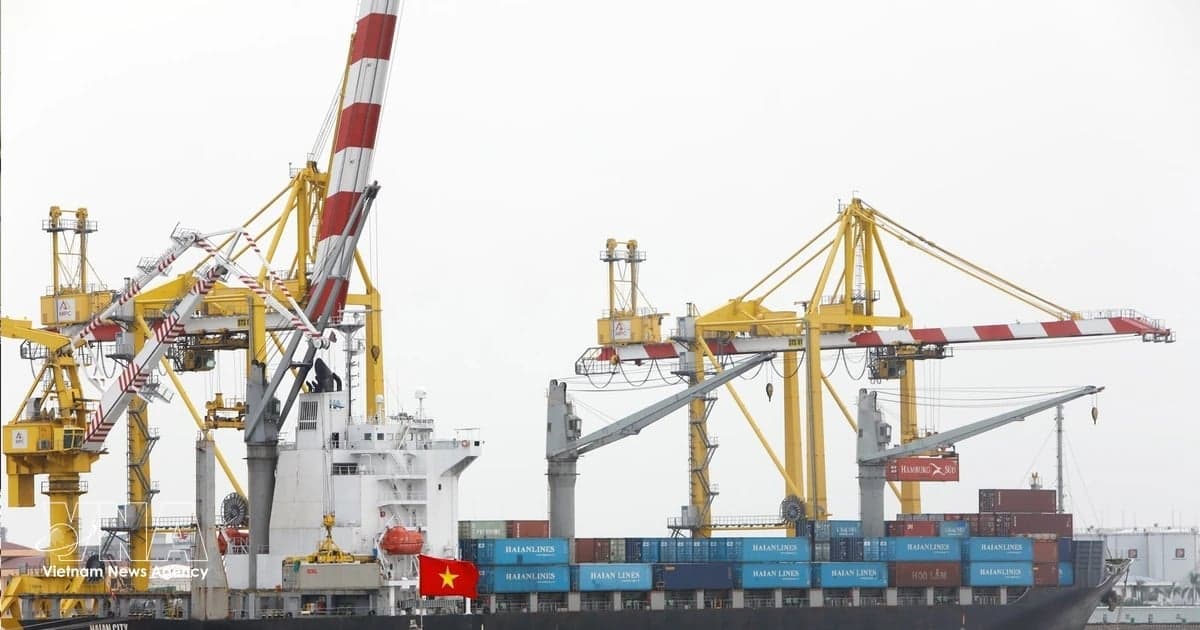
Positive trade performance during the first 10 months of 2026 gave fresh impetus to economic growth, while also showing the need to diversify markets, improve competitiveness and respond proactively to trade defence cases.
Vietnam's export and import turnover in October was estimated at 122.2 billion USD, up 47.6% year on year, according to the Ministry of Industry and Trade's Agency of Foreign Trade.
The figure for the first 10 months reached 1.01 trillion USD, rising 32.3% from a year earlier and setting a new record for the scale of Vietnam's merchandise trade.
Exports totalled about 499 billion USD, up 27.4% year on year and well above the full-year 2026 growth target of 15–16%.
Growth came from both the domestic sector and the foreign direct investment sector. Processed goods remained the main driver of exports, accounting for 87.4% of the total. Positive results were recorded in major markets including China, the US, the European Union, the Republic of Korea and ASEAN.
Vietnam recorded an estimated trade surplus of 6.8 billion USD in October. It was the second consecutive month of surplus, while the cumulative trade deficit for the first 10 months narrowed to around 12.7 billion USD.
The results show that import and export activities have maintained positive momentum, Nguyen Anh Son, Director General of the Agency of Foreign Trade, said. He added that merchandise trade remains important to economic growth.
Assoc. Prof. and Dr Dinh Trong Thinh, an economic expert, described the change as a major shift in Vietnam's exports and imports, reflecting a strong expansion in trade volumes. He attributed the result partly to export policies adopted by the Government, the Ministry of Industry and Trade, and other ministries and sectors.
National Assembly deputy Tran Hoang Ngan of Ho Chi Minh City said Vietnam is well positioned to use the potential and advantages of the 18 free trade agreements it has signed. He also said the country's growing international reputation and brand recognition are creating new momentum for Vietnamese products to reach more global markets.
To sustain this momentum in the fourth quarter of 2026, the Ministry of Industry and Trade plans to continue boosting exports, diversifying markets and making better use of free trade agreements. It also intends to strengthen early warning for trade defence investigations, tariff barriers, environmental standards, traceability requirements and rules of origin.
In the longer term, the ministry is drafting a foreign trade strategy to 2030, with a vision to 2045. It targets average annual growth of 15–16% for goods exports and 12–13% for imports, along with a sustainable trade surplus.
The strategy also aims to raise the share of exports contributed by domestic enterprises to around 28–30% by 2030. Processed and refined products are expected to account for 89–90% of total exports.
Proactive trade defence
Strong export growth also makes Vietnamese goods more vulnerable to trade defence investigations. By mid-September 2026, Vietnamese products had been subject to 327 investigations in 27 markets. The first nine months of the year saw 27 new cases, more than the total recorded in all of 2025.
The Trade Remedies Authority of Vietnam recently published a list of 50 categories of exported products at particular risk of trade defence investigations, especially over suspected origin fraud or illegal transshipment.
For businesses heavily reliant on imported raw materials and semi-finished products from countries subject to trade defence measures, proving the origin of goods and the extent of processing has become increasingly important.
Companies should therefore maintain comprehensive and consistent records of raw material purchases, import documents, material consumption, production processes and costs, as well as factory capacity data. The information may be needed for submission and verification at the request of investigating authorities, the authority noted.
They should also monitor export trends and trade policies in key markets closely to identify risks early, develop contingency plans and reduce the risk of investigations into the circumvention of trade remedy measures.
Diversifying export markets and products will also help reduce reliance on a limited number of destinations. For each market, however, businesses need to assess import regulations, competition and the potential for trade remedy action, the authority said.
Sources: VietnamPlus / Vietnam News Agency

