
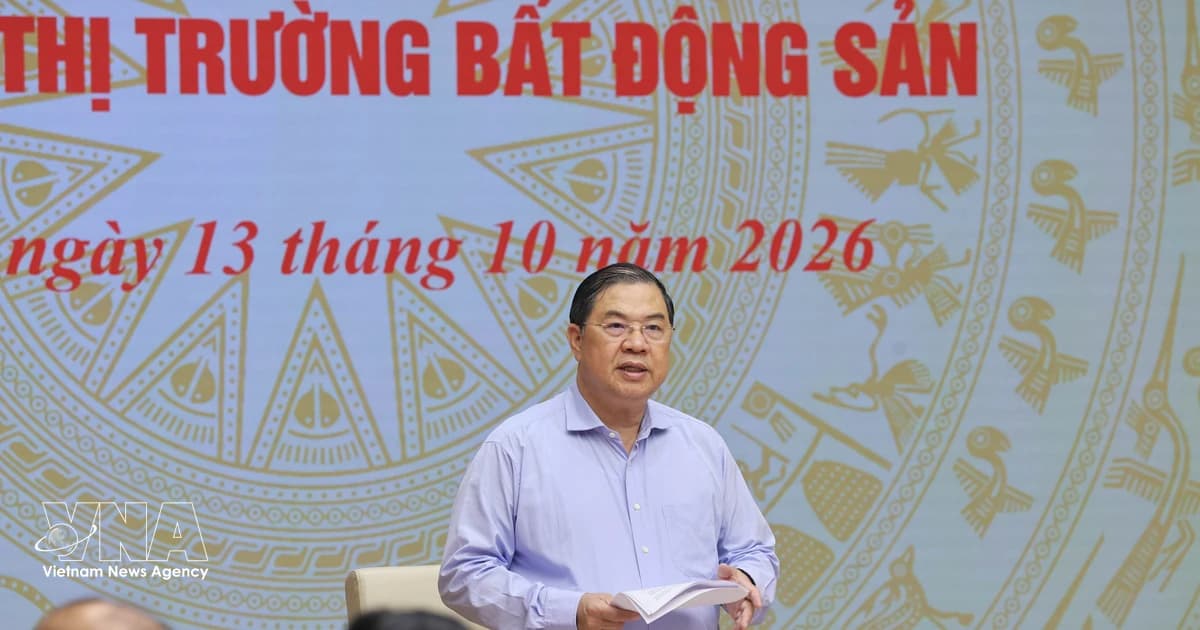
Hanoi (VNA). Standing Deputy Prime Minister Pham Gia Tuc, head of the Central Steering Committee for Housing Policy and the Real Estate Market, chaired a committee meeting on the morning of October 13. The meeting reviewed housing policy implementation during the first nine months of 2026 and set tasks and priorities for the coming period.
Real estate market still faces major bottlenecks
Deputy Minister of Construction Nguyen Van Sinh said 2,221 commercial housing, land plot and tourism real estate projects are under way nationwide, with total investment of approximately 6.87 quadrillion VND (265.19 billion USD). Of these, 1,850 projects are under construction, comprising 775,992 housing units and land plots, while 76 projects have been completed, providing 29,455 units and plots.
Apartment and land plot prices on the secondary market tended to decline compared with the second quarter of 2026, but remained high in major cities.
Outstanding credit for real estate business activities stood at around 2.594 quadrillion VND, up 1.7% from July 31, 2026. In the third quarter, real estate enterprises issued approximately 36.95 trillion VND worth of corporate bonds as of September 18.
According to reports from 27 of the country's 34 provinces and cities, property inventories at projects totalled around 51,950 units and plots in the third quarter, up from the previous quarter. Nationwide, about 5,012 projects still faced difficulties and obstacles requiring resolution.
For social housing development, 947 projects are under way nationwide, covering 910,933 units with estimated investment of 841.338 trillion VND. Projects completed, launched or approved in principle have reached 91% of the target under the programme to build one million social housing units.
In the first nine months of the year, 170 projects comprising 46,962 units were completed, while construction began on 128 projects with 183,293 units. Twenty-one localities were likely to meet or exceed their social housing targets, while six, namely Hanoi, Hue, Can Tho, Thai Nguyen, Tay Ninh and Dong Thap, were unlikely to do so.
Localities had registered to complete 17,176 rental housing units in 2026. By the end of the third quarter, 8,314 units had been completed nationwide, equivalent to 48% of the target. The Ministry of Construction estimated that 18,049 units could be completed over the full year, or 105% of the target.
At the meeting, ministries, sectors, localities and associations reported on progress in developing rental and social housing, real estate market conditions, supply and demand, and credit allocation. Many participants said access to credit remained extremely difficult and proposed measures to address obstacles in the sector.
Unlock resources and increase housing supply
With little time remaining in 2026 but a substantial workload still ahead, Standing Deputy PM Tuc urged ministries, sectors and localities to decisively implement housing development and real estate market policies.
The Ministry of Construction was asked to fully incorporate comments from the National Assembly Standing Committee, appraisal agencies and Government members into the draft revised Housing Law and Law on Real Estate Business. The drafts must fully institutionalise the orientations set out in Resolution No. 21-NQ/TW and Notice No. 64-TB/VPTW. The ministry was also instructed to study appropriate sanctions for land left idle, not put into use or used late, in order to curb speculation.
Ministries, sectors and localities must strive to meet social and rental housing targets for 2026 and the 2026-2030 period, increase the proportion of social housing available for rent, and ensure housing development matches actual demand and is supported by synchronised infrastructure. They must also prevent housing from being left vacant and resources wasted. Chairpersons of provincial and municipal People's Committees will be held accountable to the Prime Minister for results against their assigned targets.
The Deputy PM called for the definitive resolution of long-standing projects and the commencement of operations at projects whose bottlenecks had been addressed. This would unlock resources and expand supply, particularly housing priced within people's means.
He also called for close market monitoring, flexible use of credit, tax and land policy instruments, tighter risk controls, and firm action against speculation, price manipulation and other violations.
The Deputy PM assigned specific tasks to ministries, sectors, localities and relevant agencies. In particular, he urged the State Bank of Vietnam to direct credit institutions to improve access to financing, channel credit towards social and rental housing, and strive to lower lending rates while tightly controlling real estate credit risks.
Local authorities must assess housing needs among different population groups, allocate sufficient clean land in favourable locations with synchronised infrastructure, simplify procedures through a single-window, single-contact-point mechanism, resolve project bottlenecks and proactively regulate supply and demand in line with actual conditions.
Source: VNA
Sources: VietnamPlus / Vietnam News Agency

