
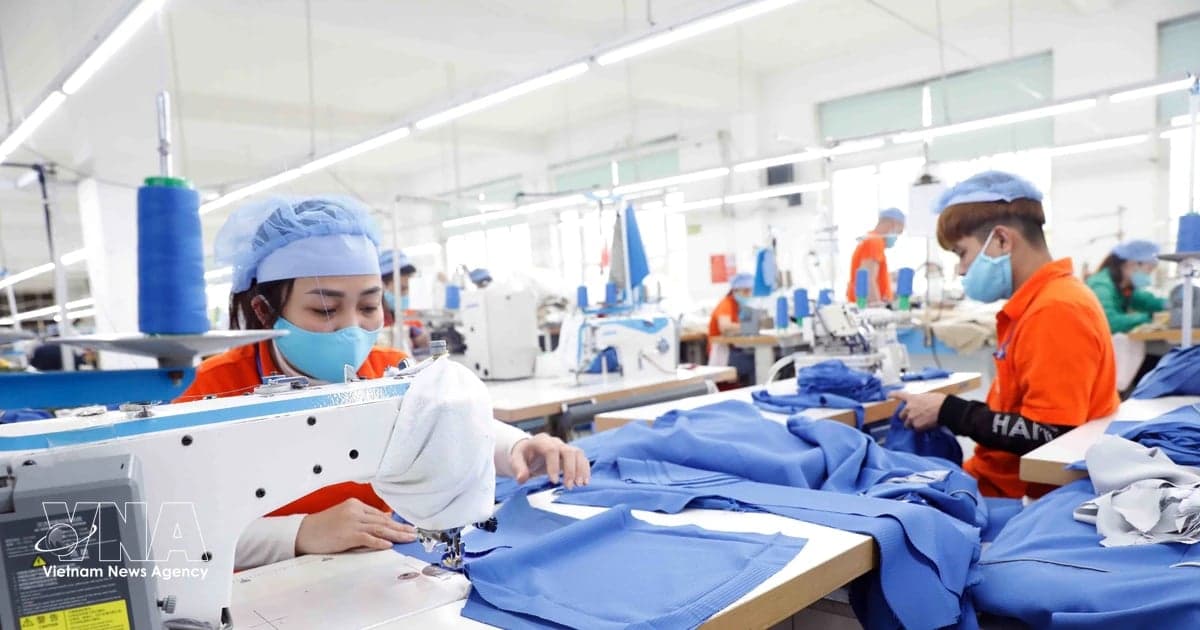
Vietnam’s textile and garment exports exceeded 36 billion USD in the first nine months of the year, rising 3.3% from the same period a year earlier. Companies are adapting to an uncertain market.
Cao Huu Hieu, General Director of the Vietnam National Textile and Garment Group (Vinatex), said the group posted revenue of nearly 1.6 trillion VND (61.94 billion USD) in the first nine months, equal to 57.1% of its plan. Pre-tax profit reached 336.6 billion VND, or 129.5% of plan, and increased 218.7%.
Yarn was the strongest segment, with revenue of 6.66 trillion VND and profit of more than 381.8 billion VND. All 12 yarn units were profitable and improved their efficiency.
Garment remained Vinatex’s largest profit source. The segment recorded revenue of 5.85 trillion VND and pre-tax profit of 679.2 billion VND, with an 11.6% pre-tax margin above the 10% plan. Results varied widely among units. Across the sector, revenue is rising while margins are falling because of pressure from prices, costs and production management on difficult, small orders.
Vinatex’s growth strategy includes expanding capacity in weaving, dyeing and materials to close the domestic supply chain and reduce dependence on outside suppliers. The group also plans to invest more in equipment, automation and advanced technology to raise productivity, launch new products and move into higher-value segments.
Another priority is digital management, data connectivity and operational optimisation. Cao Huu Hieu said the sector is entering a more difficult phase as international buyers demand fast delivery and competitive costs, along with high standards for quality, social responsibility and product sustainability.
Vu Duc Giang, Chairman of the Vietnam Textile and Apparel Association (VITAS), said companies must invest not only in scale and technology but also in their ability to join global value chains. This requires upgrading factory infrastructure to international standards, using automation to cut costs and raise labour productivity, developing raw-material supply chains, building textile industrial zones and clusters, and shifting from cut-make-trim to Free On Board (FOB) and Original Design Manufacturing (ODM).

Pham Van Quan, Deputy Director of the Industry Department under the Ministry of Industry and Trade, called textiles and garments an important export sector. It employs 1.86 million people across more than 14,300 enterprises. Exports approached 46.2 billion USD in 2025, up 6% from 2024, while the trade surplus exceeded 20.7 billion USD. Vietnam remains among the world’s top three textile and apparel exporters, and added value accounts for 52% of exported products.
Pham Van Quan said the ministry would work with local authorities, associations and companies on supplier capacity, links within the chain, technology upgrades, workforce training and market information.
He urged companies to map supply risks, diversify products, markets and customers, increase domestic sourcing when quality, price and delivery requirements are met, and work with mechanical, electronics and digital technology companies to gradually master equipment, components and production technology.
Sources: VietnamPlus / Vietnam News Agency

