
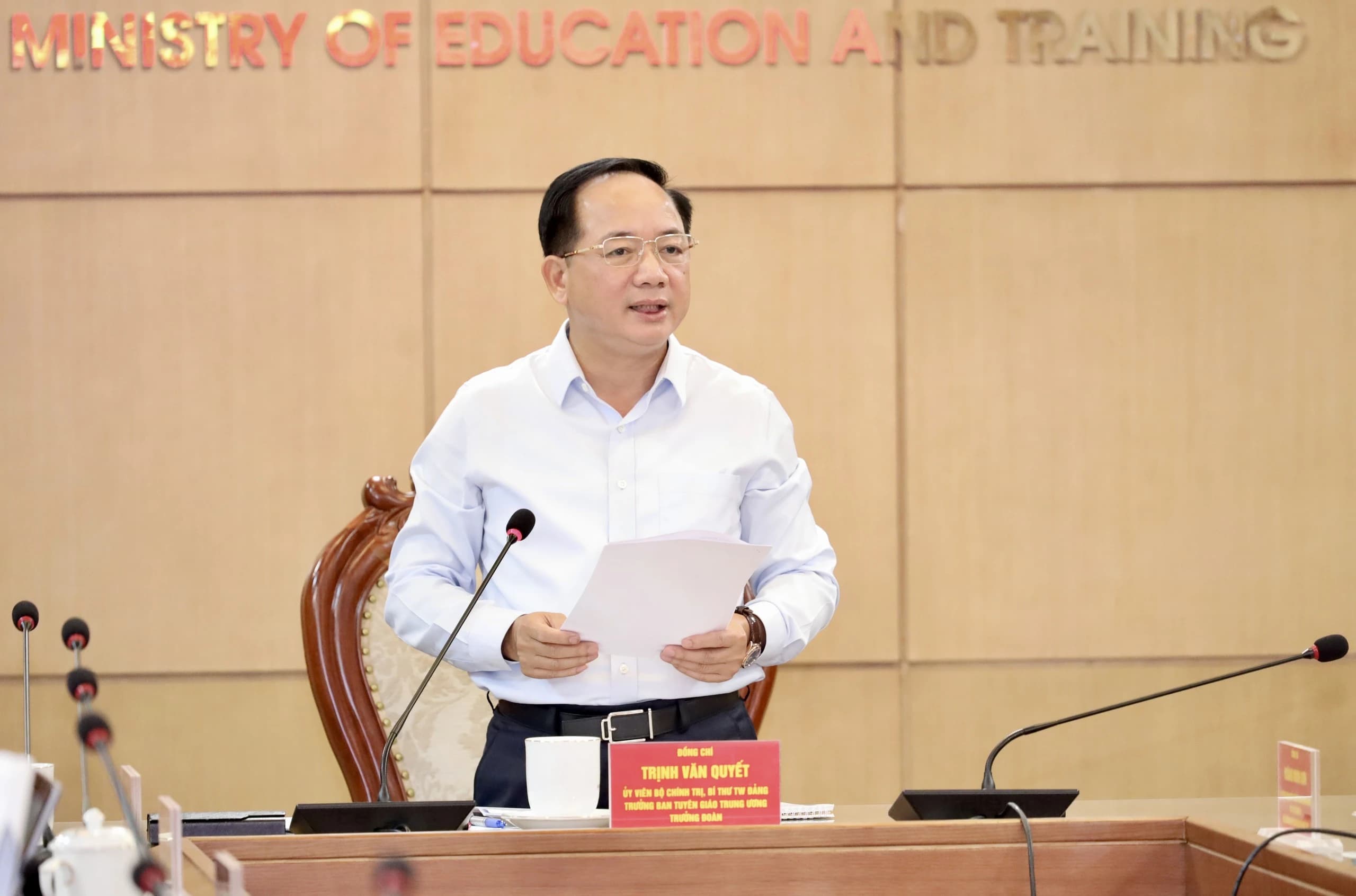
The meeting began on October 13 at Vietnam's Ministry of Education and Training. A delegation of the Communist Party of Vietnam Central Committee Secretariat, led by Politburo member, Party Central Committee Secretary and head of the Party Central Committee's Propaganda and Mass Mobilization Commission Trinh Van Quyet, held its first working meeting with the ministry's Party Committee Standing Board. The meeting addressed implementation of Politburo Resolution No. 71 on general education.
Assessing results and identifying bottlenecks
Trinh Van Quyet said the review has a comprehensive scope, with the delegation led by a Politburo member and Party Central Committee Secretary. Earlier reviews focused on specific cases or individual sectoral issues, while this one covers general education as a whole.
The delegation will assess the situation from several perspectives and compare it directly with legal regulations. This is intended to show which issues remain compliant and which need to be changed or adjusted. Based on the findings, the delegation will prepare recommendations for the Politburo and the Communist Party of Vietnam Central Committee Secretariat.
“This is not an inspection launched because of signs of a violation, and it is not a disciplinary inspection. It is a review under the overall program of the Communist Party of Vietnam Central Committee Secretariat to objectively assess the results achieved and identify bottlenecks and problems of concern to the people and the entire political system,” Trinh Van Quyet said.
According to Trinh Van Quyet, Resolution No. 71 identifies the development of education and training as a strategic task. He described general education as the foundation for developing the country's human resources and talent, saying a strong foundation should make the whole system sustainable.
Four problem areas in general education
Under the working group's plan, the review will focus on four broad areas: the general education curriculum, textbooks, infrastructure and schools, and the management structure and teaching staff.
For the curriculum, the delegation will assess its scientific basis, continuity and links between education levels, as well as its fit with students' psychological characteristics and regional conditions. It will also examine workload, workload reduction, integrated teaching and elective subjects.
In reviewing textbooks, the delegation will study content related to moral education, history, political and ideological issues, lifestyles, and the teaching of literature, history and civic education. The working group will openly assess the policy of “one curriculum, multiple textbook sets,” identify the causes of high costs for families and determine responsibility for them, along with other issues that concern the public. The delegation leader also ordered a study of whether to eliminate workbooks and other materials in which students write directly on the page and which become waste after one use.
For infrastructure and the school network, the delegation will assess shortages of schools and classrooms, as well as the effectiveness of the decision to build boarding and multi-level schools in border communes. Authorities consider the decision a way to raise education levels in mountainous areas.
For the management structure and teaching staff, the review will examine the causes of local teacher shortages and surpluses. When assessing pay policy, it will take into account total actual monthly income, including salaries and allowances, and compare it with the average income of state officials.
The delegation will seek independent opinions from experts, scientists and respected educators inside and outside the education system. Three working groups will also conduct field surveys in regions representing the north, central and southern parts of the country, including major cities, plains, mountainous areas and border regions.
Minister of Education and Training Hoang Minh Son said the ministry viewed the review as an opportunity to present the actual situation and speak openly about practical difficulties. The ministry will prepare a complete and truthful report with supporting data and submit it to the delegation by October 20.
The review covers the period from 2023 through September 30, 2026. The delegation will work with the Ministry of Education and Training and related units for about one month, then complete its report and submit it to the Communist Party of Vietnam Central Committee Secretariat by December 15.
Sources: Thanh Niên

