
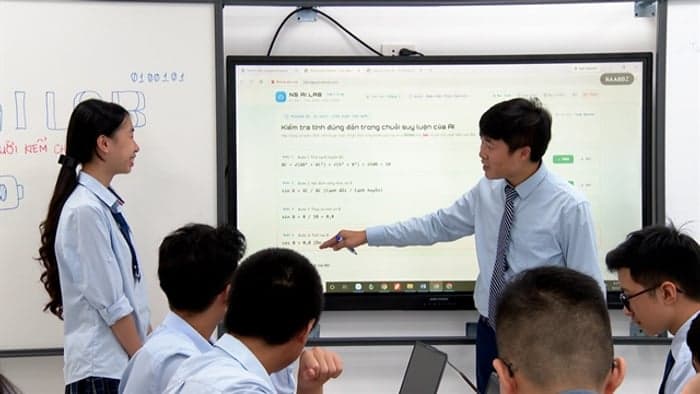
Artificial intelligence is changing teaching and learning. Schools and universities are revising curricula, assessment and digital safety so that technology supports rather than replaces human thinking.
As AI becomes more common in education, institutions are reconsidering how students learn, how teachers teach and how academic performance is assessed. The issue is how to use it responsibly while preserving critical thinking, creativity and interaction with others.
At Nguyễn Siêu School in Hà Nội, the school has created a digital ecosystem, adopted AI applications including chatbots and trained teachers. Headmistress Nguyễn Thị Minh Thúy said it had introduced codes of conduct, ethical guidelines and revised student regulations.
Rules for different age groups specify when technology can be used in lessons and when students should return to traditional learning. Thúy warned that excessive dependence could undermine creativity, teamwork and interaction, while protecting children's digital wellbeing and personal information had become part of the school's approach.
The school has also introduced after-school sports to keep students away from screens and strengthen social connections.
Rethinking teaching and assessment
At Gia Định University, AI integration has changed the curriculum, teaching methods and assessment. President Phạm Văn Song said programmes had been redesigned to include AI and technology across subjects.
AI supports students and lecturers, while examination and assessment methods are being revised. The university is also developing an AI management system that will let leaders manage operations in real time.
Song said institutions must ensure fairness when students and lecturers use AI and make sure graduates gain skills required by the labour market. Technology access alone is insufficient without clear rules and a shared understanding of their purpose.
AI as a tool, not the goal
Stefan Hermans, Director for Competitiveness, Talent Mobility and International Cooperation at the European Commission's Directorate-General for Education, Youth, Culture and Sport, said the questions facing Vietnamese educators were shared internationally. Quality education and access to it would become even more important in the AI era. "What matters is that people stay in control."
Fad Abdul Khaled, Provost of the University of Massachusetts Amherst, said educators needed to reconsider learning objectives as AI became better at tasks students had traditionally mastered themselves. He compared the change with the arrival of calculators and called for more advanced learning and stronger critical-thinking skills.
Khaled also raised concerns about academic integrity, safety and privacy. If students use AI to write assignments, educators must consider whether they have developed the skills being assessed. Students also need to understand how AI works and how to use it in daily life and future careers.
Khaled welcomed Việt Nam's efforts to address these questions through dialogue and international cooperation. He said AI should be used efficiently, safely and ethically to improve education and prepare students for work.
Strengthening international cooperation
Hermans said cooperation between Việt Nam and the European Union had created opportunities for students and institutions. Through programmes including Erasmus+, about 6,800 students had benefited from mobility opportunities, while around 100 partnerships and cooperation projects had been established between Vietnamese and European institutions.
EU Ambassador to Việt Nam Julien Guerrier said the Minister of Science and Technology was scheduled to visit Brussels on October 22, 2026, to sign a letter of intent with the European Commission's Executive Vice-President responsible for education. The agreement would begin a new phase of bilateral cooperation and further internationalise Vietnamese education.
Guerrier also cited Horizon Europe as an opportunity for universities, academics and researchers to join research projects with European counterparts.
The experience of Vietnamese schools and universities shows the importance of clear rules, teacher training and age-appropriate safeguards. Technology can expand what students and teachers do, but human judgement, critical thinking and students' overall development should remain at the centre of education.
Sources: Viet Nam News

