
Vietnam sees an opportunity to attract investment in high-tech industries, advanced manufacturing, semiconductors, data centres and logistics, while strengthening its role in global value chains as Southeast Asia becomes an increasingly important destination for international investment.
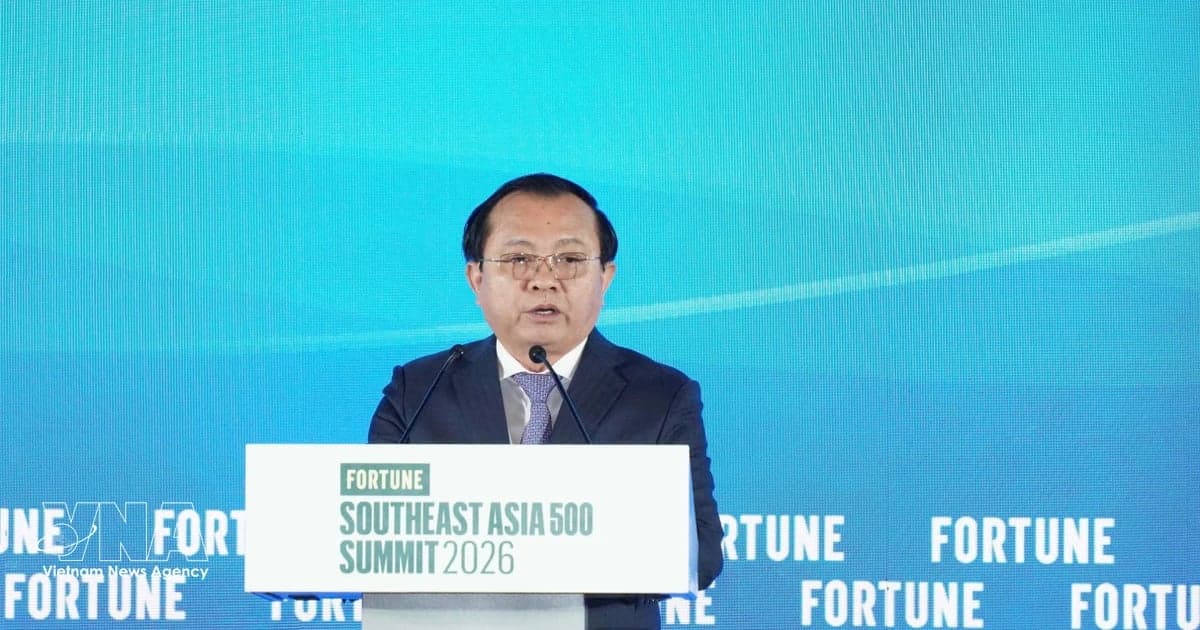
Business leaders, experts and representatives of international companies discussed the issue at the Fortune Southeast Asia 500 Summit, organised by Fortune magazine in Ho Chi Minh City on November 3.
Supply chains shift towards Southeast Asia
Geopolitical tensions, trade protectionism, tariff changes and technological competition are prompting global businesses to review production, sourcing and investment strategies, diversify manufacturing locations and strengthen supply chain resilience.
Thomas Knudsen, Executive Chairman of Toll Group, said supply chains are gradually shifting from traditional manufacturing hubs to Southeast Asia. He expects the movement of production from China to ASEAN to continue, supported by stronger regional connectivity and infrastructure development, as well as rising investment demand.
Resilient supply chains require flexible transport options, transit warehousing and better cross-border connectivity. Knudsen also noted the advantages of the region's dynamism, expanding real-time payment systems and free trade agreements.
However, the region needs to strengthen its links with global markets and build effective connections between the public and private sectors to make full use of these advantages.
James Nesbitt, Managing Director and Head of Global Subsidiaries for Singapore and ASEAN at Standard Chartered, said businesses are diversifying suppliers and customer markets, increasing inventories and adjusting production methods to reduce supply chain disruptions. Security and political factors are increasingly influencing investment decisions and production organisation.
According to Thammasak Sethaudom, President and CEO of SCG, competition from excess manufacturing capacity in China is spreading across the region. Businesses need to expand production, use free trade agreements, cut costs and increase added value. He said automation could improve precision, product quality and resource efficiency, allowing companies to focus more on design, research and development.
Vietnam prepares for new investment waves
Deputy Minister of Finance Le Tan Can said Vietnam aims to become a regional hub for artificial intelligence and data centres, as well as a destination for multinational corporations, international investment funds and financial institutions.
To achieve this goal, the country is building a new-generation investment ecosystem that connects foreign-invested enterprises with domestic businesses. Vietnam is also developing logistics, digital and clean-energy infrastructure and a skilled workforce.
The country wants to attract foreign investors as partners in technology research, innovation and product development, rather than merely as producers for the domestic market. Priority areas include semiconductors, electronics, sustainable value chains and high-quality workforce training.
Nguyen Loc Ha, Standing Vice Chairman of the Ho Chi Minh City People's Committee, highlighted the city's strengths in finance, trade, services, industry, high-tech industrial parks and the Cai Mep-Thi Vai deep-water port. He said these strengths create conditions for connecting production chains and developing logistics, trade and financial services.
In the first nine months of 2026, the city's GRDP grew by 9.06%, while registered foreign investment exceeded 19 billion USD. This was four times the figure recorded in the same period last year and accounted for more than 30% of the national total.
Ha said the southern metropolis seeks stronger links between investors and local businesses, suppliers and partners in automation, artificial intelligence, energy management and workforce training. The city is also developing an international financial centre, free trade zones and logistics infrastructure.
Businesses stressed that the opportunities created by global supply chain shifts involve more than attracting investment. They also involve turning it into technology, knowledge, production capacity and domestic added value so that Vietnam can improve competitiveness and strengthen its role in regional and global production and trade networks.
Sources: VietnamPlus / Vietnam News Agency

