
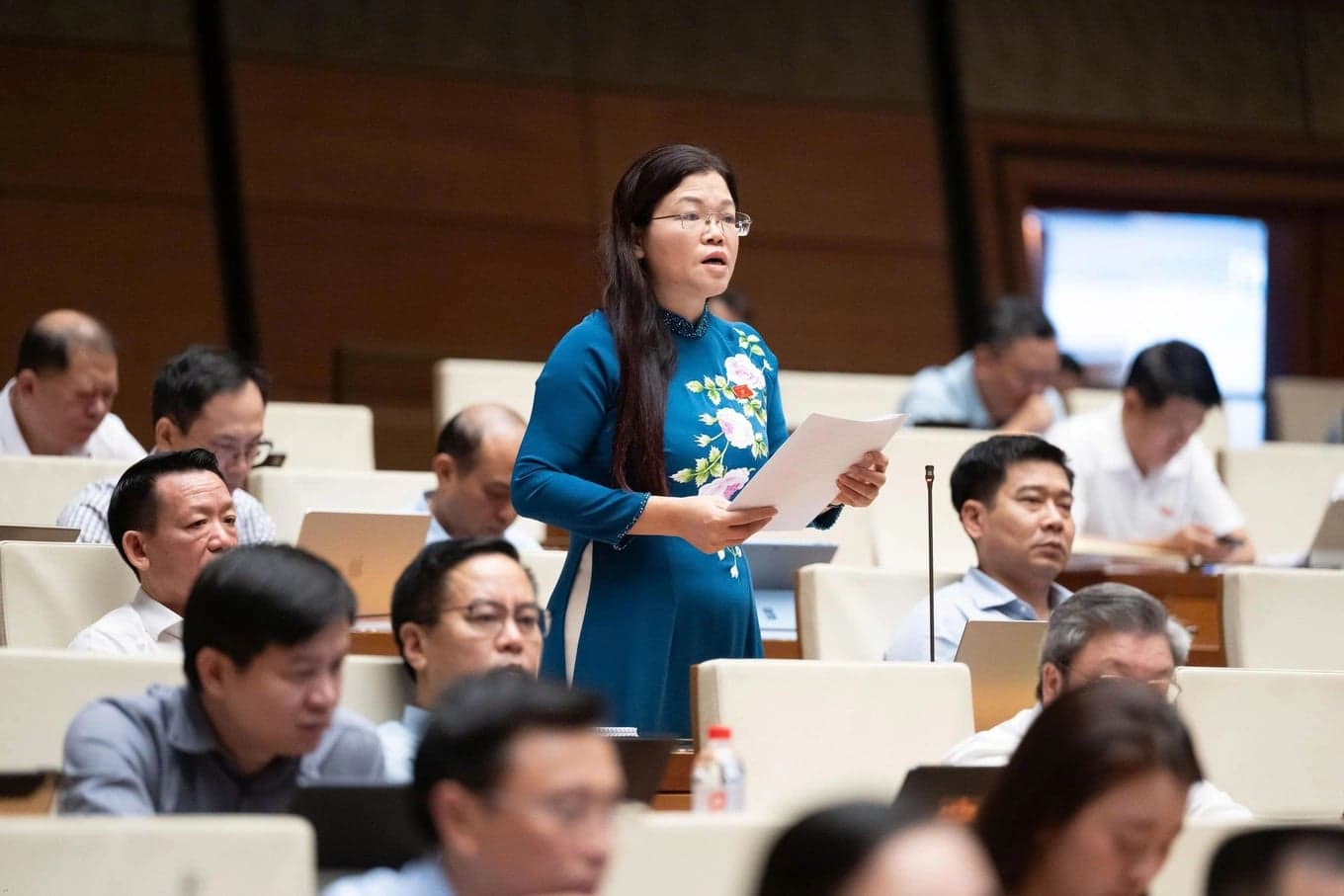
During a discussion on the socio-economic situation on October 31, National Assembly deputy Luong Thi Hoa, deputy head of the National Assembly delegation from Thanh Hoa province, proposed resolving problems with benefits and other policies for non-specialized workers in villages and urban quarters who lost their jobs after the reorganization. She said many localities are facing the issue.
Clarifying who qualifies for benefits
In Thanh Hoa, the number of villages and urban quarters was reduced from 4,351 to 1,933, a 55.6% decrease, Luong Thi Hoa said. The reorganization reduced the number of administrative units but also left some non-specialized workers without jobs or without the option to continue working.
When surplus positions were identified under guidance from the Ministry of Home Affairs, the province counted 3,092 people. Another 1,833 people lost their jobs because the province was also restructuring and strengthening its staff.
According to the deputy, the Ministry of Home Affairs has told localities to consider support policies funded by local budgets. The level of support depends on each province's budget, especially in provinces that cannot balance their own finances.
“This could lead to a large difference in benefits for people who took part in the same reorganization in different parts of the country,” she said.
Luong Thi Hoa proposed that the government issue clear guidance on the groups covered, conditions and criteria for people who lose their jobs because a locality chooses to restructure and strengthen its staff. This would provide a basis for identifying recipients and providing benefits to surplus non-specialized workers after the reorganization under Clause 5, Article 2 of Decree 154.
She also proposed that the government consider a support mechanism for provinces that cannot balance their own budgets.
“The goal is to ensure that the right people receive benefits under the law and on an equal basis, rather than expanding staff-reduction policies to every case of job loss,” the deputy stressed.
For staff who remain in local positions, she proposed improving benefits and working conditions for employees at public service centers at commune level and strengthening oversight of policy implementation after the reorganization.
Providing resources for local work
National Assembly deputy Hoang Quoc Khanh, deputy head of the National Assembly delegation from Lai Chau province, also called on the government to develop suitable policies for employees at commune-level integrated service centers.
He said he had raised the issue at a group discussion and that the government had ordered a review. An early policy would help employees work with confidence and improve the quality of public services locally.
On resources for local development, Hoang Quoc Khanh called for faster implementation of national target programs. He said that after communes, villages and hamlets were merged, mountainous areas needed roads from commune centers to hamlets, internal roads, roads to production areas, domestic water supplies and support for production development.
Most of these projects have already been included by communes in investment plans under the national target programs. Delays therefore have a major effect on poverty reduction. For disadvantaged localities, the programs are also an important source of growth.
He called for guidance to be completed quickly after the programs are integrated, transition problems to be resolved, and policies and residents' rights to continue without interruption. Plans and the 2027 budget, he said, should be assigned at the same time as the state budget so localities can begin work at the start of the year.
Luong Thi Hoa said the bottlenecks were not limited to legal provisions and also appeared during implementation.
“There are policies, but implementation is slow; powers have been delegated, but there are not enough people, funding or data,” she said.
The deputy proposed linking the delegation of powers to suitable staffing, funding, digital infrastructure and inspection and oversight mechanisms, especially at commune level. Each priority task should have a clearly identified lead agency, responsible person, deadline, resources and measurable output, she said.
She said effectiveness should be measured by time, actual cost reductions, the quality of work and the satisfaction of residents and businesses.

Sources: Dân Trí

