
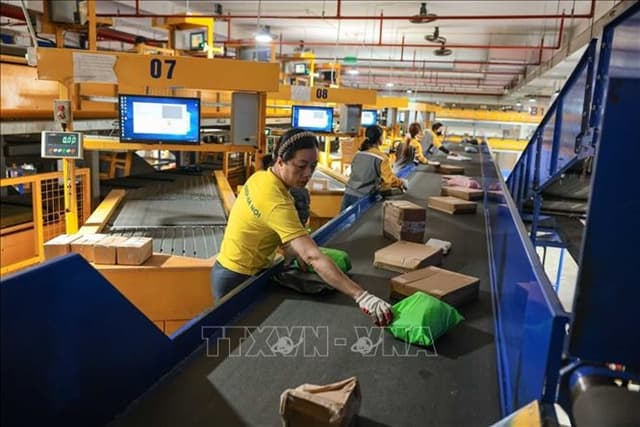
HANOI. Vietnam Post is gradually integrating technology into its postal and logistics operations as it builds a more connected network.
The company is using artificial intelligence to dispatch vehicles and digitise agricultural supply chains, while testing unmanned aerial vehicles for hard-to-reach delivery routes.
The project aims to create a smart postal and logistics ecosystem that connects the physical network with data and technology to transport goods, support production and e-commerce, provide public services and help local products reach wider markets.
At the Vietnam Digital Technology Forum in the Republic of Korea and Japan earlier this month, Vietnam Post presented five solution groups: AI-powered logistics networks, PUDO 2.0 points, low-altitude economy development with UAVs, AI digitisation of documents and handwriting, and Chatbot and Callbot assistants.
The solutions are being integrated into a network with more than 13,000 service points, automated sorting systems, iPOSTMAP and the Vietnam Logistics Platform.
Vietnam Post plans to launch an AI logistics optimisation platform this month. It will manage vehicle arrival and departure times at transit hubs and is intended to cut waiting times and congestion from several hours to about 15–20 minutes.
The company and its partners are developing a digital agricultural supply-chain platform to standardise processes from collection, processing and packaging through to export. It will also link growing-area and farmers’ digital address codes with customs procedures.
New possibilities for logistics
In Mường Ảng Commune in Điện Biên Province, the problem is the last stretch from production areas to collection points. Coffee and macadamia areas lie on hills, with some sites 4–5km from collection and purchasing points.
Steep terrain, narrow roads and weather dependence make collection difficult. Vietnam Post is using drones that can carry up to 50kg per flight, after which ground vehicles take the goods to cooperatives, purchasing organisations or processing plants.
General Director Chu Quang Hào said the company was researching and testing drones to assess their practical applications. Vietnam Post is combining its physical network with technology to create more efficient logistics models for residents, businesses and local authorities.
Infrastructure for multiple services
In Đắk Lắk Province, the postal network is being incorporated into an ecosystem linking digital transformation, public services, e-commerce, logistics and agricultural distribution.
From 2017 to 2025, the province’s 288 post offices received, processed and returned nearly 3.9 million administrative procedure dossiers.
For 2026–30, Vietnam Post and the province plan to turn commune and ward post offices into postal and public administration service centres.
The company also plans to turn about 8,000 transaction points into a Bách hóa Bưu điện chain, prioritising products certified under the One Commune, One Product programme.
Vietnam Post is seeking cooperation with international companies working in AI, robotics, autonomous technologies, unmanned traffic management, the Internet of Things and related solutions.
Sources: Viet Nam News

