
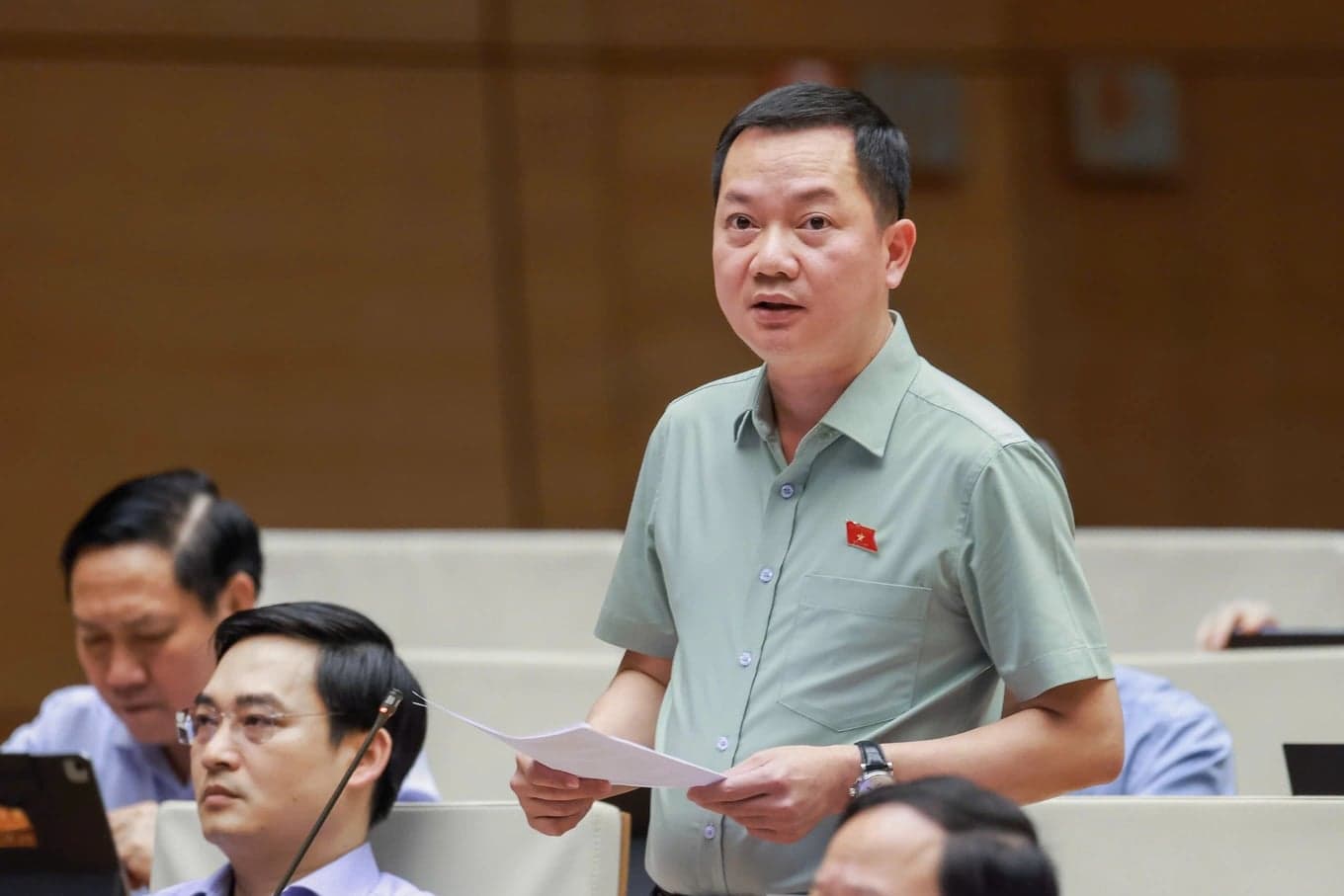
On November 5, speaking during a discussion of a draft law combining the State Budget Law and the Public Investment Law, Finance Minister Ngo Van Tuan said every state-funded expenditure, program and project must be assessed for its socio-economic effectiveness.
More than 8.2 quadrillion dong in public investment over five years
The minister said the need to improve budget efficiency is becoming more important as investment volume is expected to rise. Total investment to be mobilized is expected to increase by about 2.1 to 2.2 times from the previous period, while the need for public investment capital is expected to rise about 2.6 times.
Over the next five years, public investment from the central budget is expected to total about 3.8 quadrillion dong and local budgets about 4.42 quadrillion dong. The combined amount will be about 8.22 quadrillion dong.
The minister said the draft law puts new approaches to state budget and public investment management into law, including effectiveness assessments for state-budget spending.
He acknowledged that analysis and forecasting remain limited and have not kept pace with changes in Vietnam's domestic and global economies. Growth was forecast at 6% at the beginning of 2025, but the actual result was 8.02%. Changes in land-related revenue and unusual revenue sources also affected budget planning.
He stressed that revenue estimates must not be lowered without justification and that revenue sources must not be concealed to create room for higher collections during budget implementation.
Public investment should also be assessed after projects enter use
Deputy Trinh Xuan An proposed clearer results-based budget management and public investment accounting in the draft law.
When a budget is allocated, the output, quality, completion deadline and funding should be defined. Before a public investment decision, authorities should set the objective and outcome indicators and calculate costs over the project's entire life cycle, including operation and maintenance.
The deputy said effectiveness accounting does not mean every project must generate profit or recover its capital. Defense and security, education and healthcare facilities need suitable criteria. Every project should explain the reason for the investment, its costs, its benefits and responsibility for the result.
“A facility accepted in accordance with regulations but little used or lacking staff or operating funds still needs to be assessed for effectiveness,” An said.
He proposed making evaluation results a basis for allocating and adjusting budgets in later years. If a project fails to meet its objective, the competent authority should identify the cause and responsibility and decide whether to correct, adjust or stop it.
Deputy calls for revenue shares to match local responsibilities
Deputy Nguyen Khanh Vu of Quang Tri Province proposed reviewing how mineral extraction rights fees are divided between central and local budgets.
He said 22 mines in Quang Tri were licensed by the ministry, covering more than 2,100 hectares. Mining has long-term effects on infrastructure and the environment, while the province is responsible for management, inspections, supervision and environmental protection.
Under the draft law, local budgets would receive 30% of the fees for mines licensed by central agencies.
For a province that cannot balance its own budget, mineral revenue is counted when the equalization transfer is calculated. Higher mineral revenue could therefore reduce the transfer even though the province must continue managing mining and addressing its effects.
Vu proposed raising the local share to 50% and prioritizing mineral revenue for the commune where a mine is located. He said the proposal would not create new spending, but would redistribute revenue between the area that benefits and the area that bears the effects.
Minister Ngo Van Tuan said the Ministry of Finance would study deputies' proposals with the reviewing body and incorporate them into the draft law.
Sources: Dân Trí

