
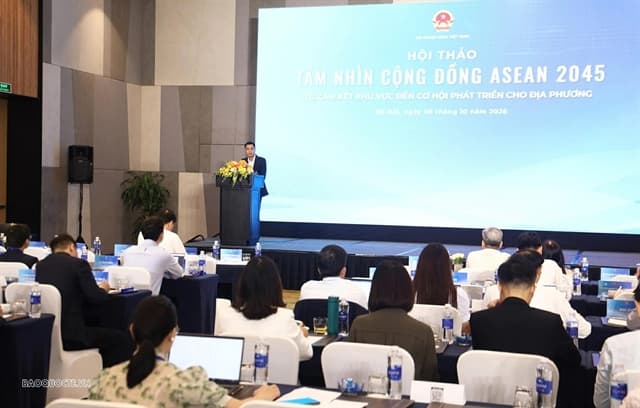
The Vietnamese Ministry of Foreign Affairs held a hybrid seminar in Hanoi on October 8 themed “ASEAN Community Vision 2045: From regional commitments to development opportunities for localities.”
The event was intended to put Politburo Conclusion 59 on orientations for Vietnam’s participation in ASEAN through 2030 into practice and bring the bloc’s cooperation agenda closer to local authorities, businesses and citizens.
Deputy Minister of Foreign Affairs Dang Hoang Giang, who heads Vietnam’s delegation to the ASEAN Senior Officials’ Meeting, said in his opening speech that 2026 would be an important stage for the bloc’s next period. Member states are beginning to implement the ASEAN Community Vision 2045 and four strategic plans covering politics and security, the economy, the socio-cultural sphere and connectivity. Their goal is a resilient, innovative and dynamic community centred on people.
Giang stressed that the 14th National Party Congress again named ASEAN the top strategic priority, linked to Vietnam’s security and development space. The current requirement is to connect integration more closely with socio-economic development goals and expand the participation of and benefits for ministries, agencies, localities, businesses and citizens.
Drawing on the four strategic plans, representatives of several localities outlined development strategies linked to ASEAN cooperation. They mentioned urban cooperation, cultural industries and heritage tourism, finance and innovation, expanded export and import markets, logistics and supply-chain links.
Delegates said ASEAN’s potential was broad, not only in politics and security but especially in the economy, trade and investment. The bloc also serves as a bridge for Vietnamese localities and companies to expand cooperation with partners such as China, Japan, the Republic of Korea, India, Australia, New Zealand and the United States.
They stressed that effective use of ASEAN cooperation agendas and mechanisms could provide practical support for national, sectoral and local development plans. The growth of each locality and company also creates conditions for Vietnam to participate more actively in ASEAN and contribute to its work.
To strengthen coordination between the State and the private sector and make ASEAN cooperation deeper, more substantive and more effective, participants proposed more active sharing of information and experience in joining ASEAN initiatives, especially those related to new trends and opportunities for regional cooperation.
Based on the event’s outcomes, the Ministry of Foreign Affairs and other ministries and agencies will continue helping localities and companies turn ASEAN cooperation orientations and commitments into practical opportunities to improve citizens’ welfare and quality of life.
Sources: Viet Nam News

