
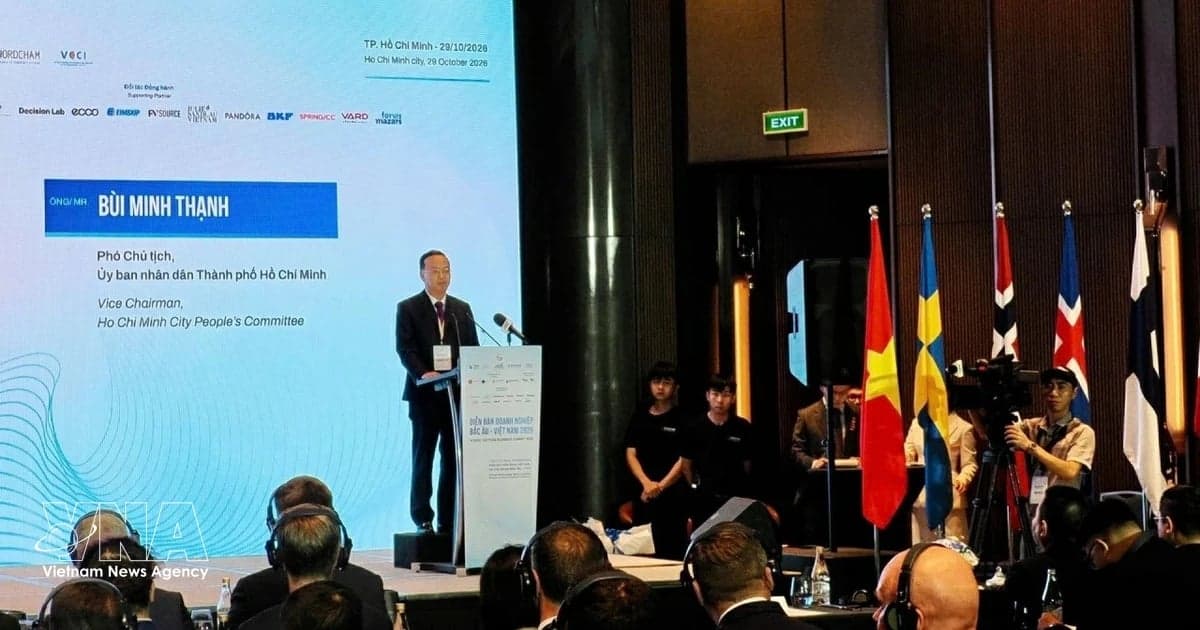
Ho Chi Minh City, VNA. Vietnam and the Nordic countries have opened new opportunities for trade, investment and technology transfer. The next test is turning diplomatic frameworks into projects, contracts and actual production capacity.
The issue was highlighted at the Nordic–Vietnam Business Forum on October 29, held as part of the 2026 Autumn Economic Forum in Ho Chi Minh City.
The forum, themed “The Next Growth Decade: Where Vietnamese Ambition and Nordic Standards Compound”, sought to match Nordic expertise in technology, governance and sustainability with Vietnam’s market, manufacturing base and workforce.
Thue Quist Thomasen, chairman of the Nordic Chamber of Commerce in Vietnam (NordCham Vietnam), said bilateral ties are gaining momentum through new agreements on sci-tech and innovation cooperation, the Vietnam–Norway Green Strategic Partnership, and the recently signed Vietnam–European Free Trade Association (EFTA) Free Trade Agreement (FTA).
Tariff cuts alone will not secure long-term investment. Companies need predictable licensing and approval procedures and access to green power, including direct power purchase agreements, Thomasen said.
Norwegian Ambassador Stein Iversen said the free trade deal and the green partnership complement each other. The trade pact sets rules for commerce and investment, while the green partnership signals political backing for a sustainable marine economy, marine spatial planning and renewable energy. Firms should prepare early to pursue these opportunities.
The EFTA–Vietnam FTA took 14 years to negotiate. It includes rules that companies will have to master, including tariffs, rules of origin and documentation. Iversen urged firms to study the text, test product fit and prepare for market standards. Ratification is still needed, and the forum heard that it could be completed in the first half of 2027.
The deal is intended to benefit both sides. Norwegian companies would gain easier access to Vietnam, while Vietnamese exporters would have better conditions for selling into EFTA markets. Seafood is a major area: it accounts for nearly 60% of Norway’s export value to Vietnam. Salmon duties are scheduled to fall to 0% when the agreement enters into force, while mackerel duties are scheduled to reach 0% over three years. Maritime industries, the circular economy and energy are also among the areas under consideration.
Bui Minh Thanh, vice chairman of the Ho Chi Minh City People’s Committee, said the city now covers more than 6,772 square kilometres and has over 14 million people after merging with Binh Duong and Ba Ria–Vung Tau provinces. The city has strengths in finance, trade, services, industry, ports, logistics and the marine economy. Its larger footprint gives it room to reshape growth and connect more deeply with global value chains.
The city wants to move from simply promoting trade and investment to co-building development capacity. Nordic investors are expected to bring technology, governance standards and innovation to help Vietnamese firms move up the value chain. Thanh said priorities include clean energy, sustainable transport, the circular economy, high-tech industry, environmental solutions and smart cities.
Thanh pledged to continue reforms to the investment climate, speed up administrative procedures and improve transparency and governance efficiency. He said these are necessary conditions for firms to invest, expand and remain in the city over the long term.
More than 100 government, diplomatic and business representatives from Vietnam and the Nordic countries attended the event. The forum heard hopes that the contacts would lead to company visits, pilot projects, contracts or investment.
Sources: VietnamPlus / Vietnam News Agency

