
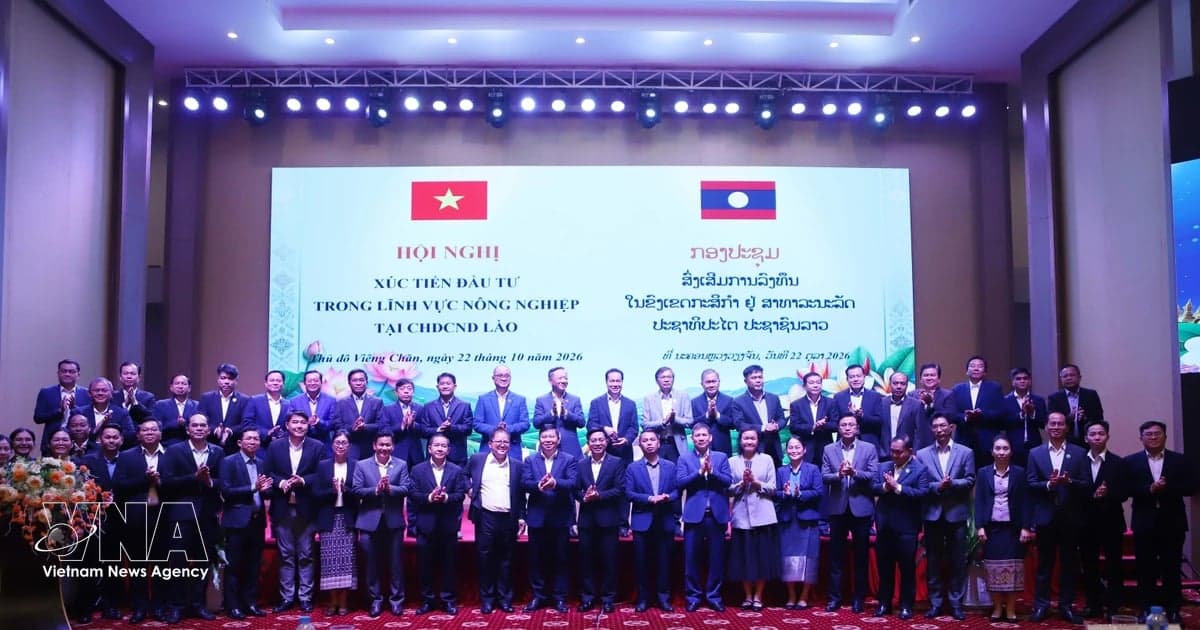
A recent Vietnam-Laos agricultural investment promotion conference was expected to turn economic, trade and investment cooperation plans into action and deepen the great friendship, special solidarity, comprehensive cooperation and strategic cohesion between the Parties, States and people of the two countries.
The event was co-hosted by the Vietnamese Embassy in Laos, the Lao Ministry of Agriculture and Environment, the Laos-Vietnam Cooperation Committee, the Lao Investment Promotion and Management Committee and the Vietnam Business Association in Laos (AVILA).
Coming right after Prime Minister Le Minh Hung’s official visit to Laos, the conference was meant to give effect to high-level cooperation pledges and open new room for collaboration. More than 250 delegates attended, including leaders of the legislature, ministries and agencies, officials from 11 Lao provinces and leading companies from both countries.
Some 208 Vietnamese companies are investing in crops, forestry and livestock in Laos, with registered capital of about 1.4 billion USD. Authorities in both countries are also upgrading transport and energy infrastructure as they aim to lift bilateral trade to 10 billion USD by 2030, while continuing efforts to attract more investment.
Pham Hai Duong, Deputy General Director of the Vietnam Rubber Group, told Vietnam News Agency resident reporters in Vientiane that expanding investment in Laos had been the right move and had brought practical benefits to both sides.
Duong said the VRG’s projects in Laos had delivered high revenue and profit over two decades of rubber planting. This showed that the land suited industrial crops, while central and southern Laos held ample potential for rubber, coffee and high-tech agriculture. The company aims to secure 120,000-150,000 ha for industrial crops in Laos by 2030 and wants Lao authorities at all levels to speed up procedures so it can obtain investment licences sooner.
Somsaad Ounsida, Chairman of the Khammuon provincial Administration Committee, said Vietnamese investors in the province had stood out for their financial strength, technology and management skills. Khammuon has drawn more than 20 Vietnamese projects, 11 of them in agriculture and forestry, which have driven economic restructuring, created jobs and improved local incomes.
Somsaad said Khammuon put attracting and supporting Vietnamese investors at the top of its agenda and remained ready to clear any obstacles. He invited Vietnamese companies to keep surveying opportunities and expand into agriculture, energy, minerals and tourism in the province.
Khamphoui Sibounheuang, Vice Chairman of the Savannakhet provincial Administration Committee, said investment in the province had lagged its potential despite more than 651,000 ha of agricultural land and a location on the East-West Economic Corridor, which links directly to Vietnam’s seaports.
To prepare for a new wave of investment, the province had adopted a five-year strategy that zones farmland into three priority areas with 13 major projects open to investors. Most involve commodity production, such as Homsavan glutinous rice, and agricultural processing.
Savannakhet has set aside an industrial park in Xaybuathong district for Vietnamese investors to build processing plants, modern slaughterhouses, animal feed factories and fertiliser plants. The province lies on an economic corridor linked to Vung Ang and Cua Lo ports and welcomes Vietnamese companies, Khamphoui added. It is ready to work with them directly to turn that potential into projects.
Sources: VietnamPlus / Vietnam News Agency

