
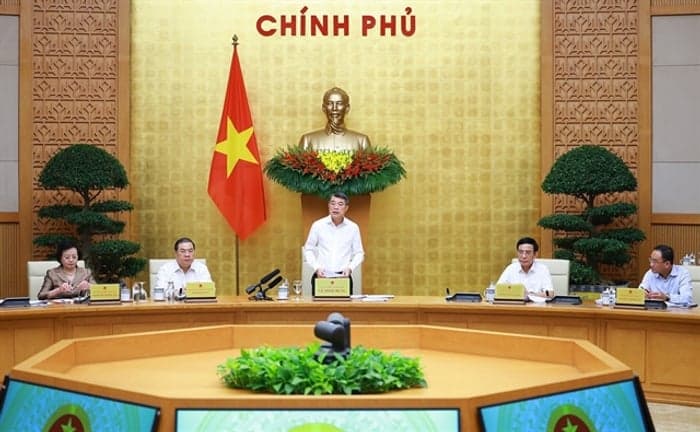
Curbing inflation will be Vietnam's top priority for the rest of the year, Prime Minister Le Minh Hung said on Wednesday. He warned that the benefits of rapid growth would not reach the wider economy or ordinary people unless prices were kept in check.
At the Government's regular monthly meeting, Hung said the Government remained committed to double digit growth but would focus on strengthening macroeconomic stability. Above all, it would keep inflation within the target set by the National Assembly.
Official figures show that consumer prices rose by an average of 4.57 per cent in the first 10 months of the year, slightly above the target of about 4.5 per cent set by lawmakers for 2026.
To cushion the effect of global volatility on domestic prices, the Government cut electricity prices by 2 per cent and reduced the excise tax on petrol to zero from November 1.
The tax cut will remain in place through March 31, 2027. It has reduced fuel prices by VNĐ1,575 to VNĐ1,804, or US$0.07, per litre. The measure is expected to cost the State budget about VNĐ7.67 trillion, or $298 million.
The Government leader acknowledged that fuel tax relief in place since the start of the year had already hit budget revenue hard.
"But to control inflation and keep prices and the macroeconomy stable, the State budget must share the burden with the economy, the public and businesses," he said.
Fiscal revenue has remained strong so far. The State collected nearly VNĐ2.45 quadrillion, or $95 billion, in the first 10 months, equal to 96.4 per cent of the full year budget target, even after granting VNĐ366.6 trillion, or $14 billion, in tax and fee exemptions, reductions and deferrals.
Land related income accounted for only about 21 per cent of the total. The Prime Minister said this showed the underlying strength of the economy.
Hung ordered the Government's price steering committee to work immediately with localities where inflation has outpaced the national average, especially major cities. He told the Ministry of Finance to update its inflation scenarios, speed up value added tax reform and propose assigning inflation targets to provinces and cities from 2027.
The State Bank of Vietnam was instructed to keep interest rates and the exchange rate stable while using more flexible tools to reduce lending rates, especially for small and medium sized enterprises, exporters and priority sectors.
The ministries overseeing agriculture and construction were told to monitor food, building material and housing costs closely.
Reports presented at the meeting showed that the economy was still growing rapidly despite external difficulties.
Two way trade topped $1 trillion for the first time, reaching $1.01 trillion in the first 10 months. Vietnam ran a trade surplus of more than $7.3 billion in October alone.
Foreign direct investment pledges rose by 74 per cent to $54.85 billion, while disbursed FDI increased by more than 13 per cent to $24.08 billion. Vietnam has also signed a free trade agreement with the European Free Trade Association, which has four member countries. It is Vietnam's 18th such agreement.
Manufacturing grew by 13 per cent, retail sales rose by 13.5 per cent and foreign arrivals reached 19.54 million, or 78 per cent of the full year target. The Government disbursed VNĐ720.5 trillion, or $28 billion, in public investment, equal to 75.4 per cent of the annual plan and nearly VNĐ230 trillion more than in the same period last year.
Still, the head of Government said disbursement remained slow for some major projects. Many localities had also made little progress in reviving stalled projects and dealing with surplus public buildings and land left after last year's sweeping administrative restructuring.
By the end of October, 2,982 previously stalled projects with combined investment of nearly VNĐ2.2 quadrillion, or $85 billion, had been unblocked and resumed. The number was 47 higher than a month earlier.
Hung directed officials to move funds from slow moving projects to those able to spend faster, with the aim of disbursing the entire public investment plan. He urged strict limits on new projects, particularly Government office buildings in provinces and cities, so that resources would go to essential infrastructure. He also pressed for faster progress on major railway, expressway and airport projects.
To support growth, the Prime Minister called for measures to encourage consumer spending and tourism ahead of the year end and Lunar New Year holidays.
The Ministry of Industry and Trade was told to guarantee fuel and electricity supplies, fast track revision of the national power development plan and submit a draft decree on fuel trading this month. The decree should reduce the number of intermediaries and lower distribution costs.
The Prime Minister also said the ministry should seek the signing of a reciprocal trade agreement with the United States.
He asked the Ministry of Construction to carry out a comprehensive review of the property market and propose ways to prevent it from harming the broader economy and financial system.
Vietnam has 947 social housing projects under way, with nearly 911,000 homes. By the end of October, 55,600 had been completed.
Among other directives, the Government leader called for stronger support for vulnerable groups, intensified efforts to recover and identify the remains of people killed in the war, and new boarding schools in border areas.
Other ministries were ordered to remove unnecessary intermediaries from the supply chains for medicines and medical equipment, tackle shortages of schools and teachers, and complete special policies to develop tourism and attract talent.
Sources: Viet Nam News, Viet Nam News

