
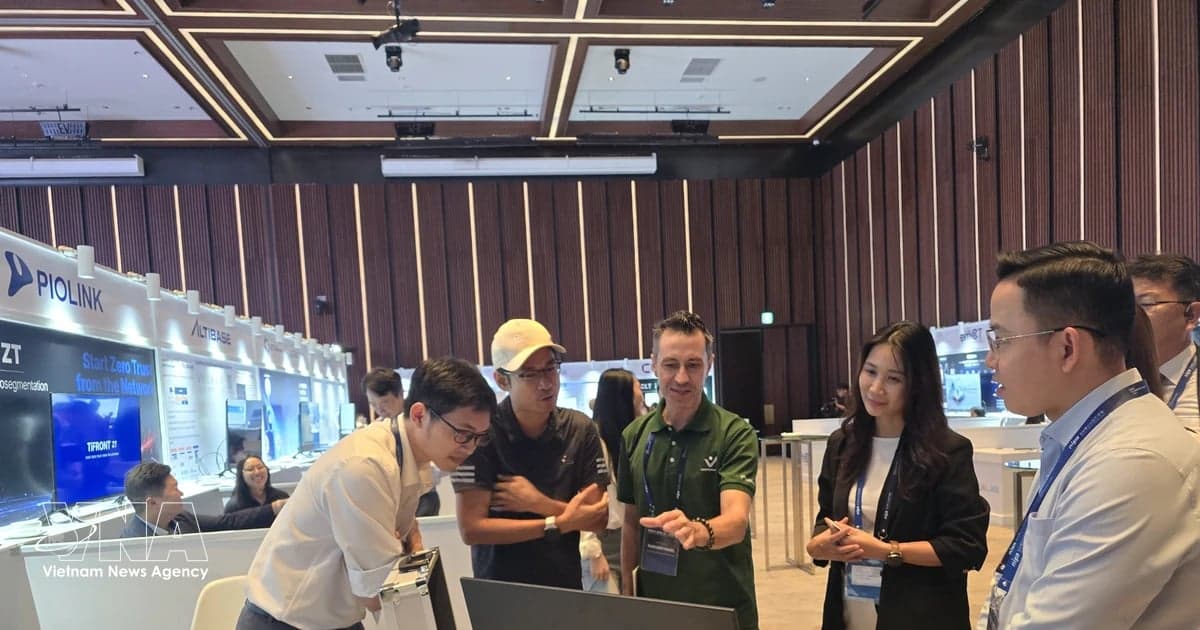
Participants at the Vietnam–RoK AI and Digital Technology Forum in Hanoi on October 29 called for stronger cooperation in artificial intelligence research and development, data infrastructure, semiconductor technology and workforce training.
Held as part of Vietnam International Digital Week 2026, the forum brought together government agencies, research institutions, universities and businesses from both countries to promote practical cooperation in AI and digital technology. Participants discussed technology trends, AI development policies and new opportunities for bilateral cooperation.
Deputy Minister of Science and Technology Tran Trung Tinh said Vietnam regards AI as a strategic technology and an important driver of growth model transformation, productivity improvement and national competitiveness.
Vietnam attaches importance to international cooperation while building its own technological capabilities, gaining greater mastery of key technologies and strengthening its participation in global AI value chains, he said.
The RoK is an important partner in this process. Its strengths in research, high-tech industries and innovation complement Vietnam’s skilled workforce, dynamic market and growing demand for technology applications.
Tinh proposed three priorities for bilateral cooperation. The first is joint AI research, development and application, particularly foundational AI models, large language models and solutions for production, business and services. Projects should address practical needs, produce commercially viable products and strengthen technological capabilities in both countries.
The second priority is developing data infrastructure, computing capacity, testing facilities and semiconductor technologies for AI. The two countries should promote investment and improve access to these resources for businesses and research institutions.
The third priority is workforce development through closer links among businesses, universities and research institutes. This includes expert exchanges, joint research, engineering training and efforts to improve workers’ AI skills.
Tinh called on businesses from both countries to identify areas of demand, find partners and invest in specific projects. The Vietnamese Ministry of Science and Technology is ready to work with Korean agencies and partners to make AI and digital technology a new driver of the two countries’ Comprehensive Strategic Partnership, he added.
RoK Ambassador to Vietnam Lee Miyon said AI and digital technology are reshaping the economic structure, society and daily life while becoming strategic assets in international relations.
The RoK aims to become one of the world’s top three AI powers through the development of independent foundational models, a national AI data centre and a global AI hub. Vietnam, meanwhile, has set goals to rank among Southeast Asia’s leading countries in AI research and development and expand its digital economy under its national AI strategy through 2030, she said.
Lee called on the two countries to move beyond traditional manufacturing cooperation and deepen collaboration in advanced industries. Priorities include developing AI data centres and next-generation telecommunications networks, as well as applying AI to manufacturing to improve productivity and strengthen the global competitiveness of products.
She also stressed the need for closer cooperation among universities, research institutes and businesses to provide training and develop young talent for digital transformation.
Kim Deuk-jung, Executive Vice President of the RoK’s National IT Industry Promotion Agency, said bilateral digital cooperation has expanded in software and information and communications technology. It should now cover emerging fields such as semiconductors, data infrastructure, AI and digital transformation.
NIPA signed a memorandum of understanding with Vietnam’s Authority of Information Technology and Communications Industry in April and plans to establish a RoK AI Innovation Centre in Vietnam in 2027. Kim said the partnership should include joint technology development and talent training as well as exchanges of technology and products.
The forum also featured discussions on AI policy, sovereign AI models, large language models, computing infrastructure, data centres and practical AI applications. Business-matching activities, technology showcases and investment presentations offered companies from both countries opportunities to seek partners, expand markets and commercialise innovations.
Sources: VietnamPlus / Vietnam News Agency

