
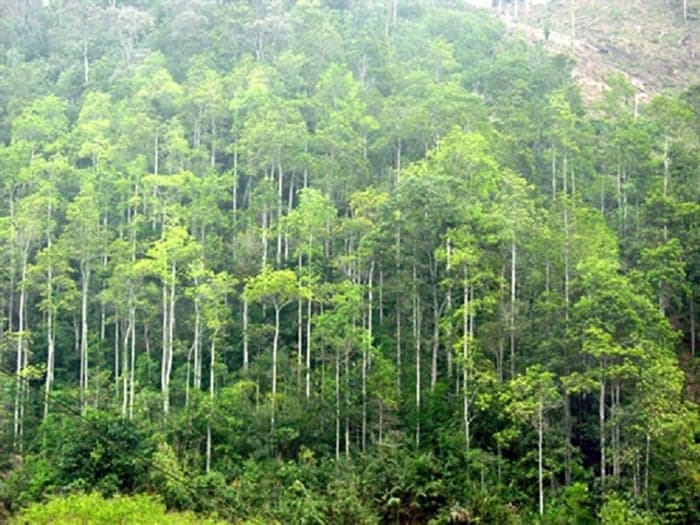
Vietnam aims to achieve average annual growth of 5.5% in the value of forestry production from 2026 to 2030.
Deputy Prime Minister Ho Quoc Dung signed a decision adjusting the Forestry Planning for the 2021–2023 period, with a vision to 2050.
The adjustment aims to turn the Party’s policies and guidelines into concrete measures and align them with the National Socio-Economic Development Strategy, the National Master Plan, the National Land Use Plan and other relevant plans. It also sets development goals and orientations for the forestry sector for 2026–2030, with a vision to 2050.
The plan seeks to build a modern, efficient, multi-value and sustainable forestry sector. It is intended to use the potential and benefits of forests, improve forest quality and strengthen their capacity to absorb and store carbon.
The plan is expected to support Vietnam’s double-digit economic growth target, protect the environment, reduce natural disaster risks, respond to climate change, conserve biodiversity and provide forest ecosystem services.
It is also intended to help reduce poverty and improve living standards in rural and mountainous areas, particularly for ethnic minority communities, safeguard national defence and security and fulfil international commitments.
The target for 2026–2030 is average annual growth of 5–5.5% in forestry production value. Forest product exports are expected to exceed $20 billion by 2030, while domestic consumption of forest products is targeted at $6–7 billion.
By 2030, the plan aims to improve incomes and living standards for forestry workers, particularly ethnic minority people. The share of trained workers employed in forestry is expected to rise from 20% to 30%, and the plan also calls for gender equality.
Forest coverage nationwide is targeted to reach 42%, contributing to Vietnam’s fulfilment of its international commitments.
By 2050, the forestry sector is expected to become one of the leading economic sectors. The plan calls for the use of tropical forest resources through advanced, environmentally friendly technologies, the production of high-value goods, participation in global supply chains and support for the country’s sustainable socio-economic development.
Under the plan, the total forestry land area will exceed 15,550ha, while forestry land with forest cover will exceed 14,000ha. From 2026 to 2030, 1.25–1.5 million hectares of forest and 300–330 million scattered trees are to be planted.
By 2030, Vietnam aims to complete forest allocation together with land allocation and the issuance of land-use rights certificates for forestry land to organisations, individuals, households and residential communities. This concerns forest and forestry land temporarily assigned to commune-level People’s Committees for direct management.
The plan also calls for advanced technologies in forest management, monitoring, surveillance and protection, especially in special-use forests, protection forests and natural production forests.
Special-use forests will be strictly managed with priority given to nature conservation and biodiversity. The plan calls for maintaining their area, boundaries and ecosystem functions and preventing the degradation of forest values.
By 2030, timber harvested from concentrated plantations is expected to exceed 30 million cu.m per year. Timber from scattered trees, home gardens and rubber trees is projected to reach 10 million cu.m per year.
The plan also calls for a system to trace the legal origin of raw timber and for the use of technology and equipment in harvesting and transporting timber and forest products.
The sector aims to develop ecotourism and forestry services.
Annual revenue from forestry services is targeted to reach VNĐ4 trillion, or $155 million, during 2026–2030.
Sources: Viet Nam News

