
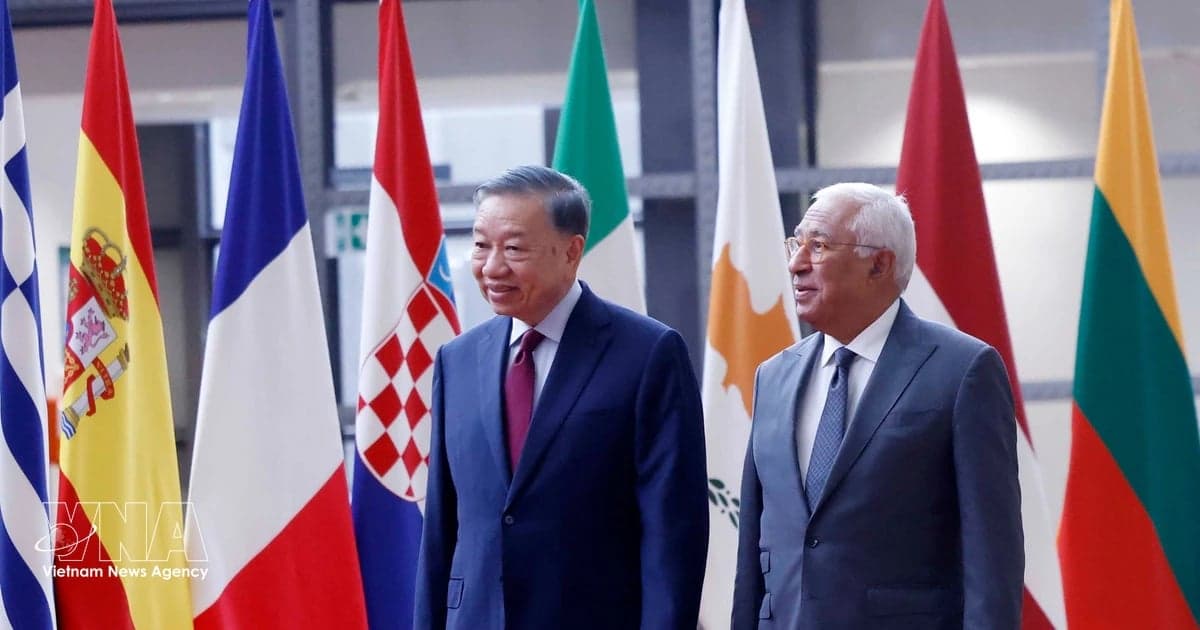
The official visits by General Secretary of the Communist Party of Vietnam Central Committee and President To Lam, his spouse, and a high-ranking Vietnamese delegation to the European Union and Belgium from October 21–24 concluded successfully. The trip strengthened political trust and opened opportunities for substantive cooperation in trade, investment, science and technology, green transition and logistics. It reaffirmed Vietnam’s foreign policy of independence, self-reliance, multilateralisation and diversification.
Deepening Vietnam–EU cooperation
Vietnam and the EU established diplomatic relations on November 28, 1990. In Brussels, To Lam met European Council President António Costa and European Commission President Ursula von der Leyen. EU leaders affirmed that Vietnam is an important partner in the Indo-Pacific and expressed confidence in deepening their Comprehensive Strategic Partnership.
Costa called for cooperation through EU programmes, including Global Gateway, in high-quality investment, sustainable infrastructure and energy transition. He also cited maritime security, cybersecurity, crisis management, climate change and emerging technologies including AI. Both sides agreed to strengthen dialogue and cooperation in green transition, innovation, strategic infrastructure and the circular economy.
To Lam called for closer economic, trade and investment links and more effective use of the EVFTA. He urged resolution of long-standing issues including removal of the EU’s “yellow card” on Vietnamese seafood exports, faster ratification of EVIPA, and strategic cooperation in science, technology, innovation and energy transition. Von der Leyen backed Vietnam’s ambition to become a regional transport and transit hub and called for implementation of arrangements involving the Bac Ai hydropower project, Lien Chieu Port in Da Nang and Long Bien Bridge in Hanoi.
At a meeting with European and Belgian businesses, To Lam said Vietnam would continue building a stable, transparent, competitive and predictable investment environment. Roxana Minzatu said combining Vietnam’s potential with EU capabilities could create opportunities in clean energy, semiconductors, AI, healthcare, manufacturing modernisation and local supply chains.
Vietnam–Belgium ties poised for stronger growth
Vietnam and Belgium have made progress in trade, investment, agriculture, education, science and technology. Their Strategic Partnership in Agriculture was established in 2018. Belgium’s Chamber of Representatives ratified EVIPA late on October 22 local time, before To Lam met Belgian parliamentary leaders. Priority areas include services, finance, research and development, ecological agriculture, environmental protection, higher education, innovation, logistics, shipbuilding, port management, renewable energy, critical raw materials, semiconductors, biotechnology, healthcare, pharmaceuticals and transport.
At the Egmont Institute, To Lam said Vietnam, one of the Southeast Asian nations with the most comprehensive partnership with the EU and the current ASEAN–EU coordinator, was ready to act as a “pilot model” and strategic bridge. At the Port of Antwerp-Bruges, he outlined plans for a modern, green and smart seaport system and stronger links between ports, inland waterways, railways and other transport modes.
Vietnam hopes to deepen cooperation with Belgium and Flanders through concrete programmes and projects. To Lam witnessed a framework agreement between the Vietnam Maritime Corporation and the Port of Antwerp-Bruges, which is expected to support maritime transport, ports and logistics and strengthen trade links between Vietnam, Belgium and Europe.
Europe is home to around 1.5 million Vietnamese people. To Lam said the Party and State were mobilising resources for national development. Referring to Politburo Resolution No. 23-NQ/TW, he described overseas Vietnamese as active participants and partners in national development. He urged the Association of Vietnamese Intellectuals in Belgium and Luxembourg to expand ties with European universities, institutes and technology companies, improve understanding of Vietnam and mentor younger intellectuals so knowledge continues to flow to the homeland.
Sources: VietnamPlus / Vietnam News Agency

