
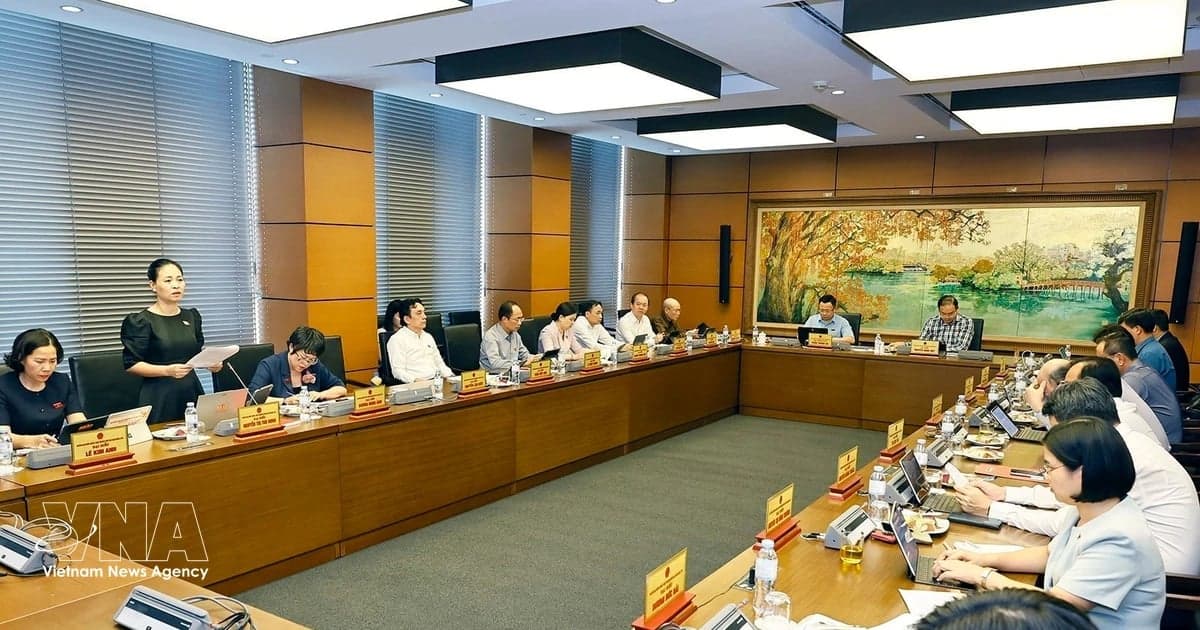
The overall principles for revisions to Vietnam's Law on Environmental Protection are to cut procedures without cutting responsibilities, ease pre-inspection while tightening post-inspection, decentralise authority without fragmenting responsibility, and never trade the environment for mere economic growth, National Assembly President Tran Thanh Man said at group discussions during the 16th NA's second session in Hanoi on October 24.
On a proposal to remove concentrated residential areas and water sources used for daily life from the list of environmentally sensitive factors, he said issues directly tied to public health cannot simply be streamlined. Environmental legislation is intended to improve quality of life, and he noted persistent concerns over household and hospital waste, water pollution, and air quality.
He said exemptions from environmental impact assessments for secondary projects in industrial parks and clusters should apply only once environmental treatment infrastructure is fully built. Projects that generate large volumes of emissions or hazardous waste, or import scrap materials, should be excluded.
The top legislator stressed the importance of data-driven environmental governance, saying data must be “clean,” accurate, complete, and reliable. He asked the drafting agency to clarify several issues, including the proposed 90% cut in administrative procedures, responsibility for projects with cross-provincial environmental impacts, what to do with 887 billion VND (34.11 million USD) that firms paid into the Vietnam Environment Protection Fund to support recycling but that has not been disbursed, and international carbon credit trading.
On the accountability of agency heads, he agreed that responsibility should be tied to measurable environmental quality indicators that are published and reviewed periodically. Responsibility cannot be assigned in vague terms, but there should also be no room to evade it.
Overhauling environmental management
Deputy Nguyen Vu Trung from Ho Chi Minh City said chairpersons of provincial People's Committees should be responsible for pollution in their localities. He proposed writing the polluter-pays principle into the draft so that polluters bear the costs of prevention, treatment, remediation, and compensation, while requiring annual disclosure of environmental budget spending, environmental performance, and progress on pollution hotspots.
Deputy Nguyen Dinh Xuan from Tay Ninh province, meanwhile, called for an overhaul of enforcement through stronger and more regular inspections and monitoring, as well as greater community involvement in oversight, rather than relying mainly on penalties after violations occur.
Xuan also suggested reviewing and narrowing the list of conditional investment and business sectors and reducing overlaps among sector-specific laws, particularly in agriculture, livestock farming, and aquaculture.
Harnessing marine resources more effectively
During group discussions on the draft revised Law on Marine and Island Resources and Environment, most deputies agreed that the legislation is needed to complete the institutional framework for integrated management of marine resources and space, protect the marine and island environment, and provide a legal foundation for modern marine governance.
The law should also help maximise the potential of marine resources and promote green, sustainable marine economic development while safeguarding national defence and security, sovereignty, sovereign rights, and jurisdiction, and meeting the requirements of global integration in the country's new development phase.
NA Vice President Nguyen Hong Dien urged a review and revision of the draft to clearly define its scope as governing the integrated management, allocation, and coordination of the use of marine space.
Sector-specific activities should be governed by their own legislation while complying with the integrated management principles set out in this law, he said.
Sources: VietnamPlus / Vietnam News Agency

