
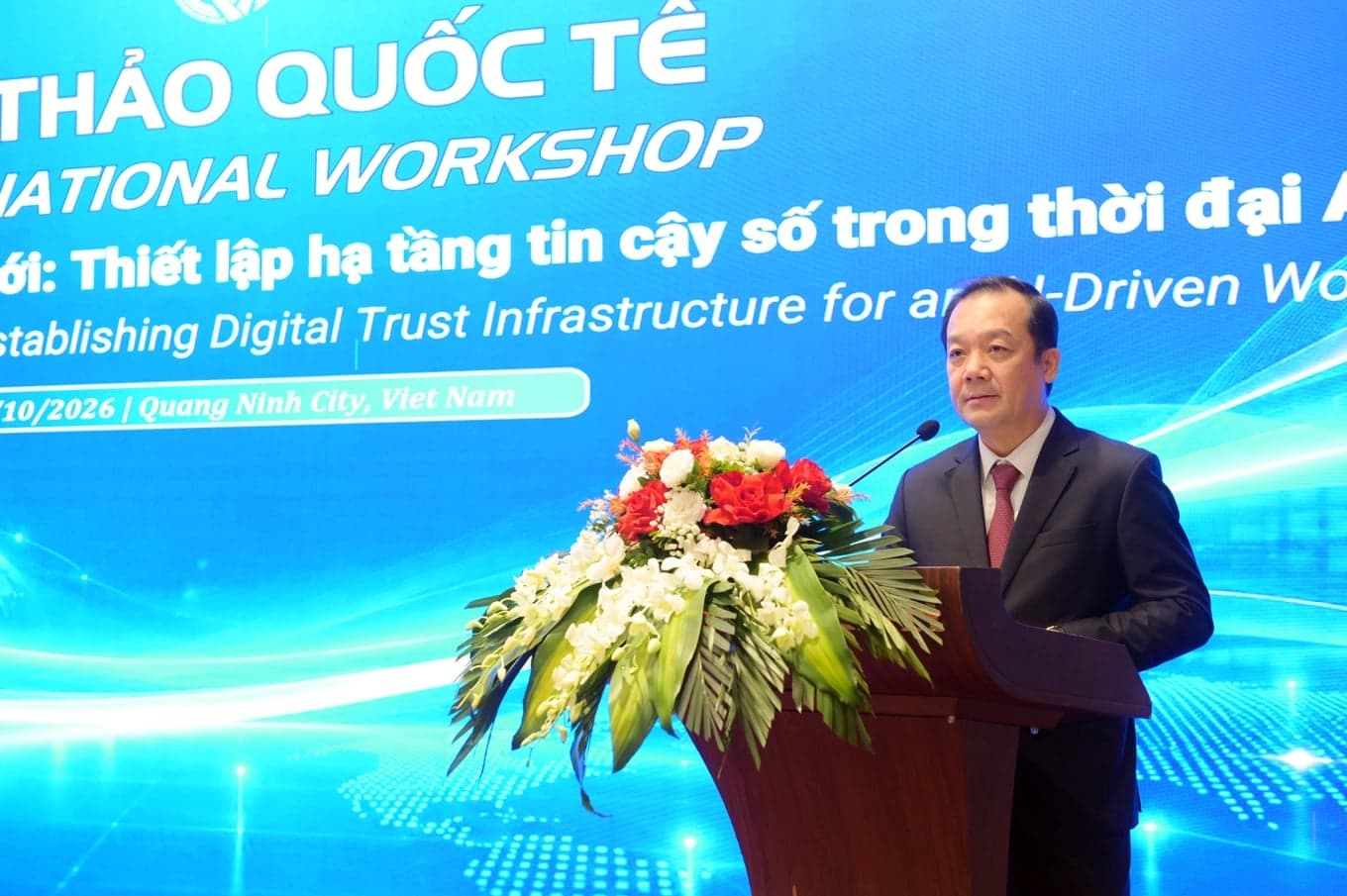
On October 29 in Quang Ninh, Vietnam’s Ministry of Science and Technology held an international workshop titled “Cross-Border Trust Services: Building Digital Trust Infrastructure in the AI Era.” The event was part of Vietnam International Digital Week 2026.
At the opening, Deputy Minister of Science and Technology Pham Duc Long said digital transformation and artificial intelligence are changing management, production and business. As transactions cross national borders, verifying and maintaining trust between parties becomes an important task.
Technical connectivity is not enough to create trust
Pham Duc Long said services such as digital signature certification, timestamping and data-message certification help identify parties, confirm the authenticity and integrity of information, and verify electronic transactions.
However, a digital signature accepted in one country is not automatically recognized in another. Barriers arise from differences in laws, technical standards and regulatory mechanisms.
The deputy minister stressed that technical connectivity is necessary but not sufficient. Parties also need legal and technical grounds for trusting one another’s verification results, as well as clear responsibility when failures occur.
For Vietnam, he said the 2023 Law on Electronic Transactions and Decree No. 23/2025/NĐ-CP provide important legal foundations for developing electronic signatures and digital trust services.
To promote cross-border recognition, the deputy minister proposed four areas of focus: improving the legal framework, increasing technical interoperability and verification capacity, developing services around practical demand, and pursuing international and regional cooperation.
Implementation should begin in areas with clear demand, practical feasibility and tangible benefits, then expand gradually.
Provenance checks to address AI-generated forgeries
The workshop also examined the role of digital trust services as AI develops.
Pham Duc Long said AI can create, edit and distribute text, images, audio and video that increasingly resemble real material. This increases the challenge posed by forged content and misinformation.
Rather than responding only after forged content appears, he proposed checking provenance in advance, recording how digital content was created and edited, and preserving the ability to verify its integrity.
Digital signatures, timestamps, public-key infrastructure and content-provenance standards can support this process.
The deputy minister cautioned, however, that verifying provenance and integrity does not mean the content is necessarily accurate. It provides a basis for further information checks and for determining the responsibility of the parties involved.
As AI takes part in automated transactions, its authority, the scope of delegated powers and responsibility for those transactions must also be clarified.

At the workshop, Vietnamese and international experts shared experience with interoperability, cross-border recognition of digital signatures, trusted third-party models and digital-content provenance verification.
The deputy minister asked the National Electronic Authentication Center to compile recommendations and experience to advise suitable solutions, while promoting practical cooperation between Vietnam and international partners.

