
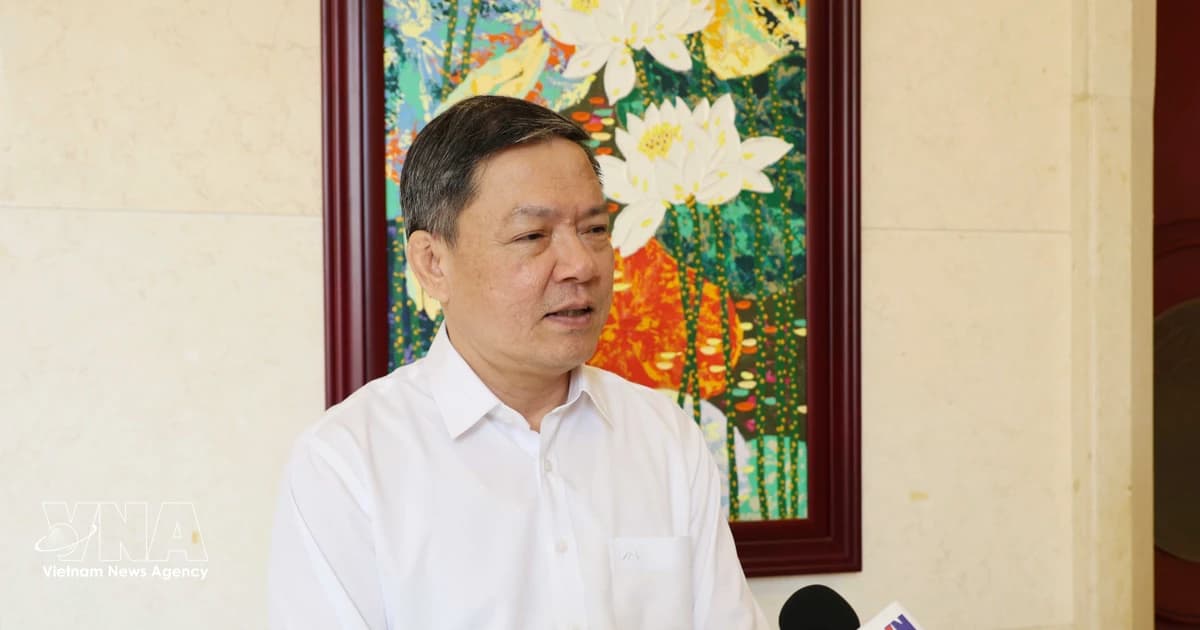
Beijing (VNA) – Vietnam-China trade is expanding rapidly and has become a notable area of bilateral relations, particularly since General Secretary of the Communist Party of Vietnam Central Committee and President To Lam’s state visit to China in April. Commercial Counsellor at the Vietnamese Embassy in China Nong Duc Lai made the statement.
In an interview with Vietnam News Agency (VNA) reporters in Beijing ahead of National Assembly Chairman Tran Thanh Man’s official visit to China, Lai said the current momentum was linked to market demand and the complementary nature of the two economies. Trade is also influenced by the close strategic orientations of the two Parties and countries’ leaders and efforts to turn them into concrete mechanisms, programmes and practical cooperation projects. This provides a basis for further growth, better quality and adaptation to changes in the global economy.
First, the strategic orientations of high-ranking leaders provide political momentum and favourable conditions for trade. During visits and contacts in recent years, the two sides have consistently described economic and trade ties as a pillar of their comprehensive strategic cooperative partnership. High-level understandings and agreements, particularly since 2023, have set directions for balanced and sustainable trade, wider market access, infrastructure, logistics and supply-chain development, and cooperation in new areas such as the digital economy, e-commerce and the green transition.
These orientations have become more specific and more closely connected to companies’ practical needs and direct benefits. Trade is considered alongside development, investment, production, transport infrastructure and regional supply chains. This allows ministries, agencies, localities and businesses to launch interconnected, complementary and long-term cooperation projects.
Second, trade continues to grow strongly because of high-level direction and demand for practical cooperation. China remains Vietnam’s largest trade partner and import source, as well as one of its main export markets. Vietnam is China’s largest trade partner in ASEAN and its third largest worldwide.
According to Vietnam Customs, bilateral trade reached 253.1 billion USD in the first nine months of this year, up 37.6% year on year. Vietnam’s exports to China rose 32.9% to 65.8 billion USD, while imports increased 39.3% to 187.3 billion USD. China accounted for about 41.3% of Vietnam’s imports and 15.2% of its total exports. Major product groups included electronics, machinery and equipment, materials and components, and agricultural and food products.
The trade structure is increasingly linked to supply chains, especially in electronics, machinery and equipment, materials and components, processing and manufacturing. Export growth to China points to room for further expansion in agricultural products, processed goods and manufactured products.
Third, high-level understandings are gradually producing practical results. Vietnamese ministries and agencies have held numerous trade and investment promotion events in China, increasing the presence of Vietnamese goods and the recognition of Vietnamese brands among Chinese consumers.
The two sides are also coordinating more closely to remove trade barriers and widen market access for farm produce, food and other major exports. Negotiating, signing and implementing quarantine and food-safety protocols provide many Vietnamese farm products with a legal basis for official export to China. Trade is gradually shifting towards a more standards-based and stable model.
Work continues on smart border gates, customs and quarantine controls, logistics and rail connectivity. These efforts help remove immediate obstacles to goods transport, strengthen long-term links between the two economies, reduce trade costs and make business operations easier.
Work on mechanisms for cross-border economic cooperation zones, production chains and supply chains shows that cooperation is moving beyond traditional trade. The aim is deeper economic integration linking trade with investment, production and infrastructure.
Fourth, trade cooperation is moving into new areas in line with development trends and the long-term interests of both countries. Alongside traditional sectors, opportunities are opening in cross-border e-commerce, the digital economy, smart logistics and the green transition. Chinese e-commerce platforms give Vietnamese companies more direct access to China’s distribution networks and consumers, especially for farm produce, processed food and branded consumer goods.
The Regional Comprehensive Economic Partnership and existing mechanisms, notably the ASEAN-China Free Trade Area, are also facilitating trade and investment. They support rules of origin and production links among Vietnam, China and other regional partners. This helps both countries make better use of complementary strengths and adapt to changes in global supply chains.
Fifth, prospects remain favourable, but attention must shift decisively from scale to quality and efficiency. Vietnam-China trade is likely to continue growing, supported by stable political ties, regular attention from high-ranking leaders, complementary economies, geographic proximity and an increasingly broad cooperation framework. Agreements on market opening, infrastructure connectivity, trade facilitation, supply chains and the digital economy should support this momentum.
Realising this potential depends largely on effective implementation of signed agreements, removal of technical barriers, improved logistics links and stronger business competitiveness. Priorities should include expanding Vietnamese exports to China, developing higher-value products, strengthening direct business ties and promoting more balanced and sustainable trade, Lai added.
VNA
Sources: VietnamPlus / Vietnam News Agency

