
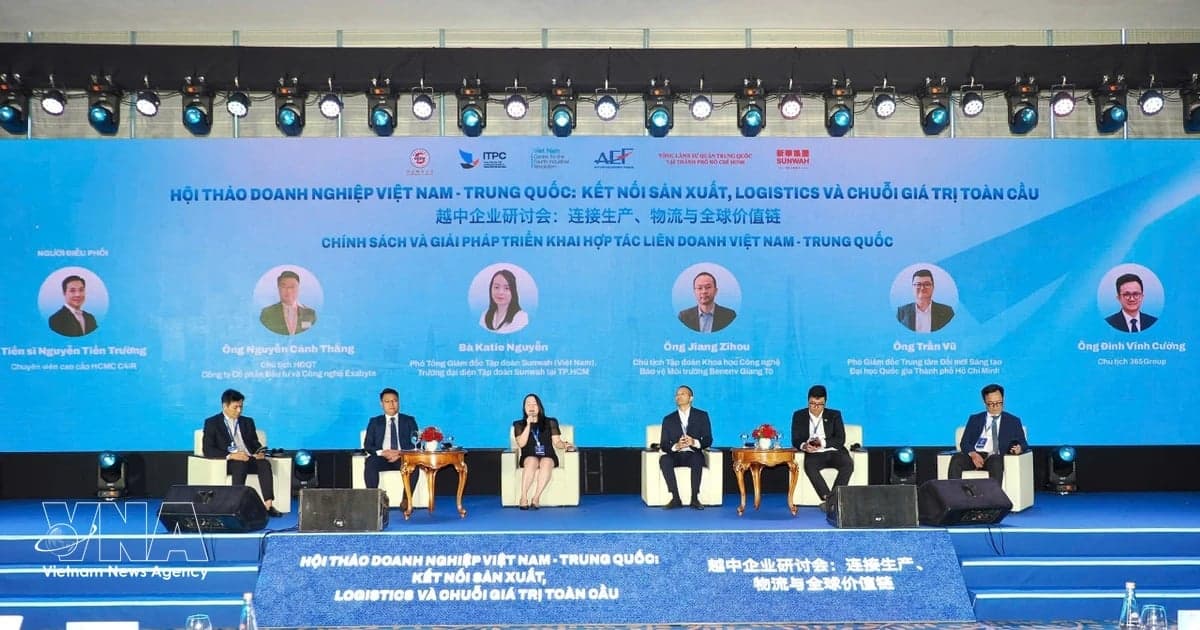
Stronger cooperation in production, logistics and technology is needed to improve the competitiveness of Vietnamese and Chinese businesses and integrate them more deeply into global supply chains, delegates said at a seminar in Ho Chi Minh City on October 29.
The seminar, themed "Connecting Manufacturing, Logistics and Global Value Chains," was jointly organised by the Ho Chi Minh City Centre for the Fourth Industrial Revolution, the Chinese Consulate General in Ho Chi Minh City and the Ho Chi Minh City chapter of the Association of Chinese Enterprises in Vietnam. It took place as part of the Autumn Economic Forum 2026.
Nguyen Loc Ha, Standing Vice Chairman of the Ho Chi Minh City People’s Committee, said economic competitiveness increasingly depends on links between production, seaports, transport infrastructure, finance and markets. The Vietnam-China partnership provides a basis for expanding economic and trade ties.
He said two-way trade reached USD 256.4 billion in 2025. With the two economies having complementary strengths, businesses in Vietnam and China have broad opportunities to participate more deeply in regional and global production networks.
Ho Chi Minh City plans to deepen cooperation in industrial development, supplier capacity, technology application and market expansion. It also prioritises transport infrastructure, seaports and logistics, particularly the Cai Mep-Thi Vai port complex, as well as smart and green solutions to reduce costs and transit times.
Ha said cooperation should create concrete business opportunities and practical initiatives. He affirmed the city’s commitment to improving its investment and business environment in line with Vietnamese law.
Xu Zhou, Acting Consul General of China in Ho Chi Minh City, said the two countries’ industrial structures and supply chains are highly complementary. As global industrial chains are restructured, cooperation should go beyond goods trade to include supply chain integration, technology exchange and knowledge sharing.
Chinese businesses are ready to work with Vietnamese partners in smart manufacturing, modern logistics, infrastructure, financial services and innovation platforms. Potential areas include production-chain integration, technology transfer, quality control, workforce training, multimodal transport, smart border gates and cold-chain storage. Joint ventures in urban railways, cross-border trade and financial platforms could also strengthen links with global value chains.
Le Truong Duy, Director of the Ho Chi Minh City Centre for the Fourth Industrial Revolution, proposed matching market demand with high-tech production, integrating infrastructure, digital technology and smart logistics across value chains, and promoting technology transfer while strengthening businesses’ ability to adopt new technologies. He also called for better data connectivity among production, transport, warehouses and ports, wider use of artificial intelligence and automation, green logistics and stronger cooperation among agencies, businesses, research institutions and universities.
Yang Wen Bin, Acting Chairman of the Ho Chi Minh City chapter of the Association of Chinese Enterprises in Vietnam, pointed to cooperation opportunities in advanced manufacturing, electronics, information technology, green energy and supporting industries. He called for stronger cross-border transport links, smart border gates, supply chain digitalisation, information sharing and harmonised technical standards. Streamlined procedures and faster customs clearance would reduce logistics costs, while quality, efficiency, added value and environmental, social and governance practices should be improved.
Dang Thi Minh Phuong, President of the Logistics and Sea Ports Association of Ho Chi Minh City, said Vietnam-China logistics cooperation is taking on a greater regional role amid global trade volatility and supply chain diversification. Ho Chi Minh City and surrounding areas have advantages as a national hub for manufacturing, goods and logistics. Ports in the area handle 65–70% of the country’s container throughput, or about 18 million TEUs a year.
The Cai Mep-Thi Vai deep-water port complex can accommodate ships of up to 21,000 TEUs and offers direct connections to the US and European markets. Phuong called for standardised transport corridors and shared data, joint investment in specialised warehouses and smart logistics centres, and technology transfer in smart ports, artificial intelligence, automation and green energy. She said these combined advantages would improve logistics efficiency and strengthen Vietnam-China supply chain links.
Sources: VietnamPlus / Vietnam News Agency

