
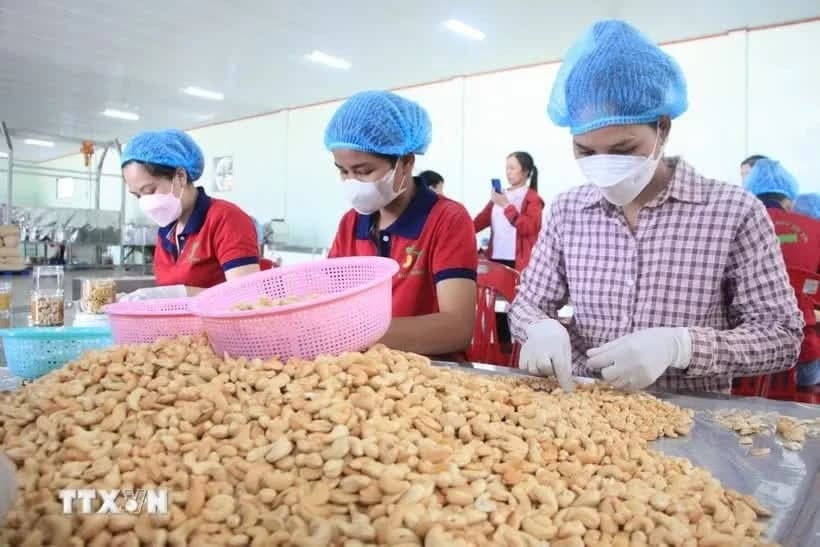
More than 500 delegates from 40 countries and territories gathered in Ho Chi Minh City for the 15th Vietnam International Cashew Conference, which opened on October 27. They discussed strengthening global supply chain links and increasing value across the industry.
The event, themed “From raw materials to added value: Connecting value chains and shaping the future of global cashew supply chains,” was organised by the Vietnam Cashew Association (VINACAS) in coordination with the Vietnam Trade Promotion Agency under the Ministry of Industry and Trade.
According to VINACAS Chairman Pham Van Cong, Vietnam exported nearly 800,000 tonnes of cashew nuts in 2025, earning a record 5.4 billion USD. For nearly two decades, the country has led the world in cashew processing and exports, accounting for more than 80% of global exports.
Shifting tariff policies, trade barriers, and rising production, transport, logistics, and financial costs are putting pressure on the entire value chain. The industry must address immediate challenges while pursuing a strategy for the next 10–20 years, with a focus on deeper processing, product diversification, and higher-value products rather than semi-processed exports.
Cong stressed that cashew production is part of a global supply and value chain in which stakeholders’ interests are closely linked. Sustainable development therefore depends on cooperation among countries, suppliers, processors, and distributors rather than individual efforts. Stakeholders should improve market transparency, share data on supply, demand, and price fluctuations, and jointly manage opportunities and risks.
Tran Ngoc Hai, a representative from the Vietnam Trade Promotion Agency, said the cashew industry faces long-term structural challenges. He noted that shifting global supply chains, sustainability-related technical barriers, rising demand for green consumption, and competition from raw-material-producing countries are forcing businesses to rethink their export strategies.
Vietnam imports around 80% of the raw cashew nuts used for processing, while land available for domestic cultivation is increasingly limited. This dependence makes it necessary to secure supplies, improve processing efficiency, and increase the value of finished products.
Hai urged businesses to shift from selling existing products to offering higher-value goods while building brands and establishing a direct presence in overseas markets. He said the ministry plans to modernise trade promotion, use artificial intelligence and big data for market forecasting, promote green and digital trade, and help businesses meet international standards.
These efforts are linked to the 2026–2030 programme for expanding into international markets, approved by the Prime Minister. It aims to help businesses improve management, build brands, identify target markets, develop distribution channels, and integrate more deeply into global value chains.
Cashew companies should fully use available support mechanisms to develop and protect their brands, expand deep processing, and introduce Vietnamese-branded products into international distribution networks, reducing reliance on foreign partners’ labels, Hai said.
Ashok Krishen, Chairman of the International Nut and Dried Fruit Council (INC), said the global nut market had grown by an average of around 8% annually over the past decade. Annual demand for nuts and dried fruit stands at about 1.4 million tonnes, with cashews accounting for the largest share.
According to Krishen, consumers, particularly young people, are becoming increasingly health-conscious and paying greater attention to their diets. Vietnam’s cashew sector could benefit by developing products that meet modern consumer preferences, provided businesses understand market demand, maintain quality, and meet import-market requirements.
He also underlined the need to boost international cooperation to establish common quality and technical standards for nuts and dried fruit. Harmonisation, he said, would facilitate trade and strengthen competitiveness.
Vietnam’s leading position in cashew kernel processing and exports provides a strong foundation for further integration into global value chains, he added.
Sources: VietnamPlus / Vietnam News Agency

