
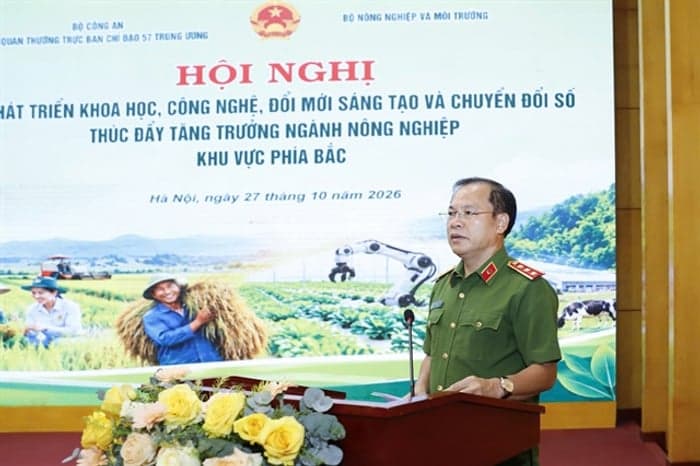
Vietnam needs to do more to turn agricultural research into commercial products, with about 76% of the sector's science and technology products still at the research stage, Deputy Minister of Public Security Nguyen Van Long said.
He urged local authorities to focus on technologies that address practical production needs, raise productivity and create greater economic value.
Speaking at a conference on science and technology in agriculture held in Hanoi on Tuesday, Long said investment in science and technology had yet to produce results matching the sector's considerable growth potential.
According to the Ministry of Public Security, all 34 provinces had reported 916 tasks linked to 908 science, technology and innovation products. Agriculture accounted for 451 products, nearly half the total.
However, 341 agricultural products remained at the research stage, while only about 24% had reached practical application or commercialisation.
Long said the figures showed a gap between research and the needs of agricultural producers and businesses. Many local projects lacked clear growth targets, while businesses ready to adopt and commercialise new technologies had not been properly identified.
He urged each locality to focus on two or three priority challenges rather than spread resources across too many projects. Research institutes and universities, he added, should concentrate on practical problems facing farmers and businesses.
Bridging research and production
Deputy Minister Long called on the Ministry of Agriculture and Environment to identify priority challenges with the greatest potential to create added value and connect local demand with the research capabilities of universities, institutes and businesses.
Projects should have clearly defined outputs and realistic implementation plans. Technical standards and regulations should also be reviewed to make it easier to adopt new technologies, he said.
The two ministries plan to organise specialised meetings on crop production, livestock farming and processing. Local authorities, businesses and researchers will work together at the meetings to address problems across agricultural supply chains.
Long also cautioned against establishing separate science and technology trading platforms for individual ministries, warning that this could duplicate efforts and waste resources. With about 20 platforms operating nationwide, authorities should consider integrating them into a system that can connect with international markets.
Between 2021 and 2025, the agriculture and environment sector led or joined 1,373 science and technology projects. They produced 225 new crop, livestock, aquaculture and forestry varieties, 150 technical advances, and 158 patents and utility solution certificates.
More than 2,000 high-tech, circular and low-emission farming models have been deployed, delivering reported economic gains of 10% to 30%.
In the northern region, research has produced cold-tolerant rice and biomass maize varieties, as well as technologies for producing vaccines against African swine fever.
The sector has also developed 25 specialised databases and information systems linked to 12 national databases.
Minister of Agriculture and Environment Trinh Viet Hung said research projects should be judged by practical results, with clearly defined outputs, resources and expected outcomes.
He called for closer cooperation among government agencies, scientists, businesses, cooperatives and farmers, while urging businesses to play a greater role in financing research and adopting new technologies.
The ministry will work with local authorities to set research priorities and deadlines. Technology and innovation will be used to raise farm productivity, add value and increase farmers' incomes.
Sources: Viet Nam News

