
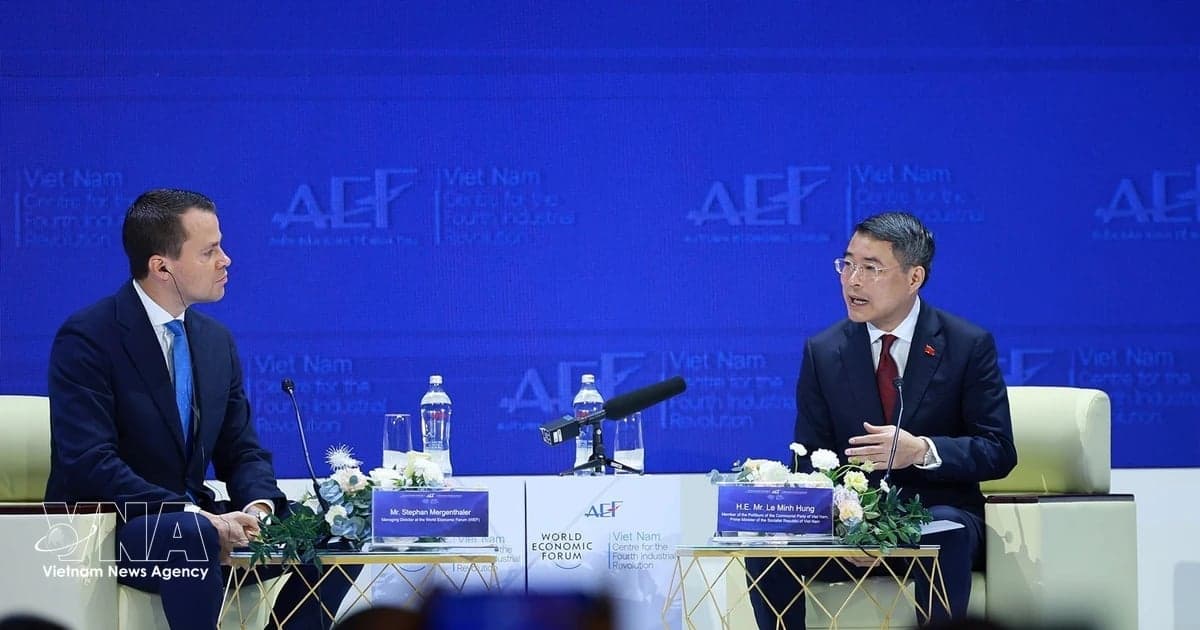
Prime Minister Le Minh Hung joined a dialogue with World Economic Forum Managing Director Stephan Mergenthaler in Ho Chi Minh City on October 28. The meeting took place during the Autumn Economic Forum 2026 and addressed Vietnam's place in the global economy.
The participants discussed changes in the global economy, new growth drivers and cooperation opportunities. Hung said the global balance of power was shifting towards a multipolar order while strategic competition among major powers was intensifying across the economy, technology, data and energy, as well as trade, investment, environmental and governance rules.
Globalisation was continuing but changing its structure. Fragmentation was increasing alongside demands for security, autonomy and resilience. Advances in science, technology and artificial intelligence were changing production, governance and the distribution of advantages and resources.
Hung identified three linked challenges: international institutions and common rules need updating; traditional growth drivers are limiting developing countries, which need new development models; and declining strategic trust requires new approaches to cooperation, investment and coordination.
Development capacity depends not only on a country's size and comparative advantages, but also on resilience, strategic autonomy, the ability to create new growth drivers and the mobilisation of resources. Countries need to diversify markets, partners and supply sources while using science, technology, innovation and digital transformation to improve productivity and competitiveness.
Vietnam has identified challenges arising from global and regional changes and formulated policies for a new phase. Its priorities are to strengthen autonomy while pursuing international integration, renew the development model with science, technology, innovation and digital transformation as leading drivers, and accelerate institutional reform and better governance.
Economic resilience and strategic autonomy
As an open economy, Vietnam is exposed to external shocks that can quickly affect production, business activity and development targets. The government will maintain socioeconomic stability and a strong macroeconomic foundation and build a modern institutional and legal framework aligned with international standards.
Vietnam is developing transport, digital and energy infrastructure, supporting science and technology and building domestic technological capabilities. It also wants stronger links between local businesses, foreign-invested enterprises and international investors, including projects involving technology transfer, training and human resource development.
The country will strengthen domestic capacity in strategic goods, especially food and energy, and focus on infrastructure, disaster prevention, risk management and climate-change response. It will also reform education and vocational training and diversify external partnerships.
A hub for technology, green energy and green agriculture
By 2035, Vietnam aims to establish a new position in the regional and global economy. It wants to become an emerging digital technology hub, a hub for new, green and clean energy, and a centre for green agricultural production.
The country also seeks to become a reliable link in regional and global supply and value chains. Hung cited its geostrategic location, stable political environment, macroeconomic foundations, free-trade agreements and diverse economic ties as advantages.
Hung reaffirmed Vietnam's policy of independence, self-reliance, resilience, multilateralisation and diversification. Strategic autonomy means strengthening domestic capabilities, preserving independent decision-making and choosing cooperation that serves national interests while respecting partners' legitimate interests. Vietnam is ready to cooperate with all countries on the basis of mutual respect, equality and mutual benefit.
Partners should move from seeking opportunities to partnering for development
Hung called on international partners, including the WEF, governments and businesses, to work with Vietnam to turn ideas, solutions and new growth drivers into concrete projects and products, share responsibility and maintain long-term cooperation.
Foreign companies and investors should share technology, knowledge and management expertise and take part in workforce training and innovation. International corporations can help raise productivity, develop industrial ecosystems, strengthen business links and expand Vietnamese participation in global value chains.
Vietnam wants to be more than an investment destination and become a long-term development partner. The government will pursue growth with macroeconomic stability, improve institutions and infrastructure, raise workforce quality, maintain dialogue with investors and address proposals within the law.
At the end of the meeting, Hung witnessed the announcement of a partnership between the Ho Chi Minh City People's Committee and the World Economic Forum, opening a new stage of cooperation.
Sources: VietnamPlus / Vietnam News Agency

