
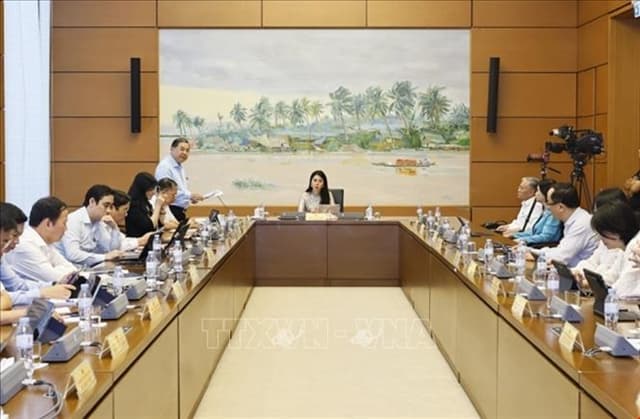
National Assembly delegations from Hai Phong City and Ha Tinh and Lang Son provinces discussed draft amendments to the Law on International Agreements on Tuesday. Deputy Prime Minister Pham Gia Tuc stressed that the agreements must be implemented and turned into real growth opportunities.
The discussion took place in Hanoi during the ongoing second session of the 16th National Assembly.
Tuc, who is also a National Assembly deputy representing the central province of Ha Tinh, said the amendments are guided by decentralisation, delegated authority and simplified procedures. The aim is to create favourable conditions for agencies in the political system to carry out international cooperation activities.
Tuc said Party and State leaders had helped secure several international cooperation agreements and commitments during recent overseas visits. The next challenge is for ministries, sectors, localities and the business community to use the opportunities and benefits they offer.
"Signing the agreements is important, but executing them is more critical," Tuc said.
Tuc cited Vietnam's 18 free trade agreements as an example. They offer significant opportunities for market expansion and trade cooperation, but some sectors and businesses have not yet made use of the opportunities and incentives, particularly tariff preferences.
National Assembly Vice President Nguyen Khac Dinh praised the draft law for removing procedures for concluding international agreements on behalf of ministries and ministerial-level agencies. The draft would instead set only general principles and delegate detailed regulations to the Government.
Dinh said the criteria for distinguishing international agreements from civil contracts and international treaties were not clear enough. The current draft relies only on the criterion that an agreement "does not give rise to rights or obligations under international law".
He said this was insufficient to distinguish international agreements from commercial civil contracts entered into by State agencies, which could cause confusion in practice.
National Assembly deputy Nguyen Ngoc Son from Hai Phong said the Government had incorporated most recommendations from the National Assembly Standing Committee and the reviewing body on the delegation of authority to sign international agreements. He called for further clarification of signing authority, oversight mechanisms and implementation procedures.
Son also said the draft defines the supervisory authority of the National Assembly and its bodies, but that some provisions need clarification.
These include Clause 2 of Article 5, which says the National Assembly's Council for Ethnic Affairs and its committees should coordinate with corresponding bodies of the foreign signatory to "conduct oversight".
"Oversight is a constitutional prerogative of Vietnam's State power bodies, so it should not be framed as a joint activity with foreign entities," Son said. He proposed replacing the wording with a mechanism for information exchange and coordination in monitoring the agreements' implementation.
Son also supported restricting the scope of agreements that border communes and wards may enter into, but disagreed with giving the Government power through sub-legislative instruments to decide which other communes or wards may enter into such agreements and which subject areas they may cover.
He suggested that the law establish criteria for identifying the entities that may be granted such authority.
The deputy also recommended making consultation with the Ministry of Foreign Affairs and other relevant agencies mandatory as part of the formal procedure for entering into agreements.
He further proposed expanding the requirement to submit copies of signed agreements to other ministries, local authorities and commune-level entities so that the Ministry of Foreign Affairs remains fully informed.
Sources: Viet Nam News

