
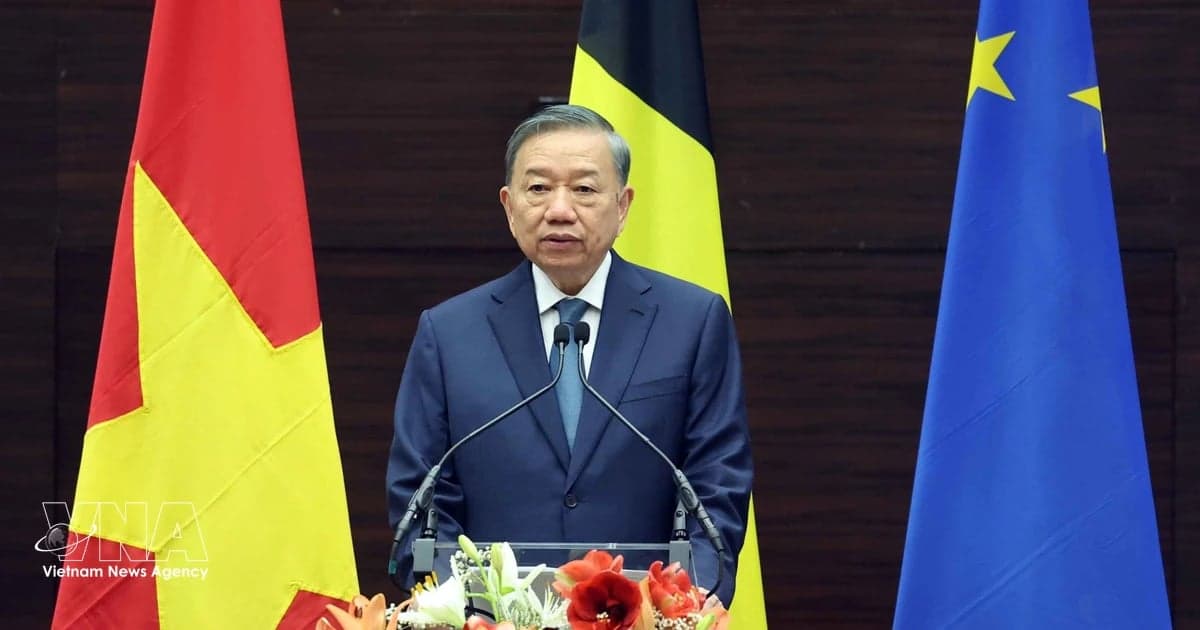
General Secretary of the Communist Party of Vietnam Central Committee and President To Lam delivered a policy speech at the Egmont Royal Institute for International Relations in Brussels on October 23. He focused on turning a shared vision into action, from political determination to a new model of cooperation.
Lam said that after four decades of Doi Moi, Vietnam had transformed from a war-torn nation facing encirclement and embargoes into the EU’s leading trade and investment partner in Southeast Asia. He said countries with different political systems and levels of development can overcome differences through dialogue, mutually beneficial cooperation and respect for international law.
He highlighted three messages: the world is undergoing changes that bring a risk of fragmentation while opening opportunities; Vietnam and the EU are increasingly aligned in their vision, values and understanding of strategic autonomy; and Vietnam–Belgium ties should drive the strategic development of the Vietnam–EU partnership.
The strategic task is to safeguard national autonomy while contributing to a fair, open rules-based international order. Vietnam’s guiding philosophy is “confidence, autonomy, self-reliance, self-strengthening and national pride”. Self-reliance builds resilience, while broad international cooperation expands opportunities for development.
Vietnam is pursuing two centennial goals: becoming a developing country with a modern industrial base by 2030 and a developed, high-income country by 2045. It is moving from dependence on natural resources and low-cost labour towards growth based on knowledge, innovation, digital transformation and the green transition, while maintaining a foreign policy of independence, self-reliance, multilateralisation and diversification.
The road ahead includes the risk of the middle-income trap, pressure to raise productivity and the vulnerability of an open economy to geo-economic shocks. Lam said Vietnam needs its own efforts as well as strategic, fair, balanced and effective cooperation with international partners, describing the EU as a leading partner.
He said Vietnam’s relationship with the EU has special importance. Vietnam is the only Southeast Asian country with such a comprehensive network of cooperation with the EU and has strategic or comprehensive partnerships with 11 EU member states. Cooperation with the EU is a strategic pillar of Vietnam’s multilateral and diversified foreign policy and its pursuit of autonomous development.
The sides share common ground in four areas: strategic autonomy and Vietnam’s emphasis on self-strengthening; new green standards such as CBAM and EUDR; fairness, transparency, equality and mutual benefit in trade and economic security; and international law and maritime security.
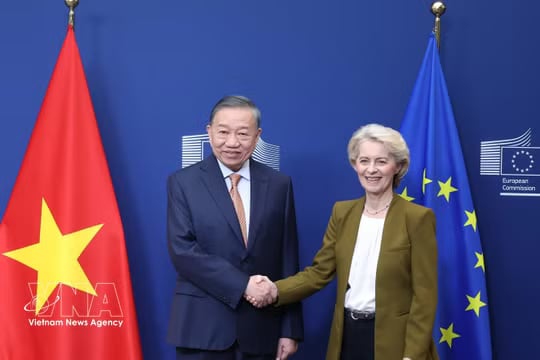
Lam called Vietnam–Belgium ties the clearest evidence of the depth of the partnership with the EU. He urged stronger political trust and economic security, closer trade and investment ties, secure supply chains, expanded cybersecurity and maritime security cooperation, and coordination among the EU, Vietnam and ASEAN.
He proposed bringing economic, trade and investment cooperation to a new level. The EU should provide technical assistance to help Vietnamese businesses meet CBAM and EUDR standards, while European investment funds could expand their presence in Vietnam’s strategic infrastructure and logistics sectors.
Other priorities are science and technology, semiconductors and innovation. Vietnam proposed connecting the two technology ecosystems and developing cooperation with Belgium, home to the IMEC semiconductor research centre. Lam mentioned joint centres for semiconductors, responsible AI and biotechnology, as well as links between innovation and startup networks.
Lam called for an accelerated green and just energy transition involving the private sector and local authorities, particularly to address climate change in the Mekong Delta. He also stressed education, training and people-to-people exchanges, including a knowledge alliance based on cooperation between Belgian and Vietnamese universities and the Vietnamese community’s role as a cultural bridge.
Vietnam, the current coordinator of ASEAN–EU relations, is ready to act as a pilot model and strategic bridge. This could make ASEAN–EU cooperation an example of inter-regional partnership and contribute to peace and prosperity on both continents. Lam said he hoped European policymakers and scholars would see Vietnam as a trusted partner and strategic link between Asia and Europe. He added that the relationship could grow beyond diplomatic documents into an economic, intellectual and technological corridor between Hanoi and Brussels, guided by unity in diversity.
Sources: VietnamPlus / Vietnam News Agency

