
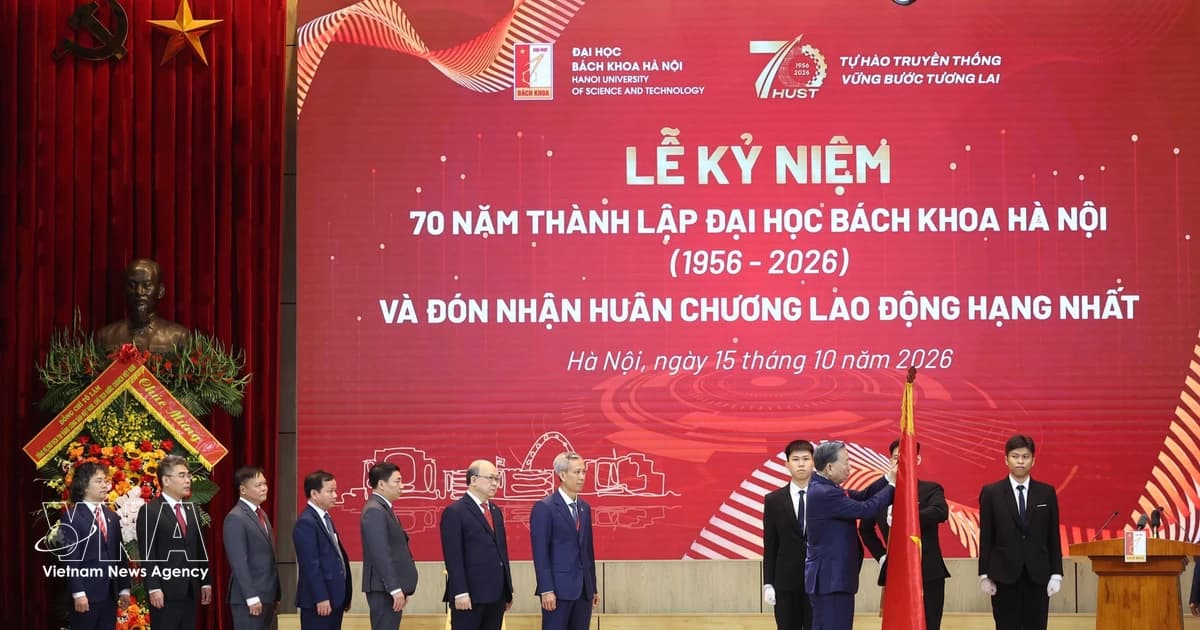
General Secretary of the Communist Party of Vietnam Central Committee and President To Lam on October 15 called on the Hanoi University of Science and Technology (HUST) to become an outstanding research university capable of undertaking major national missions, as Vietnam seeks to strengthen its technological capabilities and drive scientific and industrial development.
Speaking at a Hanoi ceremony marking HUST’s 70th anniversary (October 15, 1956–2026) and its receipt of the First-Class Labour Order, he called for the university’s reputation and capabilities to produce practical contributions to the country’s next stage. He said scientific and technological advances, artificial intelligence, technological competition and supply-chain disruptions were creating challenges, requiring Vietnam to improve productivity and quality, strengthen self-reliance and pursue international cooperation.
Politburo Resolutions 57 and 71 set requirements for breakthroughs in science and technology, innovation, digital transformation, education and training. Government Decision No. 663 of May 23, 2025 approved a plan to develop HUST into one of Asia’s leading universities and a centre for education, talent development, research and innovation serving strategic technology and industrial sectors. To Lam called for defined programmes, strong research teams, centres of excellence and shared laboratories.
The goal of ranking among Asia’s top 100–150 universities by 2035 must rest on education and research quality, academic reputation and contributions to Vietnam. HUST should identify talent early, link education with research and production, strengthen basic sciences, systems thinking and practice, train engineers in design and testing, and develop experts able to lead major programmes. In the AI era, innovative thinking, autonomy, independence, verification skills and academic integrity are essential.
Research should focus on mastering technologies and solving national challenges. HUST should set priorities, define capabilities and products, choose partners, strengthen design and manufacturing, help businesses improve production and supply-chain participation, and identify approaches in semiconductors. Research should address energy, transport, urban development, healthcare, the environment and disaster response. Wartime work on detecting and neutralising magnetic mines should inform peacetime challenges, supported by sustained investment in basic sciences.
The university should attract Vietnamese intellectual talent worldwide and international experts through ambitious programmes, good working conditions, career opportunities, professional autonomy and long-term engagement. Flexible cooperation should let experts who cannot work there regularly conduct research, lead teams, train students and transfer technology.
To Lam urged HUST to build an innovation ecosystem linking research with production and daily life, with clear tasks, responsibilities and benefits among the State, universities and businesses. Its Interdisciplinary Innovation Space, launched in June 2026, should receive resources for testing, technology refinement, intellectual-property protection and pilot production.
The university should preserve a culture based on human qualities, scientific ethics and academic integrity, and apply care to every design and calculation because engineering products affect human safety, infrastructure and the environment. The Government and local authorities should provide resources, especially to turn the second campus in Hung Yen province into an innovation complex.
HUST has 42,000 students, a global alumni network of 300,000 and partnerships with more than 100 international partners. It participates in 10 international networks and offers 68 undergraduate, 42 master’s and 28 doctoral programmes. Its five priority research fields are artificial intelligence and data technology, health science and technology, advanced materials, sustainable energy and the environment, and intelligent devices and systems.
At the ceremony, To Lam presented HUST with the First-Class Labour Order on behalf of the Party and State leadership. Earlier, he and other delegates inaugurated the Interdisciplinary Innovation Space, a Design Factory-based ecosystem combining an innovation centre, research institutes and spaces for corporations and businesses, as well as creative areas, design and digital simulation studios, rapid-prototyping laboratories, product-testing areas, group workspaces, exhibition areas and flexible classrooms.
Sources: VietnamPlus / Vietnam News Agency

