
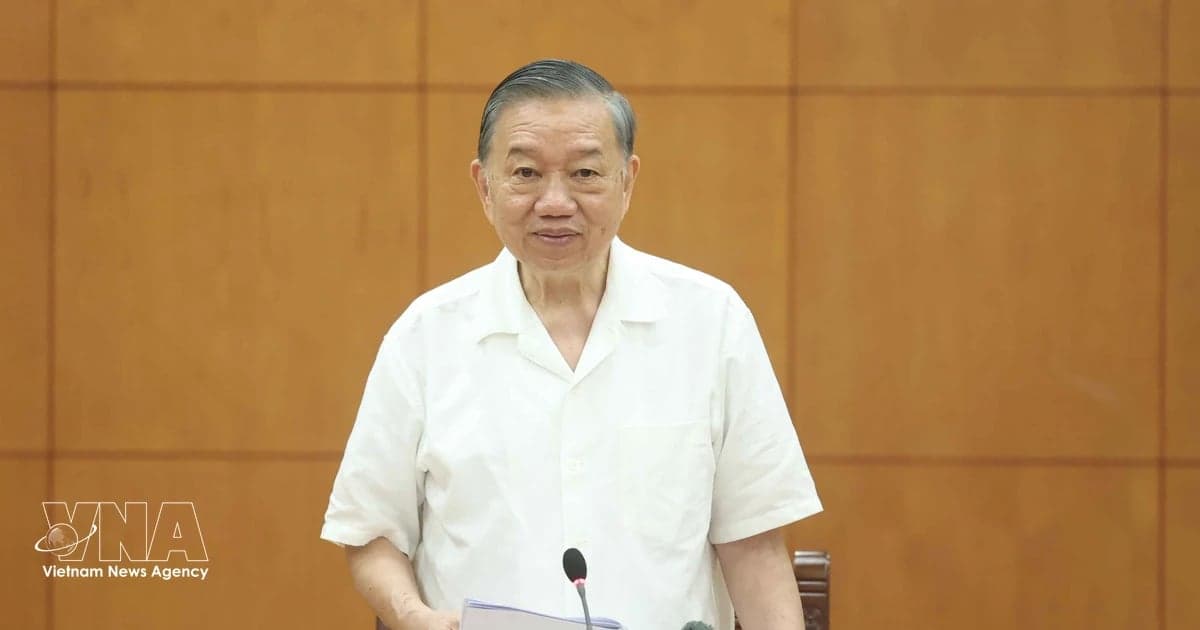
On November 2, General Secretary of the Communist Party of Vietnam Central Committee and President To Lam called for a shift in logistics development from expanding services to building national logistics capacity. He said this would strengthen Vietnam's competitiveness, economic self-reliance and resilience.
He made the statement at a working session with the Government's Party Committee and relevant agencies on national logistics and infrastructure. Lam said logistics concerns the entire economy's capacity to organise, connect and operate, not just one sector, and is linked to competitiveness, self-reliance, resilience, national defence and security.
Amid Vietnam's ambition to achieve double-digit growth, logistics must improve productivity, reduce costs, expand development space and generate new sources of growth. Its development should be part of the country's overall strategy under unified Government-level direction, rather than assigned separately to ministries, sectors or localities.
Vietnam should become an important regional and global hub for logistics, transit and goods distribution. It should attract international cargo flows for transit, storage, distribution and value-added services, join regional and global supply chains, and turn its geographical advantages into competitive strengths through logistics hubs, trade gateways and international transport corridors with clear roadmaps.
A unified modern national logistics network should align with economic spatial planning and international connectivity. Investment should overcome fragmentation and administrative-boundary-based planning while using regional strengths. Science, technology, innovation, digital transformation and green development should modernise the sector, with digital and green logistics becoming new advantages.
Lam called for strong Vietnamese logistics enterprises able to master high-value segments of international supply chains, and stronger links between logistics firms, manufacturers, exporters, trading companies and international groups. He also called for better institutions and coordination mechanisms and multi-centre, multimodal planning based on cargo, connectivity, production, markets, land and investment efficiency.
He urged better links along economic corridors, especially between ports, airports, freight stations, border gates, industrial parks, production areas and consumption centres. Digital transformation should use standardised data, electronic documents and interconnected systems linking businesses with customs, ports, warehouses and transport operators. Green transport, efficient warehouses and low-emission vehicles should be encouraged.
Immediate priorities include upgrading Vietnam's logistics strategy, creating a national coordination mechanism, identifying bottlenecks to resolve before 2027, and developing international logistics gateways and hubs. Ministries, sectors and localities should set responsibilities and deadlines. The goal is to bring logistics costs closer to regional and global averages, improve services, increase domestic value added and strengthen Vietnam's role in regional logistics networks.
Sources: VietnamPlus / Vietnam News Agency

