
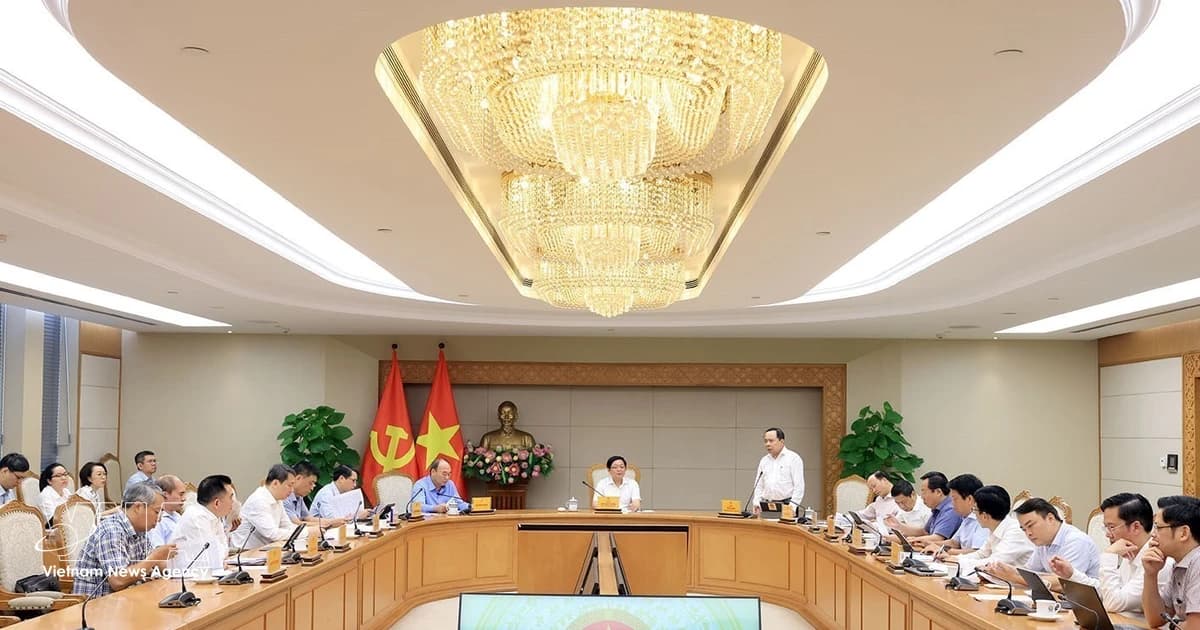
Deputy Prime Minister Ho Quoc Dung chaired a meeting at the Government headquarters on the morning of October 20 to review progress in implementing strategic technology development tasks.
According to the Ministry of Science and Technology, after the Prime Minister issued Decision No. 808/QD-TTg assigning tasks for strategic technology development, the ministry received 29 proposals from ministries and agencies. Following appraisal, 23 were deemed eligible for approval, while six failed to meet the requirements.
As of October 19, 17 of the 23 eligible tasks had been approved, with proposed funding totalling about 2.32 trillion VND, or 89.63 million USD. Since early September 2026, the Ministry of Science and Technology has received another 10 proposals. Five have undergone appraisal: reports for two are being finalised, while three are deemed ineligible for approval. The remaining five are being reviewed before appraisal.
Approved tasks and those undergoing procedural finalisation cover space, electronics, energy, high-speed rail, healthcare, agriculture, robotics, artificial intelligence, education and banking. Vietnam remains heavily dependent on imported technologies and equipment in these fields, but domestic market demand is sufficiently large to support local production capabilities.
According to the ministry, the tasks are intended to help Vietnam master core technologies, reduce dependence on imports, improve productivity, create markets for new technology products, support economic growth and address social challenges.
However, the pace of task approval has varied across ministries and agencies. Delays in approving some tasks could affect the selection of lead organisations, contract signing and implementation during 2026.
Some proposals failed to meet the criteria for strategic technology tasks. Others identified the right problems but lacked innovation and substantive research aimed at mastering technology.
Concluding the meeting, Deputy PM Dung said strategic technology development was a challenging task requiring new approaches. Commissioned research must address the country's development needs and produce specific products.
He noted that the legal framework for strategic technology development had largely been completed. However, no single model could be applied to identify core technologies across all fields because each sector has its own characteristics.
The main requirement is for strategic technology products to address the country's development challenges and be put into practical use. They should help people and businesses improve productivity, quality and efficiency while supporting economic growth, he stressed.
For tasks awaiting approval, he asked ministries and sectors to urgently complete the necessary procedures and secure approval within October 2026, with the goal of approving at least 20 tasks. Ministries and sectors were also instructed to promptly select lead organisations and sign implementation contracts for the 17 approved tasks. They aim to complete this process in November 2026 so the tasks can begin as soon as possible.
The Deputy PM called on the Ministry of Science and Technology to identify and resolve emerging difficulties and obstacles, and to promptly report issues beyond its authority to the competent authorities.
On funding, the ministry was asked to continue guiding ministries and sectors in finalising proposals and budget estimates. It must also work urgently with the Ministry of Finance to allocate funding for implementation in 2026 and prepare plans and resources for 2027. Dung stressed that no approved task should be left without the funding needed for implementation.
Regarding the institutional framework, he directed the Ministry of Science and Technology to urgently issue a circular in November 2026 on managing the special national science, technology and innovation programme for strategic technologies.
The ministry was also asked to proactively coordinate with other ministries and sectors to review and supplement regulations on testing conditions, standards, technical regulations, inspection procedures and licensing requirements for strategic technology products.
He said the completion of these mechanisms must go hand in hand with efforts to accelerate appraisal, approval and implementation so that the process is not interrupted.
The Deputy PM called on ministries and sectors to uphold their responsibilities, coordinate proactively and promptly resolve difficulties and obstacles. The Ministry of Science and Technology was instructed to hold monthly coordination meetings to monitor progress and press for implementation so that the tasks can be put into practice soon, deliver tangible products and make practical contributions to national development.
Sources: VietnamPlus / Vietnam News Agency

