
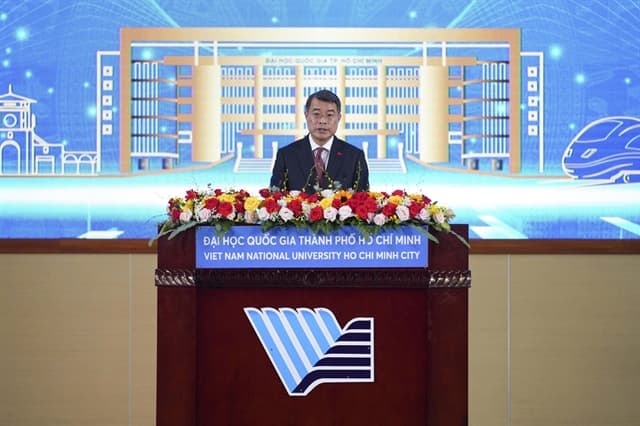
Prime Minister Lê Minh Hưng attended the 2026-27 academic year opening ceremony at Vietnam National University-HCM City (VNU-HCM) on October 13. He urged the university to spearhead strategic technology autonomy and talent development.
The annual event, held under the theme “VNU-HCM with the Aspiration for Strategic Technology Autonomy through Vietnamese Talent”, opened the new academic year and connected lecturers, scientists, students and alumni across the university system.
Speaking at the event, the Prime Minister described higher education as the main driver of high-quality human resources, talent development, science, technology and innovation, which should strengthen national competitiveness.
He praised VNU-HCM’s contributions over its 31-year development. The university currently educates more than 110,000 students across 180 internationally accredited programmes and remains a major centre for education and scientific research.
Lê Minh Hưng urged VNU-HCM to show greater determination and ambition.
“The university must become the country’s premier hub for discovering, training and gathering top talent,” the Prime Minister said.
He said the university should build a continuous talent ecosystem connecting high-performing school students, undergraduates, postgraduates, young scientists and leading experts, especially in basic sciences and strategic technologies.
The Prime Minister also urged the university to become a reliable centre for policy consultation and debate, bringing academic knowledge from lecture halls and laboratories into policymaking and socio-economic governance.
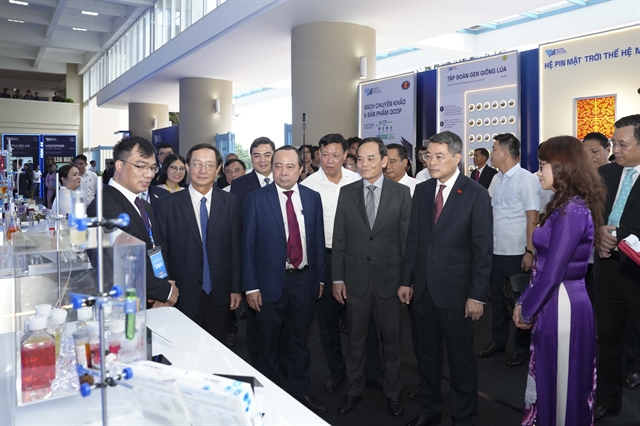
He called for closer integration of training, research and innovation, and tasked VNU-HCM with mastering core strategic technologies that can produce competitive Vietnamese-branded products.
He said the Government strongly supports decentralisation to help national universities become elite, world-class institutions.
The Prime Minister asked relevant ministries to study mechanisms such as lump-sum funding so scientific results can cross the “valley of death” from laboratories to the market.
He also called on local authorities in the Southeast and Mekong Delta regions to place direct orders and invest in shared infrastructure at VNU-HCM.
Addressing students, Lê Minh Hưng said the country needs not only people who are skilled in technology, but also people with competence, responsibility, global knowledge and a Vietnamese soul, who dare to think, act, innovate and take responsibility for their choices.
Strategic technology roadmap and institutional reforms
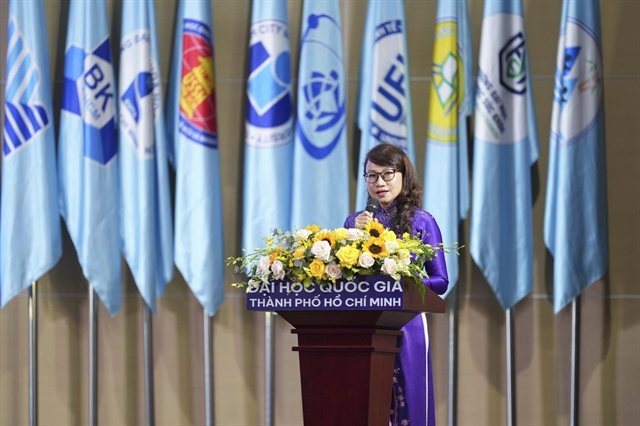
Associate Professor Nguyễn Thị Thanh Mai, chancellor of VNU-HCM, said a university does not become great because it has many units or a large number of learners.
“The stature of a university lies in the people it educates, the knowledge it contributes, and its presence when society needs a trustworthy solution,” she said.
“The country does not need another giant machine. It needs a giant that knows where it is going, knows to whom it is accountable, dares to accept difficult tasks and dares to say what needs to be said,” the chancellor added.
Mai said VNU-HCM’s development goals extend beyond global rankings.
“We want young Vietnamese people working at scientific centres around the world to look back here and see an environment worthy of returning to or collaborating with in the long term,” she said.
She proposed that the Prime Minister speed up the issuance of a new decree on national universities. It should provide a broad enough institutional framework for universities to organise, train, attract experts and partner with enterprises proactively, while ensuring accountability.
VNU-HCM outlined a three-stage roadmap for strategic technology development. In the immediate phase, it will focus on applied research in artificial intelligence, edge chips, biological preparations and molecular diagnostics.
By 2030, the university aims to establish public-private research clusters focused on Vietnamese large language models, vaccines, cell technology, energy storage batteries, green hydrogen and quantum technology.
Beyond 2030, VNU-HCM plans to build autonomy in deep-tech sectors such as sovereign AI, 6G chips, aerospace, precision medicine and nuclear energy.
By 2030, the university targets 100 international patents, 10 strategic technology products, mastery of 15 core technologies, 20 strong research teams and a place among Asia’s leading universities.
A notable moment at the ceremony was the Prime Minister’s presentation of gifts to individuals who took part in the nationwide 500-day campaign to speed up the search for, recovery and identification of martyrs’ remains.
Lecturers, specialists, trainees and alumni from Ho Chi Minh City University of Technology and Ho Chi Minh City University of Science used geophysical surveys, data analysis and site zoning to support the forces conducting the searches.
The Prime Minister and VNU-HCM leaders also awarded 17 top performers in the 2026-27 entrance exams and top graduates of the 2025-26 academic year.
The “Made by VNU-HCM” exhibition displayed 23 scientific and technological research projects across five strategic technology groups. They included a four-legged firefighting robot, brain-computer interfaces, AI applications in biomedicine, semiconductor microchips, indigenous herbal products, stem cell technology, microneedle patches and next-generation solar cells.
Seven businesses and partners also announced sponsorships worth more than VNĐ160 billion (US$6.3 million) to support VNU-HCM’s development.
Sources: Viet Nam News

