
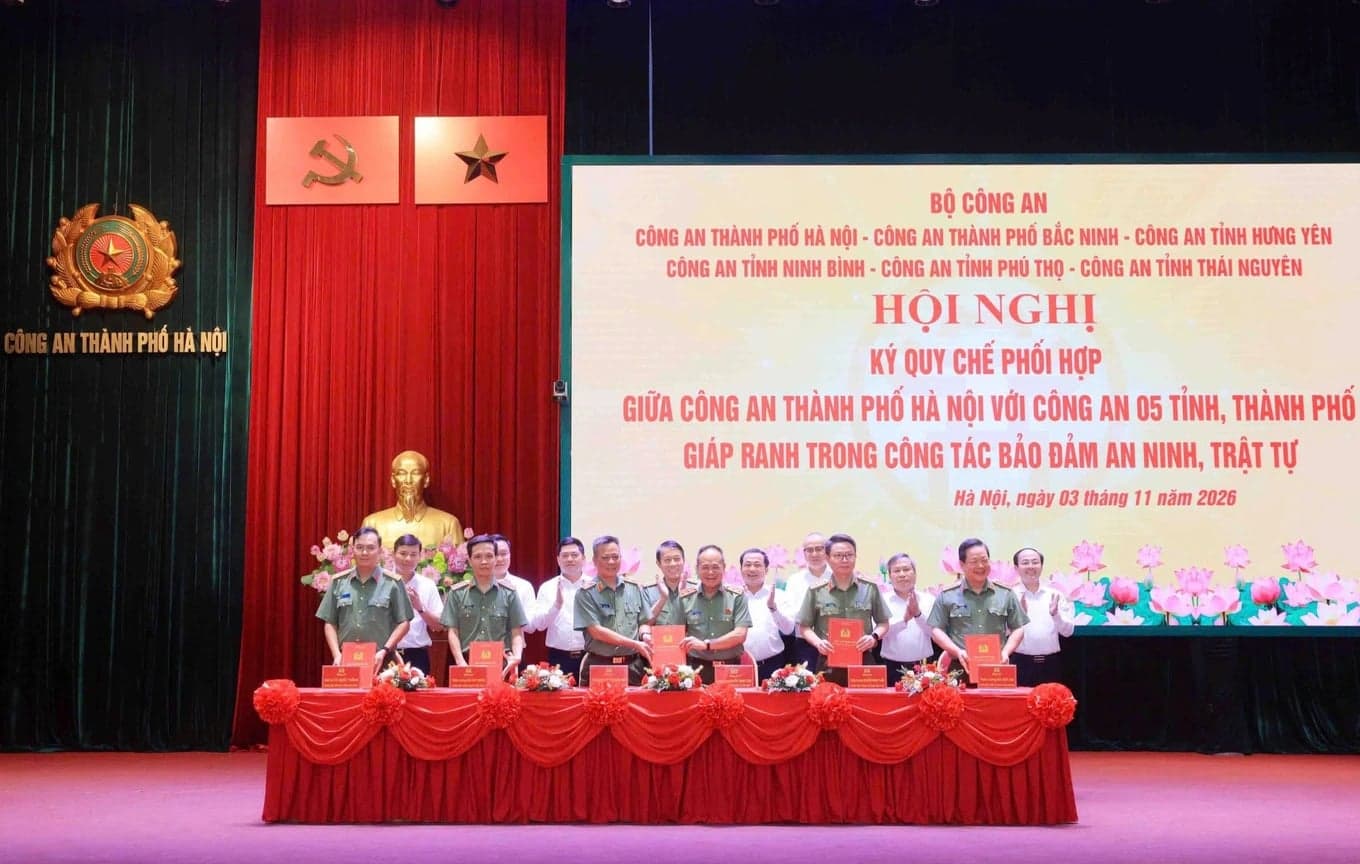
On November 3, police in Hanoi, Bac Ninh city, and the provinces of Hung Yen, Ninh Binh, Phu Tho, and Thai Nguyen held a conference and signed a coordination framework on security and public order.
Handling crime across neighboring areas
After the administrative reorganization, Hanoi borders five provinces and cities. The six localities cover more than 32,000 square kilometers and have a combined population of over 26 million.
Hanoi police and police agencies in the neighboring localities had previously signed several coordination frameworks covering crime prevention, environmental protection, waterway traffic safety, fire prevention and firefighting, and rescue operations.
The joint work helped detect and handle several cases and criminal groups operating across provincial borders, as well as respond to fires, incidents, and other complex situations.
During the first 10 months of the year, Hanoi police and police from the other localities handled three cases involving 22 teenagers and young people who used border areas and transport routes to disturb public order in Hanoi.
In the fight against drugs, the forces exchanged information, investigated cases, and dismantled several illegal drug trafficking networks, including a network moving drugs from Europe to Vietnam.
Since 2025, Hanoi police have also sent personnel and vehicles to help neighboring localities deal with six fires.
The report also said that coordination had sometimes been slow and that frameworks signed by individual departments and agencies remained fragmented and insufficiently aligned.
The new framework covers cooperation on national security, social order and safety, the nationwide movement to protect national security, and police force building.
The forms of cooperation include exchanging information and documents, assigning personnel and vehicles to specific operations, and holding regular or ad hoc meetings.
Every two years, Hanoi police will coordinate with police in the other localities to review and assess implementation of the framework.
Responsibilities should not remain unclear
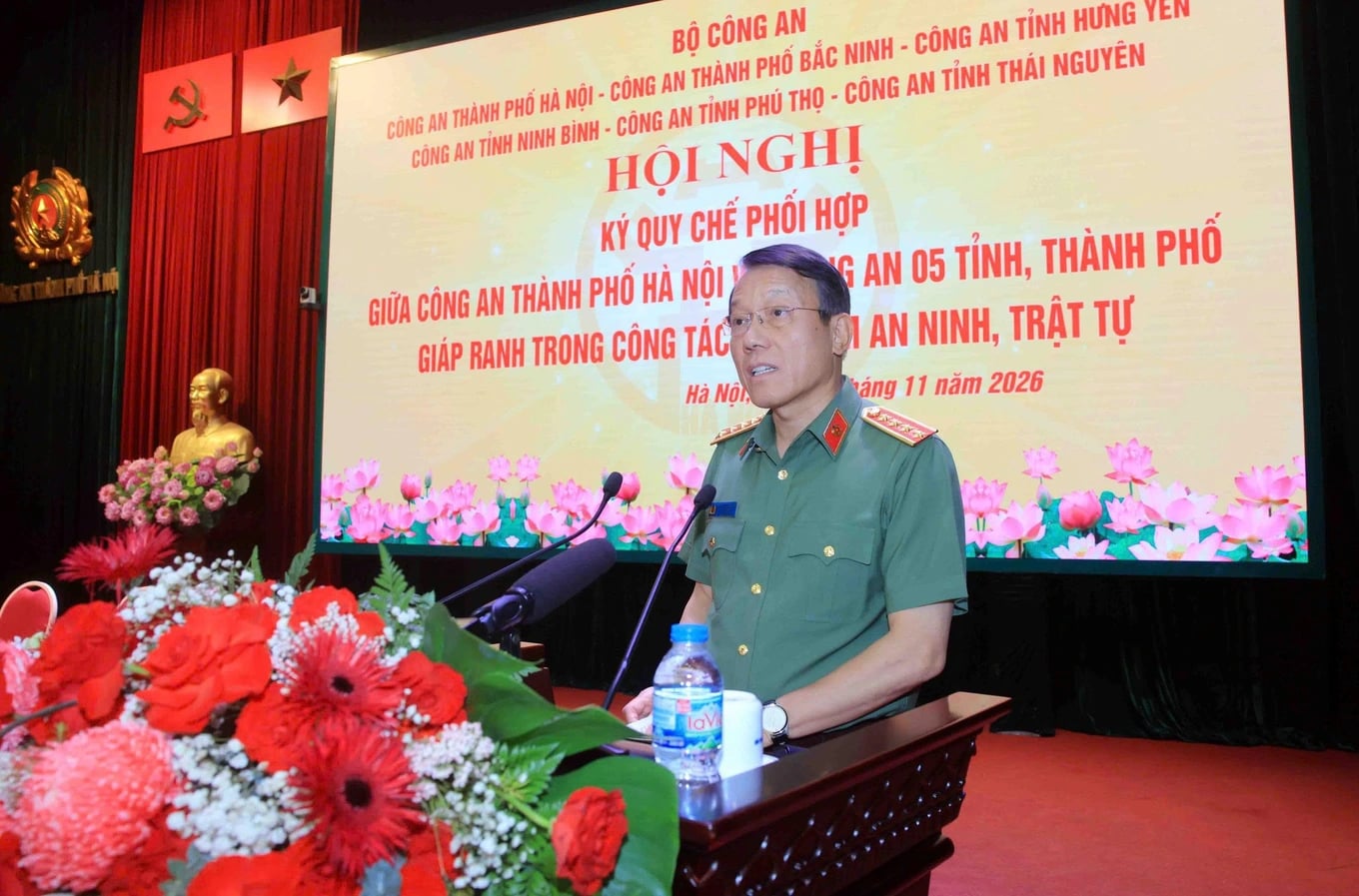
At the conference, Minister of Public Security General Luong Tam Quang praised the localities for taking the initiative to establish a coordination framework across their security and public order work.
The minister said coordination problems usually resulted not from a lack of mechanisms or contact points, but from delayed information sharing, inconsistent assessments, unclear responsibilities, and irregular follow-up on agreed conclusions.
He called on local police to move from case-by-case coordination to regular, proactive work with clear priorities. The units should not only exchange information, but also agree on assessments, plans, and implementation.
When an issue exceeds their authority or the units disagree, they should discuss it directly, act quickly, and promptly report it to the directors of the relevant police agencies.
The minister stressed that coordination should be measured and verified with data. It should also help create a secure and favorable environment for socio-economic development in the capital region and neighboring localities.
Hanoi Party Secretary Tran Duc Thang said that as economic links, transport infrastructure, and population movement grow stronger, security and public order risks are no longer confined to one locality.
He asked the police agencies in the six localities to clearly define responsibilities, the lead and coordinating agencies, and procedures for mobilizing forces when complex situations arise.
Alongside stronger action against drug crime, economic crime, high-tech crime, and online fraud, the Hanoi Party secretary called for attention to transport routes and transit areas so criminals cannot exploit administrative boundaries or coordination gaps to avoid action.
Tran Duc Thang also called for the gradual connection and sharing of data for professional operations and state management within the agencies' authority, as well as research into smart cameras and data analysis technology, with information security and personal data protection ensured.
In response, Lieutenant General Nguyen Thanh Tung, director of Hanoi police, pledged on behalf of the six localities to implement the framework in a decisive and substantive way, resolve difficulties, and help maintain security and public order for socio-economic development.
Sources: Dân Trí

