
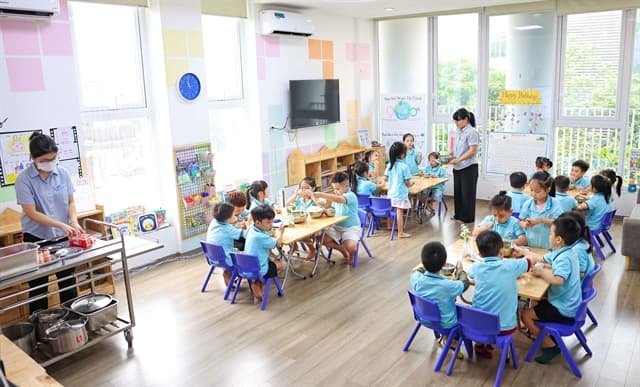
Experts have called for the urgent development and completion of policies and mandatory standards for school nutrition in Vietnam. They said this was needed to ensure students receive balanced, nutritious meals that meet food safety requirements.
Without standardised requirements, schools face shortages of trained staff, errors in meal planning and inadequate food safety controls.
Dr Bui Thi Mai Huong, deputy director of the Centre for Nutrition and Food Science and Technology Services under the National Institute of Nutrition, said Vietnam faces a double burden of malnutrition, with undernutrition coexisting alongside overweight and obesity.
Stunting among children under five in the northern mountainous region reaches 37.4 per cent, while overweight and obesity among children aged five to 19 in urban areas affects 26.8 per cent. Micronutrient deficiencies remain another concern.
Some school meals focus mainly on ensuring children eat enough rather than meeting their nutritional needs. Research has found shortcomings in school food environments and food safety: students can readily access sugary drinks, fast food and confectionery in canteens, while meal supply and preparation can pose risks when storage, transport and kitchen procedures are inadequate.
Some kitchens do not fully follow food safety principles, including a one-way workflow to prevent cross-contamination. Compliance with rules on food production, processing and trading also needs closer monitoring, Huong said.
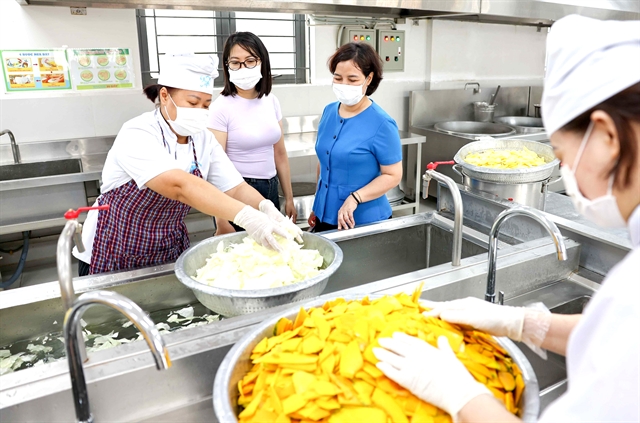
Although Vietnam has a relatively comprehensive policy and legal framework for school nutrition, implementation gaps remain. There are no mandatory national technical regulations, and many schools rely on kitchen staff or catering providers without consistent nutritional requirements.
The education system has no dedicated positions for nutrition officers or specialists. Menu planning, food safety management and student health monitoring are often additional duties for school healthcare staff, who may lack specialised training. Remote and mountainous schools may also lack kitchen space and equipment, clean water and adequate storage. Meal costs depend largely on parents’ ability to pay, making consistent standards difficult.
Huong called for mandatory regulations covering meal composition, nutritional requirements and prohibited or restricted ingredients, based on international benchmarks and Vietnam’s recommended dietary allowances. She also supported model menus using local foods, digital tools for portion and micronutrient calculations, and nutrition education in the formal curriculum.
Evidence-based monitoring could assess nutritional interventions and help reduce underweight and anaemia. Huong also called for financial support, subsidies for specific needs and stronger coordination. Effective implementation would require action by authorities, schools and service providers, together with community oversight.
Ha Thi Phuong of the TH Nutrition Institute called for a coherent legal framework, mandatory rules on meal quality, monitoring, staffing and infrastructure, transparent funding by the State, parents and businesses, stronger independent oversight and public disclosure of menus, milk types and compliance. Experts said coordinated action was needed to give all students safe and nutritious meals.
Sources: Viet Nam News

