
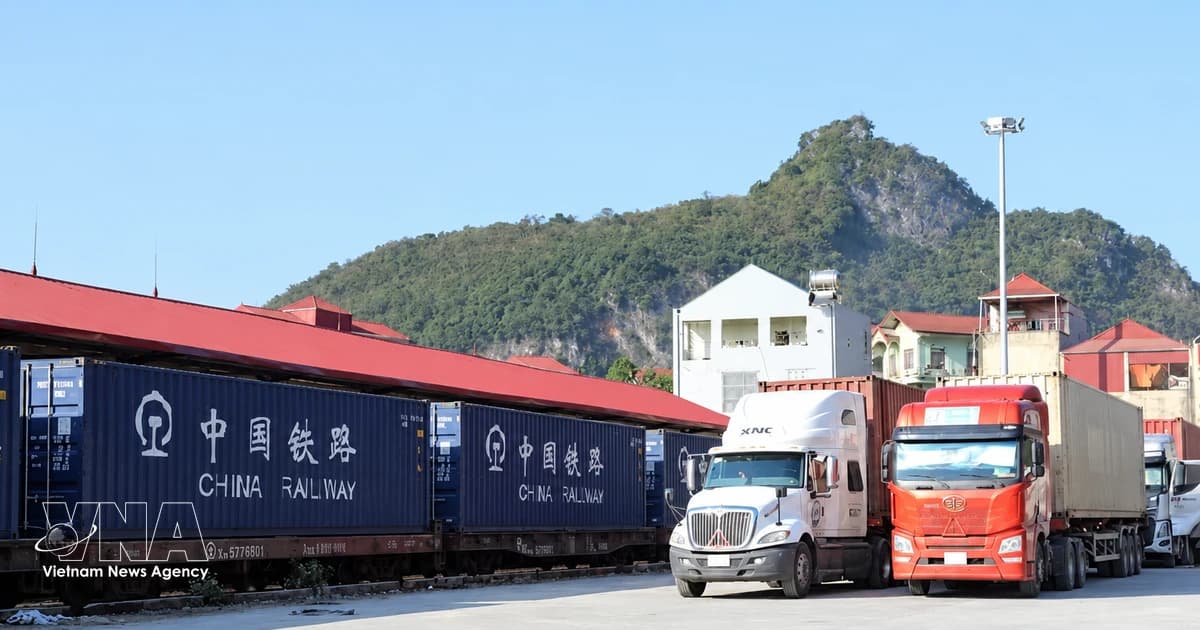
The Management Board of Vietnam’s Dong Dang, Lang Son Border Gate Economic Zone and the Pingxiang municipal government in China’s Guangxi held talks on October 19 at the Tan Thanh, Po Chai customs clearance area between border markers 1090 and 1091.
The sides discussed ways to remove export-import bottlenecks, increase clearance capacity and speed up the rollout of the smart border gate model. The measures are intended to facilitate cross-border trade, transport and people-to-people exchanges.
They also exchanged information on border gate management, goods delivery, infrastructure development and the use of technology in cross-border trade.
On the dedicated goods transport route between markers 1088/2 and 1089, Lang Son proposed piloting delivery with automated guided vehicles, or AGVs, under a trailer-uncoupling arrangement. Trailers would be allowed to stay on the route for no more than 48 hours. The scheme would initially cover electronic components and full-container shipments. Both sides will report to their competent authorities to seek additional regulations and create a legal framework for smart cross-border transport.
At the Coc Nam, Lung Nghiu customs clearance area between markers 1104 and 1105, Lang Son urged Pingxiang to upgrade the connecting road. The Chinese side is narrow and has only one traffic lane, directly reducing clearance capacity. The Vietnamese side proposed widening it to at least two lanes while continuing talks on clearance hours from 7:00 to 18:00 Hanoi time.
Traffic through the crossing has fallen by more than 90% since mid-August 2026, reportedly after China changed vehicle size standards. Lang Son said harmonised vehicle management standards should be considered so companies can continue their export-import operations.
Trials at Huu Nghi border gate
The delegations devoted much of the talks to the smart border gate model. At Huu Nghi international border gate, Lang Son launched a project on June 30, 2025 to expand the dedicated goods route between markers 1119 and 1120. Total investment exceeds 94.6 billion VND (3.63 million USD). The province plans nighttime trials of intelligent guided vehicles, or IGVs, in the area in December 2026, tentatively from 20:00 to 22:00, once all conditions are met.
Vietnam asked Pingxiang to arrange a separate traffic lane, lighting and on-site personnel so the trials do not disrupt regular customs clearance. The project to expand the dedicated route and build an inter-agency working facility near markers 1088/2 and 1089 is expected to be completed in the second quarter of 2027.
Lang Son said the smart border gate investor is building digital and logistics infrastructure, studying unmanned transport vehicles and developing management software. To make the systems work together, the province called for closer exchanges between the investing and operating companies on both sides, as well as agreement on technical standards, connection interfaces, logistics data sharing and management coordination.
Beyond trade and transport, the sides discussed reopening and formally upgrading the Binh Nghi, Ping Er Guan border gate pair to a bilateral crossing, including the road at marker 1035. In tourism, they explored expanding self-driving tours and linking border gates with clearance points to ease cross-border travel.
Xie Tao, Deputy Secretary of the Pingxiang municipal Party Committee and Mayor of Pingxiang, who led the Chinese delegation, said the talks showed the two localities’ resolve to coordinate on border gate problems and gradually modernise cross-border transport and goods management.
Hoang Viet Dong, deputy head of the Dong Dang, Lang Son Border Gate Economic Zone Management Board and head of the Vietnamese delegation, said Lang Son wants close coordination with Pingxiang on administrative reform and more efficient inspection and control procedures. He said this would facilitate trade, particularly Vietnamese fruit and agricultural products.
Sources: VietnamPlus / Vietnam News Agency

