
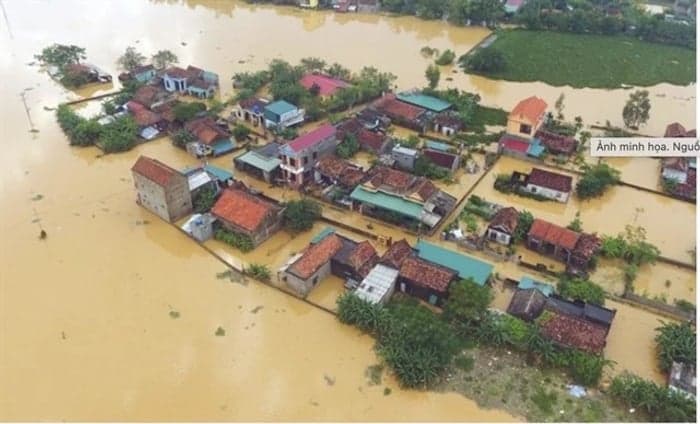
Vietnam could face a super typhoon comparable in strength to Typhoon Yagi, which struck the country in 2024, once every seven years on average if global temperatures rise by four degrees Celsius. The projection is included in the updated 2025 climate change scenarios.
The Ministry of Agriculture and Environment has released the updated 2025 Climate Change Scenarios and added the document to the National Climate Change Database.
The scenarios provide a scientific basis for management, policymaking, planning, risk management and early climate adaptation.
Under the high-emissions scenario, the number of hot days could increase by more than 50 by the end of the 21st century, while the number of extreme-heat days could rise by about 20.
By contrast, the number of severe-cold and damaging-cold days is projected to fall sharply in northern Vietnam and the north-central region.
Maximum one-day and five-consecutive-day rainfall could increase by about 30–40% in northern and southern regions. The number of days with heavy rain is also expected to rise significantly, especially in the south.
In some parts of northern Vietnam, the Central Highlands and the south, the number of days with rainfall above 100mm could increase by 80–100% under the high-emissions scenario.
The changes point to a higher risk of extreme rainfall and the need to strengthen disaster prevention and response capacity and improve climate adaptation.
For the first time, the 2025 scenarios also provide information on extreme climate events under global warming thresholds of 1.5, 2, 3 and 4 degrees Celsius above pre-industrial levels.
The scenarios say that super typhoons comparable in strength to Typhoon Yagi in 2024 are likely to become more frequent as global temperatures rise.
If the global average temperature rises by 2 degrees Celsius, Vietnam could experience such a super typhoon once every 13 years on average.
The frequency would rise to once every nine years under the 3-degree warming scenario and once every seven years under the 4-degree scenario.
Under the 4-degree warming scenario, northern Vietnam could be affected by a super typhoon once every 13 years on average, while the corresponding figure for the central region is once every 16 years.
In the south, such storms are projected to be much less frequent, occurring about once every 133 years.
The 2025 climate change scenarios also include, for the first time, a detailed assessment of urban areas, focusing on Hanoi and Ho Chi Minh City.
The assessment considers the combined effects of global warming and urbanisation, including rising temperatures, more frequent hot weather, the urban heat island effect and extreme rainfall.
The scenarios indicate that climate change will affect climate-sensitive sectors including public health, rice production and infrastructure.
As the planet warms, climate change is also expected to accelerate sea-level rise.
By 2100, average sea-level rise is projected to reach about 46.1cm under the low-emissions scenario and as much as 63.7cm under the high-emissions scenario.
Assoc. Prof. Pham Thi Thanh Nga stressed that climate change scenarios should not be confused with weather forecasts or climate predictions.
She said they are scientifically grounded hypothetical scenarios showing possible future climate trends based on relationships between socio-economic activity, greenhouse gas emissions, climate change and sea-level rise.
She added that effective use of the scenarios requires consideration of uncertainty and selection of scenarios suited to the intended purpose.
Sources: VietnamPlus / Vietnam News Agency

