
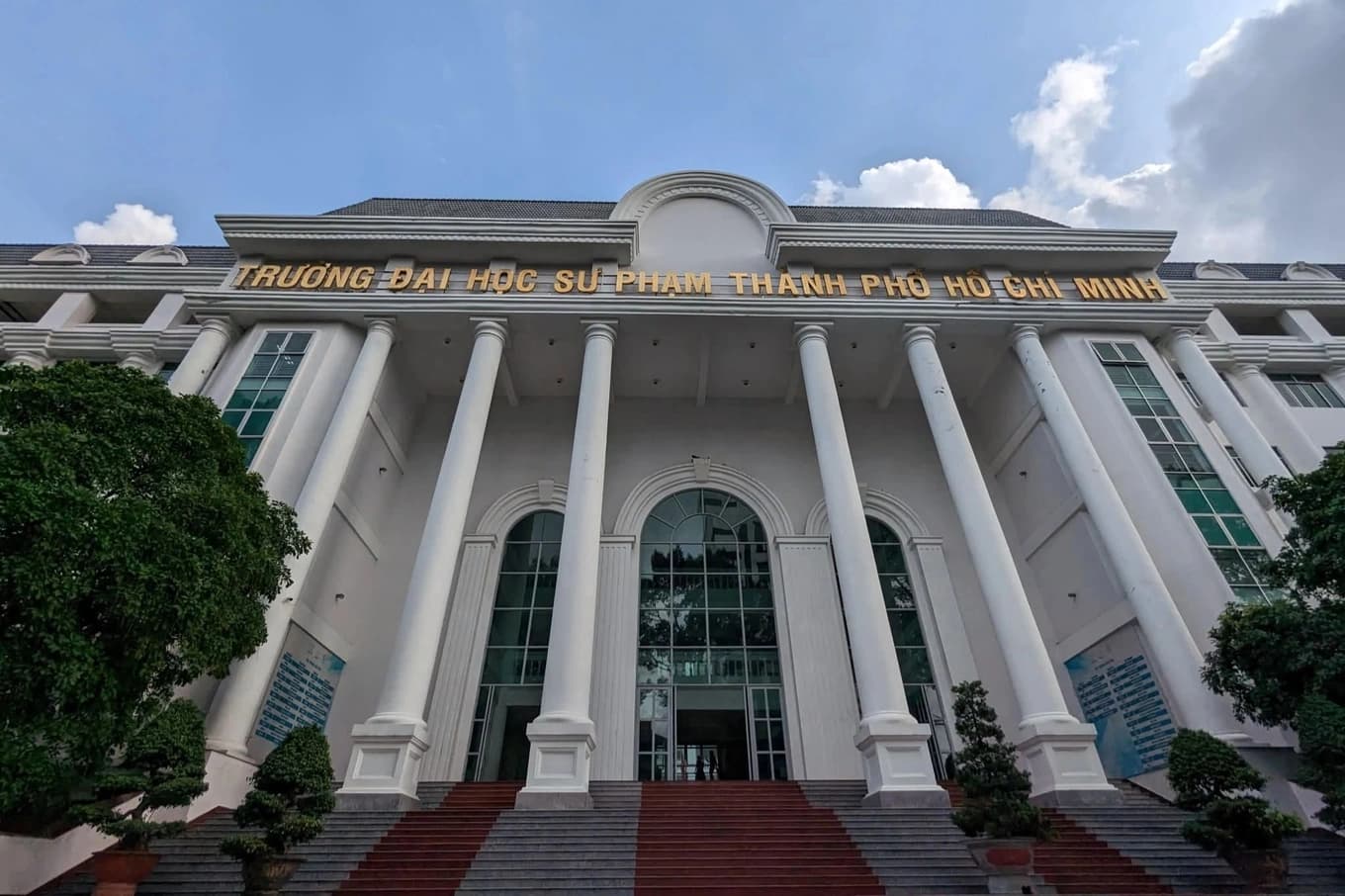
Under a new plan from the Ministry of Education and Training, Ho Chi Minh City University of Education is expected to take in Ho Chi Minh City Central College of Education and Ho Chi Minh City School of Education Management. The arrangement would expand the university's scale and connect teacher training with the training of education managers.
Three institutions, different specializations
Before the restructuring, the university was already a large center for training teachers and education specialists in southern Vietnam. As of July 1, 2025, it had 819 officials and employees, including 2 professors, 38 associate professors, 245 PhDs and 366 master's degree holders.
It offers 45 undergraduate programs, including 22 teacher-training programs and 23 other fields, as well as one college-level early-childhood education program, 29 master's programs and 10 doctoral programs. More than 23,000 students and learners study there.
The 2026 admissions plan totals about 5,745 places: 4,745 at the main campus in Ho Chi Minh City, 620 at the Long An branch and 380 at the Gia Lai branch. The university also has specialist centers, the Institute of Educational Research, a practice secondary school and a publishing house. Training takes place at two Ho Chi Minh City campuses and branches in Long An, now part of Tay Ninh province, and Gia Lai.
Ho Chi Minh City Central College of Education trains preschool teachers and specialists in related fields. It was established on September 25, 1976, and received its current name in April 2007. Its main campus at 182 Nguyễn Chí Thanh covers about 15,300 square meters and has more than 200 employees and lecturers. Programs include early childhood education, special education, music, fine arts, English teaching, social work and other fields.
Ho Chi Minh City School of Education Management trains education-sector leaders and managers, conducts research and applies its results. It says it trains or provides professional development for about 13,000 learners nationwide each year. From 2021 to 2025, it held nearly 700 courses attended by more than 75,000 learners. It has nearly 60 employees, all lecturers have postgraduate qualifications and 14 hold PhDs. The school marked its 50th anniversary on March 24.
The three institutions therefore have different roles: training teachers, providing pedagogical programs and developing education managers.
Ministry warns against mechanical mergers
The restructuring plan says public institutions should become more streamlined and effective, improve quality, increase autonomy and update governance. They should also have an appropriate scale, improve competitiveness, reduce administrative units and increase the efficiency of public investment. The ministry says a mechanical merger must not reduce quality.
The process must protect the lawful rights and interests of students, lecturers and workers and must not interrupt training. Study programs, diplomas and certificates must be transferred without a break, while organizational, personnel, financial, property and legal issues must be handled in a coordinated way. The ministry also requires policies for redundant employees and reviews before other institutions are restructured.
The same plan would merge Central College of Education into Hanoi University of Education and Central College of Education in Nha Trang into Nha Trang University. A branch of Hanoi University of Civil Engineering is planned in Quang Ninh on the basis of the College of Construction and Social Technology.
Eight vocational institutions will be transferred to local authorities: Construction College No. 1, Urban Construction Works College, Hanoi College of Engineering and Professional Training, Construction Mechanics Vocational School, Construction Mechanization College, Viet-Xo Vocational College No. 1, Lilama 2 International College of Technology and Nam Dinh Construction College.
Three vocational institutions will be transferred to the Ministry of Public Security: the College of Technical Technology, Dung Quat Technical College and Technical College II. The Institute for School Design Research will be transferred unchanged to Hanoi University of Civil Engineering.
Sources: Dân Trí

