
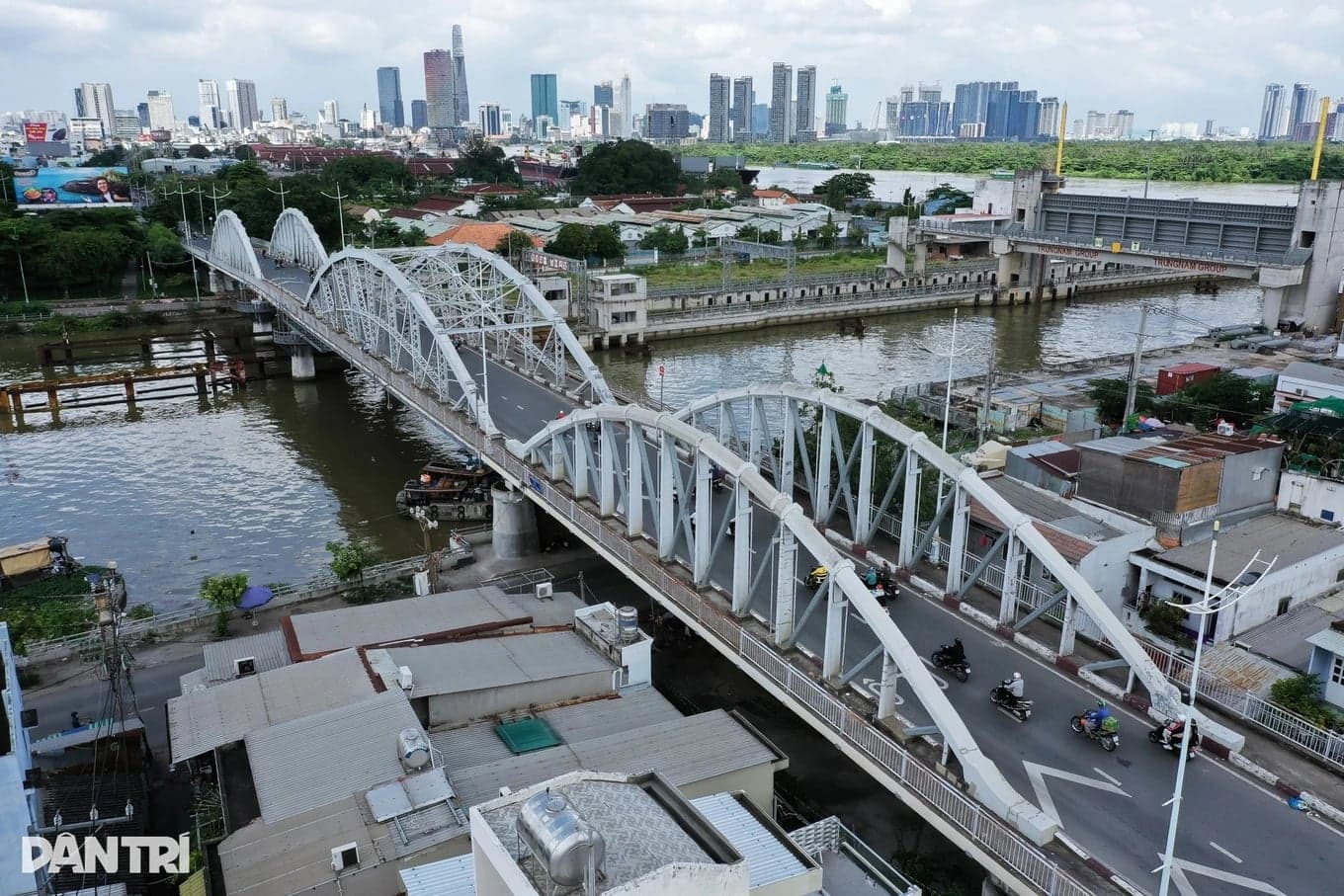
The Ho Chi Minh City People's Committee has approved the design competition brief for new Tan Thuan 1 and Tan Thuan 2 bridges. Both structures are part of a project to upgrade transport infrastructure along Nguyen Tat Thanh Street in Xom Chieu and Tan Thuan wards.
Tan Thuan 1 Bridge will cross the Te Canal and connect Nguyen Tat Thanh Street with Huynh Tan Phat Street. The study area will extend from Khanh Hoi Bridge in Xom Chieu Ward to the Huynh Tan Phat and Luu Trong Lu intersection in Tan Thuan Ward.
The bridge is planned with six motor-vehicle lanes. The design speed will be 60 km/h on the main route and 40 km/h at the intersection area. The study section will be about 3,000 metres long, including a bridge more than 372 metres long and over 24 metres wide. The estimated construction cost is more than VND521 billion.
Tan Thuan 2 Bridge will also cross the Te Canal, connecting the area around Ton That Thuyet and Nguyen Tat Thanh streets with Nguyen Van Linh Street. The study area will begin about 110 metres from the abutment of the existing Tan Thuan 2 Bridge in Xom Chieu Ward and end at the Tan Thuan 2 approach road and Nguyen Van Linh Street intersection in Tan Thuan Ward.
The new bridge is planned with eight motor-vehicle lanes, five more than the existing three-lane bridge. The study section will be about 900 metres long, while the bridge section will be more than 391 metres long and 32.75 metres wide. The estimated construction cost is about VND676 billion.
Ho Chi Minh City authorities require the architectural designs to fit the landscape of the Te Canal, the urban area and the Nha Rong and Khanh Hoi area. The design should have a modern, light visual language. An unusual structural solution may be considered, but it must be durable, safe and suitable for actual conditions.
The competition entries must address traffic organization, limit conflicts between traffic flows and connect smoothly with related roads. Construction plans must divide the work into suitable stages so traffic in the area is not interrupted.
The competition council will assess the entries based on planning, architectural and landscape ideas, transport connectivity, technical, structural and technological solutions, feasibility during construction and operation, and economic efficiency.
Sources: Dân Trí

