
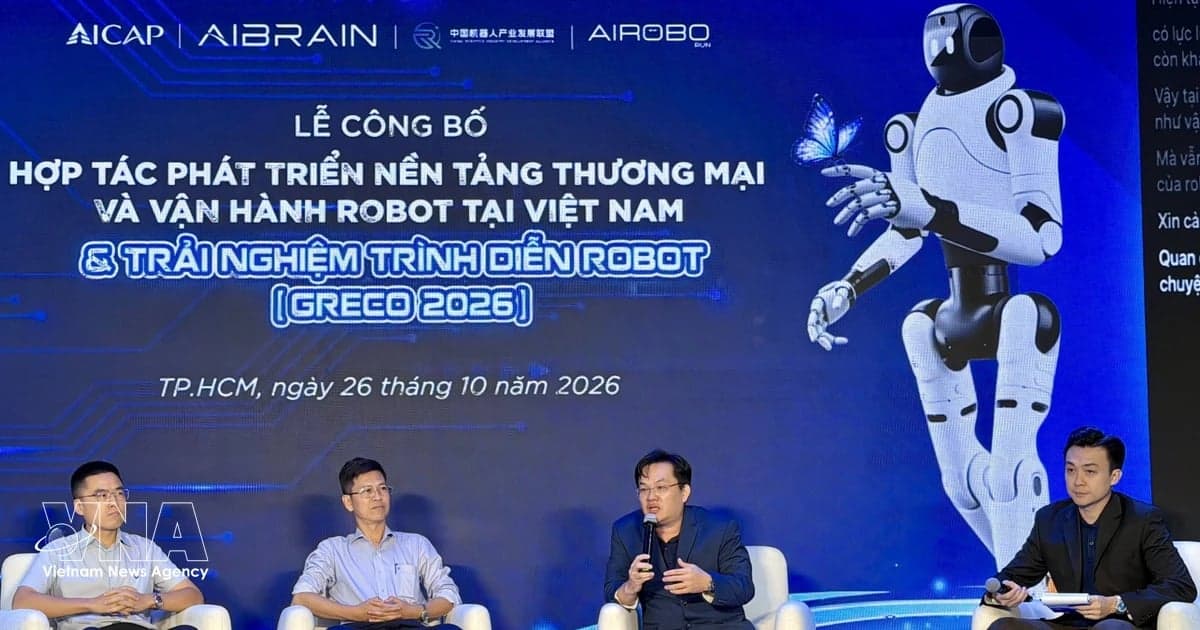
The initiative was announced on October 26 by AICAP Group JSC in cooperation with the China Robot Industry Development Alliance (CDRA), AIBRAIN and Ho Chi Minh City University of Technology (HUTECH), at the 2026 Ho Chi Minh City Green Growth Products and Services Exhibition Space (GRECO 2026).
The cooperation is aligned with Politburo Resolution No. 57-NQ/TW, dated December 22, 2024, which identifies science, technology, innovation and digital transformation as key drivers of national development. Government decisions have also designated robotics and automation, including autonomous mobile robots and industrial robots, as strategic technologies and products prioritised for research and development.
AICAP Group Chairman Do Truong Son said the initiative seeks to develop a localised platform for robot trading and operation in Vietnam. The partners will establish an industrial cooperation framework to promote robot sales, services and deployment tailored to the domestic market.
The strategy focuses on three areas. The first is deploying floor-cleaning robots and other continuous-operation services in hotels, shopping centres, office buildings and industrial parks. The second involves scientific research, teaching and robotics training in universities and research institutes. The third covers robot demonstrations, exhibitions and hands-on experiences at tourist destinations and cultural events.
The initiative also aims to strengthen the connection between businesses and universities in research, training and the demand for industrial applications.
Vietnam's challenge is not only to expand robot adoption but also to increase its participation in the industry's value chain. Importing equipment can speed up adoption, but sustainable development requires local businesses capable of integrating systems, developing solutions, providing technical services and conducting research.
Vietnam's industrial robotics market was valued at approximately 112 million USD in 2025 and is forecast to grow at a compound annual growth rate of 12.88% from 2026 to 2031. However, the country has an estimated 23 to 58 industrial robots per 10,000 manufacturing workers, compared with 84 in Thailand and 101 in Malaysia, indicating considerable room for wider adoption.
Meanwhile, Vietnam's smart factory market exceeded 926 million USD in 2025 and is projected to reach 2.14 billion USD by 2034 as businesses accelerate production digitalisation. The expansion of robotics is closely linked to the development of smart factories, creating demand for software, system integration, data connectivity, workforce training, maintenance and operational optimisation.
Assoc. Prof. Dr Nguyen Thanh Phuong, HUTECH vice rector, said developing a single robot capable of meeting every need is difficult given the wide range of business requirements. A more practical approach, he said, is to build common technology platforms and communication standards that allow different components to be integrated and customised for specific businesses and tasks.
He stressed that this approach requires workers who can understand practical problems, design solutions and integrate systems. Universities already train students in mechatronics and robotics, but closer cooperation with businesses is needed to share resources and practical experience and give students opportunities to work on real-world applications.
Sources: VietnamPlus / Vietnam News Agency

